How to Read a Nutrition Label Without Getting Confused
Introduction
Walk into any supermarket and you will find food packages covered with words such as:
"Healthy"
"No Added Sugar"
"High Protein"
"Multigrain"
"Natural"
"Low Fat"
"Rich in Fibre"
These claims can make choosing food seem easier.
But there is one section that often tells you much more:
the nutrition label.
Nutrition labels provide information about the nutrients and energy contained in a packaged food. However, the numbers can look confusing at first.
You may see:
Calories
Protein
Carbohydrates
Total sugars
Added sugars
Fat
Saturated fat
Trans fat
Fibre
Sodium
Serving size
Ingredients
So which numbers actually matter?
The answer depends on the food and your individual goals.
If you are trying to manage weight, you may pay more attention to calories, protein, fibre and serving size.
If you are monitoring sugar intake, total and added sugars become more important.
If you are trying to reduce sodium intake, sodium deserves closer attention.
The goal is not to memorize every number on every package.
Instead, learn a simple system for reading the label in the right order.
This guide will show you how to do exactly that.https://www.fssai.gov.in/
Start With the Serving Size
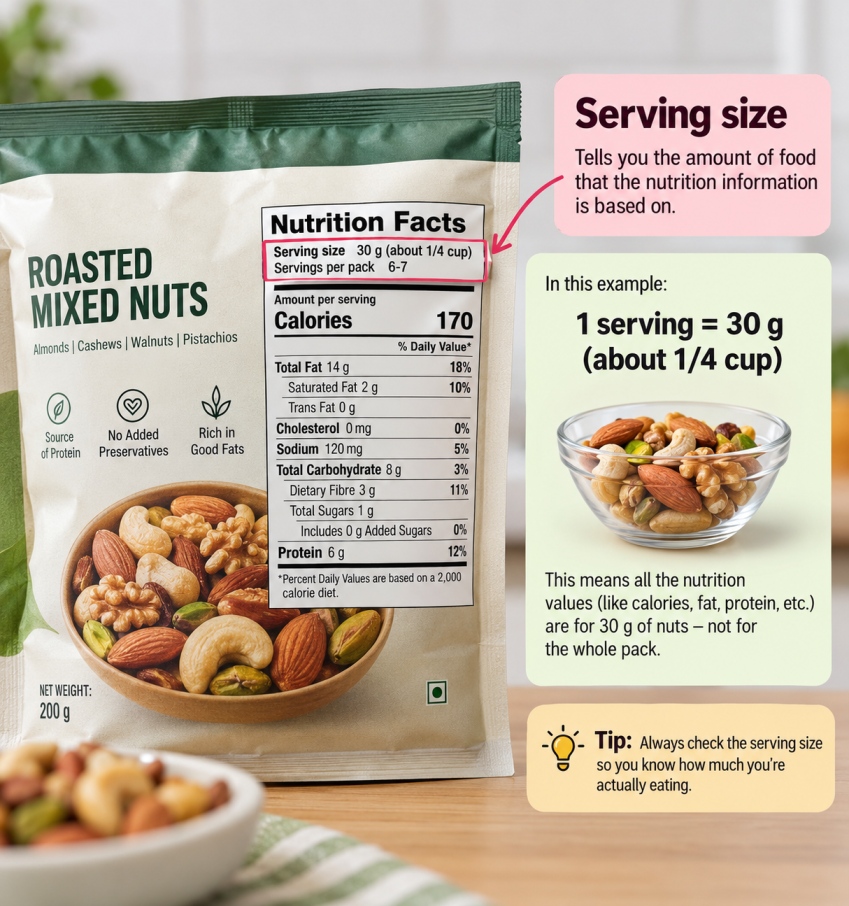
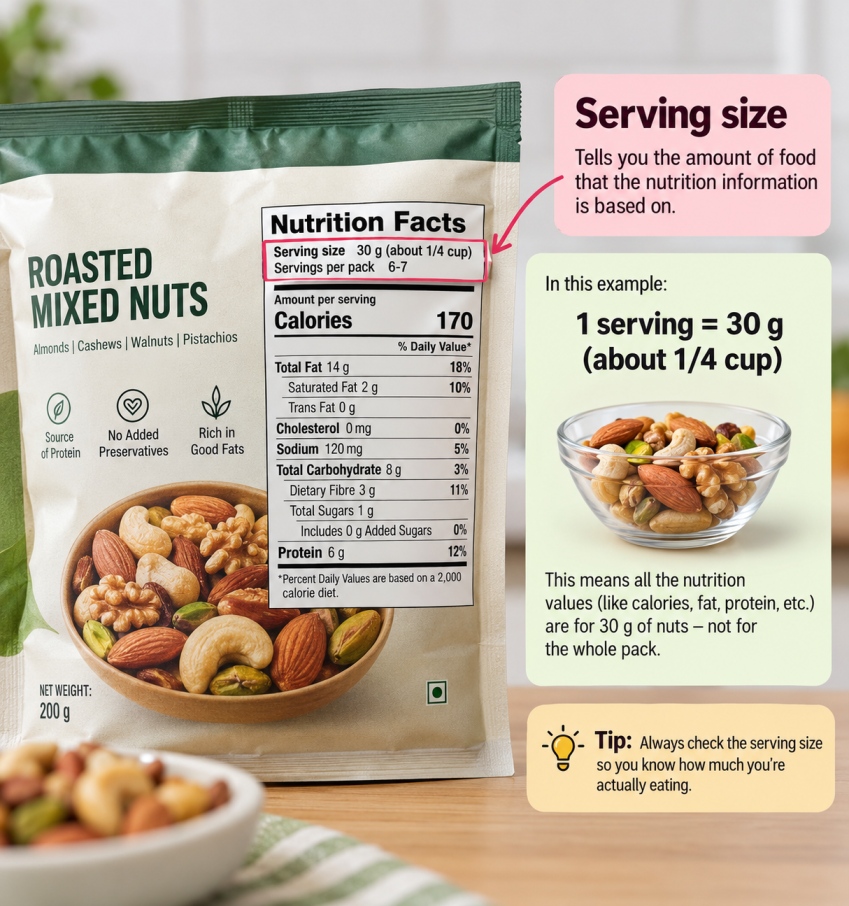
1. Serving Size Is the First Thing to Check
One of the most common nutrition-label mistakes is looking at the calorie number without checking the serving size.
For example, imagine a snack packet says:
Serving size: 30 g
Calories: 150 kcal
If the entire packet contains 60 g, eating the whole packet means you have consumed approximately:
150 × 2 = 300 kcal
The label is not misleading.
You simply need to understand that the nutrition information is based on the stated serving.
The Simple Rule
Before looking at calories, ask:
"How much is one serving?"
Then ask:
"How much am I actually going to eat?"
These two quantities may be very different.https://www.fssai.gov.in/
Serving Size vs Portion Size
These terms are related but not identical.
Serving Size
The amount used by the manufacturer to present the nutrition information.
Portion
The amount you actually eat.
For example:
A package may list a serving as 25 g, but you may eat 50 g.
That means you consumed two servings.
This is especially important for:
Chips
Biscuits
Namkeen
Breakfast cereals
Granola
Nuts
Chocolate
Ice cream
Instant noodles
Packaged snacks
Why This Matters for Weight Management
Even a nutritious food can contribute a lot of calories if the portion is very large.
For example, nuts can provide protein, fibre and healthy fats, but eating several large handfuls is very different from eating a small measured portion.
Understanding serving size helps you make more realistic choices without labelling foods as simply "good" or "bad."
2. Check Calories — But Don't Stop There
Calories tell you how much energy the food provides.
If the package says:
Calories: 200 kcal per serving
and you eat two servings:
200 × 2 = 400 kcal
Calories can be useful when managing overall energy intake.
However, calories alone do not tell you whether a food is nutritionally valuable.
Consider two foods with similar calories.
One might provide:
More protein
More fibre
Less added sugar
Less saturated fat
More micronutrients
The other may provide mostly refined carbohydrate, sugar or fat.
So instead of asking only:
"How many calories?"
also ask:
"What am I getting for those calories?"
3. Look at Protein
Protein is important for:
Muscle maintenance
Tissue repair
Enzymes and hormones
Satiety
Healthy body composition
When comparing packaged foods, a higher protein content can sometimes make a food more filling or nutritionally useful.
This is particularly relevant when comparing:
Breakfast cereals
Protein bars
Yogurts
Snack products
Ready-to-eat meals
Plant-based products
However, a product labelled "high protein" still needs to be evaluated as a whole.
Check:
Protein + calories + sugar + fibre + ingredients
rather than looking at protein alone.
4. Check Total Sugar and Added Sugar
Sugar is one of the most commonly misunderstood parts of a nutrition label.
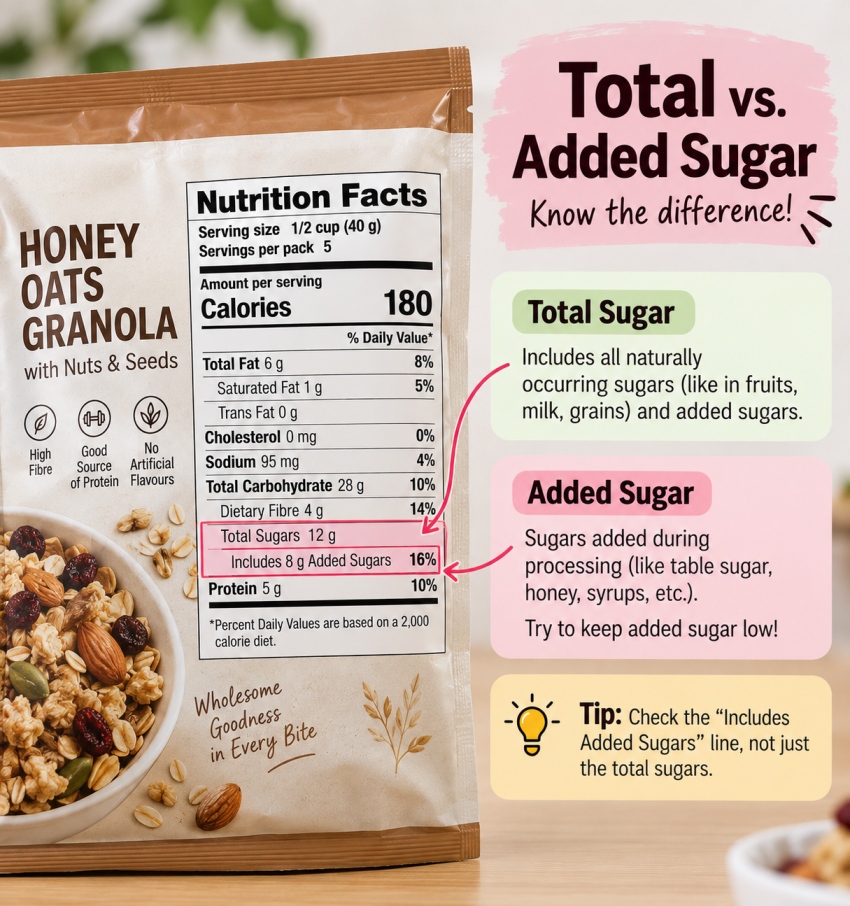
Total Sugar
This represents the total amount of sugars in the food according to the applicable nutrition-labelling declaration.
Added Sugar
Added sugars are sugars added during processing or preparation rather than sugars naturally present in foods.
For example, milk naturally contains lactose.
Fruit naturally contains sugars.
But sugar, syrups and similar ingredients may be added during processing.
Why Added Sugar Matters
Two foods can contain the same amount of total sugar but have very different sources.
For example:
Plain milk
contains naturally occurring lactose.
A sweetened flavoured dairy product may contain naturally occurring lactose plus added sugars.
This is why looking at the ingredient list along with the nutrition panel is useful.
5. Learn the Different Names for Added Sugars
Sugar may not always appear simply as the word:
"Sugar."
Ingredients can include terms such as:
Glucose syrup
Fructose
Sucrose
Dextrose
Maltose
Invert sugar
Honey
Molasses
Syrups
The exact ingredient terminology varies by product.
Important
Seeing one type of sugar in the ingredient list does not automatically make a food unhealthy.
The bigger question is:
How much sugar does the food provide, and how often are you eating it?
6. Check Dietary Fibre
Fibre supports:
Digestive health
Satiety
Healthy bowel function
Overall diet quality
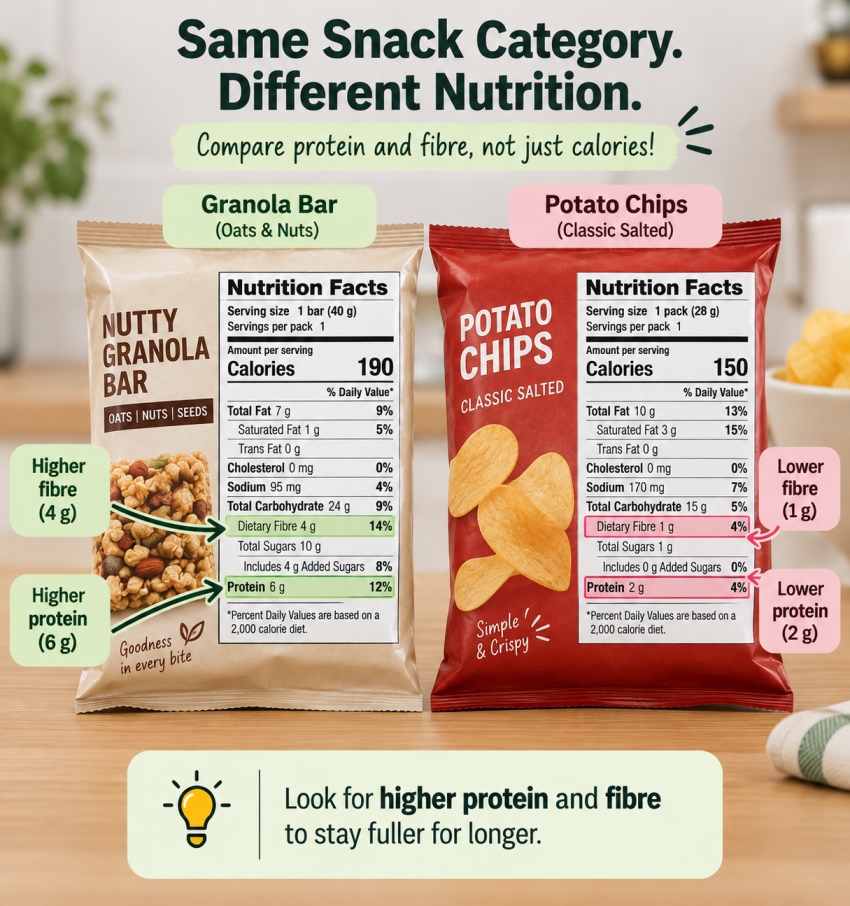
When comparing similar packaged foods, a product with more fibre can sometimes be a more satisfying choice.
Fibre can be found naturally in:
Whole grains
Oats
Pulses
Beans
Nuts
Seeds
Fruits
Vegetables
A Useful Comparison
Instead of choosing breakfast cereal based only on:
"Multigrain"
compare:
Fibre + sugar + protein + ingredients
This gives you a better picture of the actual product.
7. Look at Total Fat and Saturated Fat
Fat is an essential nutrient.
The goal is not to avoid all fat.
Nutrition labels may separate total fat from different types of fat, including saturated fat and trans fat.
Saturated Fat
High intake of saturated fat can contribute to an unhealthy dietary pattern, particularly when it replaces healthier unsaturated fats.
Common sources can include:
Butter
Ghee
Cream
High-fat dairy
Fatty meats
Some packaged foods
The overall food pattern matters more than judging one food from a single number.
What About Trans Fat?
Trans fats are a type of unsaturated fat associated with adverse cardiovascular effects.
For packaged foods, check the nutrition information where trans fat is declared and also pay attention to the ingredients.
Avoid assuming that a product is automatically healthy simply because its front package uses words such as:
"baked"
or
"light."
The full label gives more information.
8. Don't Forget Sodium
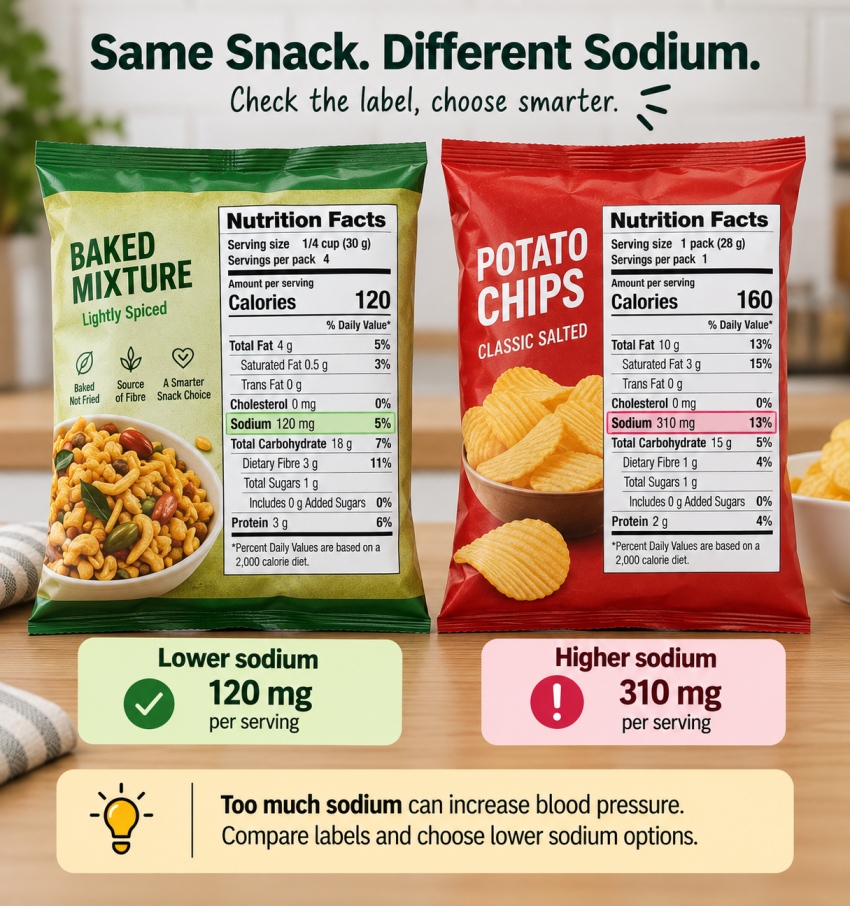
Sodium is an important mineral, but excessive sodium intake is a concern for many people.
Packaged foods that can contribute substantial sodium include:
Instant noodles
Chips
Namkeen
Processed meats
Packaged soups
Sauces
Ready-to-eat meals
Savoury snacks
When comparing two similar products, checking sodium can help identify the lower-sodium option.
This is particularly important for people who have been advised by their healthcare professional to limit sodium.
9. Understand % Daily Value or Reference Values
Some nutrition labels use a percentage reference value or daily value to show how much a nutrient contributes to a reference daily intake.
The important thing is to understand that these percentages are reference values, not necessarily your personal nutrition target.
Your individual requirements can differ according to:
Age
Sex
Body size
Activity
Pregnancy or lactation
Health conditions
Dietary pattern
Therefore, do not assume that a label's percentage automatically represents exactly what you personally need.
10. Ingredients Are Listed in Order
The ingredient list can tell you what the product is actually made from.
In general, ingredients are listed in descending order by weight under food-labelling regulations.
This means the ingredients appearing earlier in the list are present in greater amounts than those appearing later.
This can be especially useful when comparing products.
Example: Choosing a Breakfast Cereal
Imagine two products.
Product A
Ingredients begin with:
Whole grain + oats + nuts + seeds
Product B
Ingredients begin with:
Refined cereal + sugar + syrup
Both packages may use attractive health-oriented marketing.
But the ingredient lists tell a different story.
This is why:
Front of pack = marketing information
Back of pack = detailed information
You should use both, but give greater weight to the detailed nutrition and ingredient information.
11. Don't Be Fooled by "Healthy-Sounding" Words
Food packaging may use terms such as:
Natural
Multigrain
Light
Fitness
Immunity
Energy
Premium
Traditional
No artificial colours
Baked
High protein
These words do not automatically tell you the complete nutritional quality of a product.
For example:
"Multigrain"
does not necessarily mean that the product is made primarily from whole grains.
Check the ingredient list.
Similarly:
"Baked"
does not automatically mean low-calorie.
And:
"High protein"
does not automatically mean low in sugar, sodium or calories.
12. "No Added Sugar" Does Not Mean "Sugar-Free"
This is a particularly important distinction.
A product can have no added sugar while still containing naturally occurring sugars.
For example, fruit-based products can contain naturally occurring sugars.
Therefore, check:
Total sugar + added sugar + ingredients
rather than relying only on the front-of-pack claim.
13. "Low Fat" Does Not Automatically Mean Healthy
Removing or reducing fat does not automatically make a product nutritious.
A low-fat product may still contain:
Added sugar
Refined starch
High sodium
Large amounts of calories
This is why it is better to evaluate the whole nutrition profile.
14. "High Fibre" and "High Protein" Still Need Context
A product can be marketed around one positive nutrient while containing other ingredients you may want to limit.
For example:
High protein + high added sugar
is a different nutritional profile from:
High protein + low added sugar + good fibre
So when you see a positive claim, ask:
"What else is in the product?"
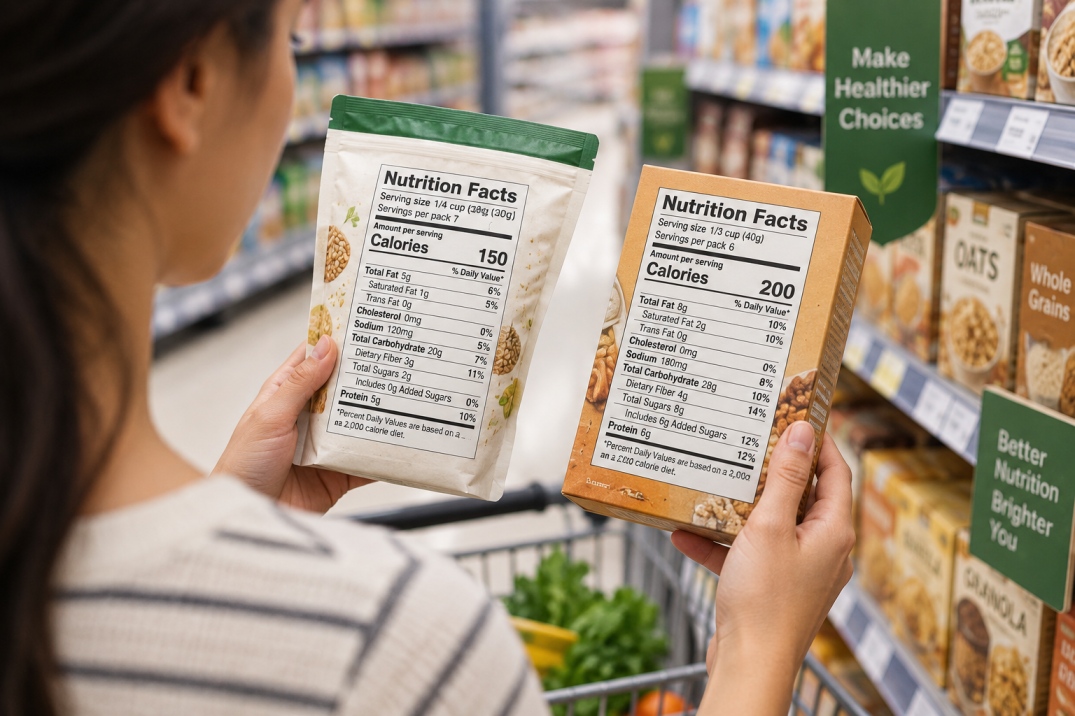
Comparing Two Similar Products
Suppose you are choosing between two breakfast cereals.
Nutrient
Product A
Product B
Calories
180 kcal
190 kcal
Protein
5 g
7 g
Fibre
2 g
6 g
Added sugar
Higher
Lower
Sodium
Higher
Lower
Product B may look more favourable despite having slightly more calories.
Why?
Because calories are only one part of the picture.
The better choice depends on your overall dietary needs, portion size and how the food fits into your diet.
A Simple 5-Step Label Reading Method
Instead of studying every number, use this order:
Step 1 — Serving Size
How much does the label call one serving?
Step 2 — Calories
How much energy am I getting for the amount I will actually eat?
Step 3 — Protein and Fibre
Does this food provide useful protein and fibre?
Step 4 — Sugar, Saturated Fat and Sodium
Are any of these particularly high for the food and my needs?
Step 5 — Ingredients
What is the product actually made from?
This takes much less time once you practise it.
Using Nutrition Labels for Real-Life Goals
Reading Labels for Weight Loss
If weight management is your goal, focus on:
Serving size
Calories
Protein
Fibre
Added sugar
Overall portion
A common mistake is choosing a product simply because it says:
"Diet"
or
"Low fat."
Instead, compare the complete label.
A food that provides more protein and fibre may be more satisfying than a highly refined snack with similar calories.https://wellorafit.com/services/nutrition-diet-planning/
Reading Labels for Better Blood Sugar Management
When choosing packaged foods, look at:
Total carbohydrate
Total sugar
Added sugar
Fibre
Serving size
Ingredients
Do not look at sugar alone.
For example, a food can contain naturally occurring sugar but also provide substantial fibre and other nutrients.
The overall carbohydrate amount, portion size and the rest of the meal matter.
People with diabetes should use individualized nutrition advice from their healthcare professional.
Reading Labels for Heart Health
Pay particular attention to:
Saturated fat
Trans fat
Sodium
Fibre
Serving size
When possible, compare similar products and choose options with less saturated fat and sodium and more fibre, depending on your individual dietary needs.
Reading Labels for Increasing Protein
If you are trying to increase protein intake, compare:
Protein per serving
but also check:
Calories + sugar + saturated fat + sodium + ingredients
A protein bar with 15 g protein is not automatically the best option if it also contains a large amount of added sugar and is eaten as an unnecessary extra snack.
Reading Labels as a Vegetarian
Vegetarian shoppers may want to pay particular attention to:
Protein
Fibre
Iron
Vitamin B12
Calcium
Added sugar
Sodium
For example, when comparing plant-based products, check the actual nutrition panel rather than assuming that every plant-based product is nutritionally superior.
Common Nutrition Label Mistakes
Mistake 1: Looking Only at Calories
Why it matters:
Calories don't show the complete nutritional value of a food.
Better approach:
Check calories together with protein, fibre, sugar, fat, sodium and ingredients.
Mistake 2: Ignoring Serving Size
Why it matters:
You may eat multiple servings without realizing it.
Better approach:
Calculate based on the amount you actually eat.
Mistake 3: Believing the Front of the Package
Why it matters:
Front-of-pack claims highlight selected features.
Better approach:
Turn the package around and read the nutrition information and ingredients.
Mistake 4: Assuming "Natural" Means Healthy
Why it matters:
A product can contain natural ingredients and still be high in sugar, fat or sodium.
Better approach:
Look at the complete nutrition profile.
Mistake 5: Choosing "No Added Sugar" Without Checking Ingredients
Why it matters:
The product may still contain naturally occurring sugars or other ingredients that affect its nutritional profile.
Better approach:
Check total sugar, added sugar and ingredients.
Mistake 6: Ignoring Sodium
Why it matters:
Savoury packaged foods can contribute significant sodium.
Better approach:
Compare sodium when choosing between similar products.
A 30-Second Supermarket Label Check
When you pick up a packaged food, ask:
1. How much am I actually going to eat?
Check the serving size.
2. How many calories will my portion provide?
Calculate based on your actual portion.
3. Is there enough protein?
Check the protein value.
4. Is there useful fibre?
Check dietary fibre.
5. How much added sugar is present?
Look at the nutrition panel and ingredients.
6. What about saturated fat and sodium?
Pay particular attention if these are nutrients you are trying to limit.
7. What are the first few ingredients?
This helps you understand what the product is primarily made from.
That's it.
You do not need to spend 10 minutes analysing every package.
How to Compare Two Products Quickly
When two products look similar, follow this simple method:
Same serving size?
↓
Compare calories
↓
Compare protein
↓
Compare fibre
↓
Compare added sugar
↓
Compare saturated fat
↓
Compare sodium
↓
Check ingredients
Then choose the product that better fits your dietary needs.https://wellorafit.com/services/nutrition-diet-planning/
Key Takeaways
Always start by checking the serving size.
Calories tell you about energy, but not the complete nutritional quality of a food.
Check protein and fibre when comparing similar products.
Look at both total sugar and added sugar where declared.
Check saturated fat, trans fat and sodium when relevant.
Ingredients can reveal what a product is actually made from.
Do not rely only on front-of-pack claims such as "healthy," "natural," "multigrain" or "high protein."
"No added sugar" does not necessarily mean sugar-free.
"Low fat" does not automatically mean healthy.
Compare similar products rather than judging foods in isolation.
Your actual portion matters more than the package's stated serving if you consume a different amount.
You do not need to understand every number to make better food choices.
A simple 5-step label check can make grocery shopping much easier.
Conclusion
Nutrition labels can look complicated, but you do not need to understand every number to make a better food choice.
Start with the basics:
Serving size → Calories → Protein & Fibre → Sugar → Fat & Sodium → Ingredients
Then consider how the food fits into your overall diet.
Remember that the healthiest choice is not always the package with the most impressive claim on the front.
A product saying "high protein," "multigrain," "natural" or "no added sugar" still deserves a look at the nutrition panel and ingredients.
The goal is not to become obsessed with numbers.
It is to become a more informed shopper.
Once you know what to look for, reading a nutrition label can take less than a minute — and that small habit can help you make more informed food choices every day.
Don't let the label confuse you. Turn the package around, check the numbers, read the ingredients, and choose based on the whole picture.
FAQ
1. What should I look at first on a nutrition label?
Start with the serving size. Then look at calories, protein, fibre, sugar, fat, sodium and the ingredients list.
2. What does serving size mean?
Serving size is the quantity used by the manufacturer to present the nutrition information. Your actual portion may be smaller or larger.
3. How do I calculate calories if I eat two servings?
Multiply the calories per serving by the number of servings you consume.
For example:
150 kcal × 2 servings = 300 kcal
4. Is a high-protein food automatically healthy?
No. Check the complete nutrition profile, including calories, added sugar, fibre, saturated fat, sodium and ingredients.
5. Is "no added sugar" the same as sugar-free?
No. A product can contain naturally occurring sugars even when no sugar has been added.
6. Is low-fat food always healthier?
Not necessarily. Check the complete nutrition label because a low-fat product may still contain considerable sugar, refined carbohydrates or sodium.
7. How can I identify added sugar?
Look for the added-sugar declaration where provided and check the ingredient list for sugars and sweetening ingredients such as sucrose, glucose syrup, fructose, dextrose, maltose, honey and other syrups.
8. What is more important: calories or ingredients?
Both provide different information. Calories tell you about energy, while ingredients tell you what the product contains. Looking at both gives a better overall picture.
9. How do I choose a healthier packaged snack?
Compare serving size, calories, protein, fibre, added sugar, saturated fat, sodium and ingredients with similar products.
10. Should I avoid all packaged foods?
Not necessarily. Packaged foods can be part of a balanced diet. The important thing is to understand the product and how frequently and how much you consume.
11. How do I read food labels for weight loss?
Pay particular attention to serving size, calories, protein, fibre, added sugar and overall portion size. Choose foods that provide useful nutrition without making it easy to consume excessive calories.
12. Do I need to calculate everything on a nutrition label?
No. You can make useful decisions by focusing on a few key areas: serving size, calories, protein, fibre, sugar, saturated fat, sodium and ingredients.
Ready to Begin Your Health Journey?
Get a personalized, medically guided plan built around your unique biology.