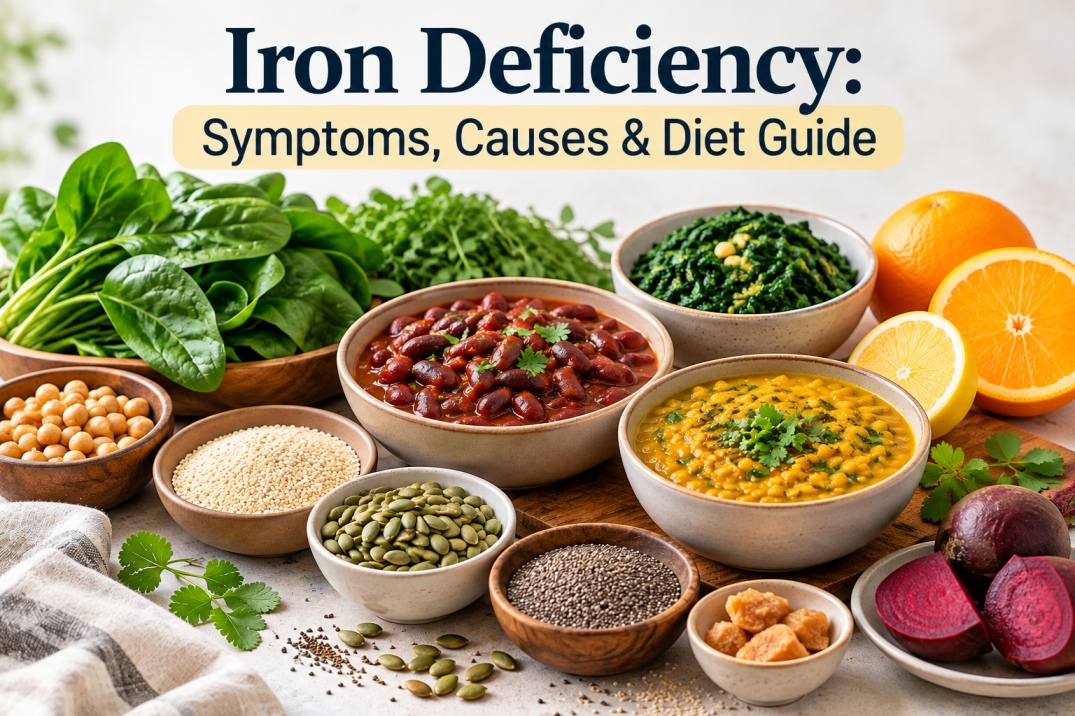
Iron Deficiency: Symptoms, Causes & Diet Guide
Iron is a small nutrient with a very important job.
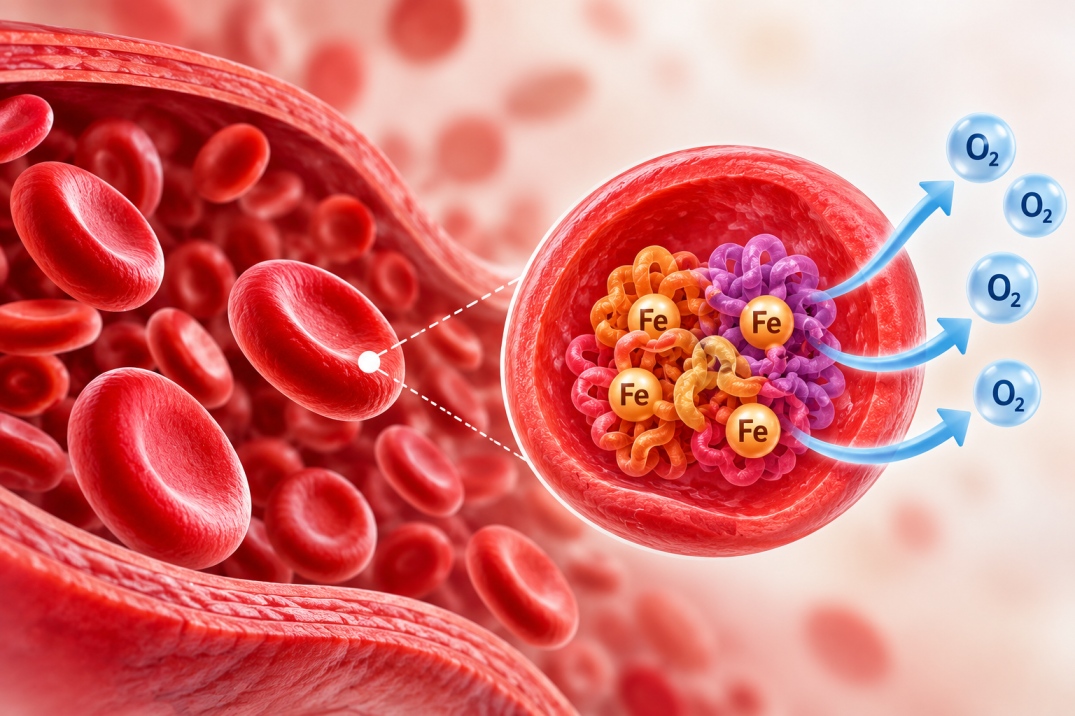
Your body needs iron to make haemoglobin, the protein in red blood cells that carries oxygen throughout the body. Iron is also involved in energy metabolism, muscle function and several important cellular processes.
When your body does not have enough iron, it first begins using its stored iron. If the deficiency continues, iron stores can become depleted and the body may eventually produce fewer healthy red blood cells, leading to iron-deficiency anaemia.
This is why iron deficiency should not be ignored.
Feeling tired all the time, experiencing weakness, getting headaches or feeling breathless during normal activity can have many possible causes. These symptoms do not automatically mean you are iron deficient. Proper assessment and blood testing are needed to determine the cause.
Iron deficiency is particularly important for menstruating women, pregnant women, growing children and people with blood loss or conditions that interfere with nutrient absorption. WHO identifies iron deficiency as the most common nutritional cause of anaemia globally.
The good news is that iron deficiency is often preventable and treatable when the underlying cause is identified.
In this guide, we will explain:
What iron does in the body
The difference between iron deficiency and iron-deficiency anaemia
Common symptoms
Major causes and risk factors
Heme and non-heme iron
Indian vegetarian sources of iron
How vitamin C improves iron absorption
How tea and coffee can interfere with absorption
Whether jaggery is really a good source of iron
How to build an iron-supportive Indian diet
When diet alone may not be enoughhttps://www.who.int/news-room/fact-sheets/detail/ANAEMIA
What Is Iron Deficiency?
Iron deficiency occurs when the body's iron stores are too low to meet its needs.
The body stores iron mainly in tissues such as the liver, spleen and bone marrow.
When dietary intake and absorption are insufficient, or when iron losses are too high, these stores gradually decline.
Initially, a person may have low iron stores without having anaemia.
If deficiency continues, haemoglobin production can be affected and iron-deficiency anaemia may develop.
This distinction is important.
Iron deficiency
Low or depleted iron stores.
Iron-deficiency anaemia
Iron deficiency has progressed enough to impair red blood cell production and lower haemoglobin.
Therefore:
Iron deficiency does not always mean you already have anaemia.
And:
Not every case of anaemia is caused by iron deficiency.
WHO emphasizes that anaemia has many possible causes, including deficiencies of iron, folate and vitamin B12, infections, inflammation, chronic diseases, blood loss and inherited blood disorders.https://ods.od.nih.gov/factsheets/iron-consumer/
Why Does Your Body Need Iron?
Iron performs several essential functions.
1. Oxygen Transport
Haemoglobin contains iron and allows red blood cells to carry oxygen from the lungs to tissues throughout the body.
When iron deficiency progresses to anaemia, oxygen delivery can become less efficient.
This can contribute to:
Fatigue
Weakness
Reduced exercise capacity
Shortness of breath
2. Energy Metabolism
Iron is involved in cellular energy production.
This is one reason iron deficiency can be associated with tiredness and reduced physical performance.
However, fatigue has many causes.
Poor sleep, inadequate calorie intake, stress, thyroid disorders, infections and several other conditions can also cause fatigue.
So fatigue alone should never be used to diagnose iron deficiency.
3. Muscle Function
Iron is involved in oxygen storage and energy metabolism within muscle.
Severe iron deficiency can therefore affect physical performance and exercise capacity.
4. Brain Function
Iron is involved in neurological development and normal brain function.
Iron deficiency is particularly important during periods of rapid growth, including childhood and pregnancy. WHO notes that iron-deficiency anaemia can affect cognitive and physical development in children.
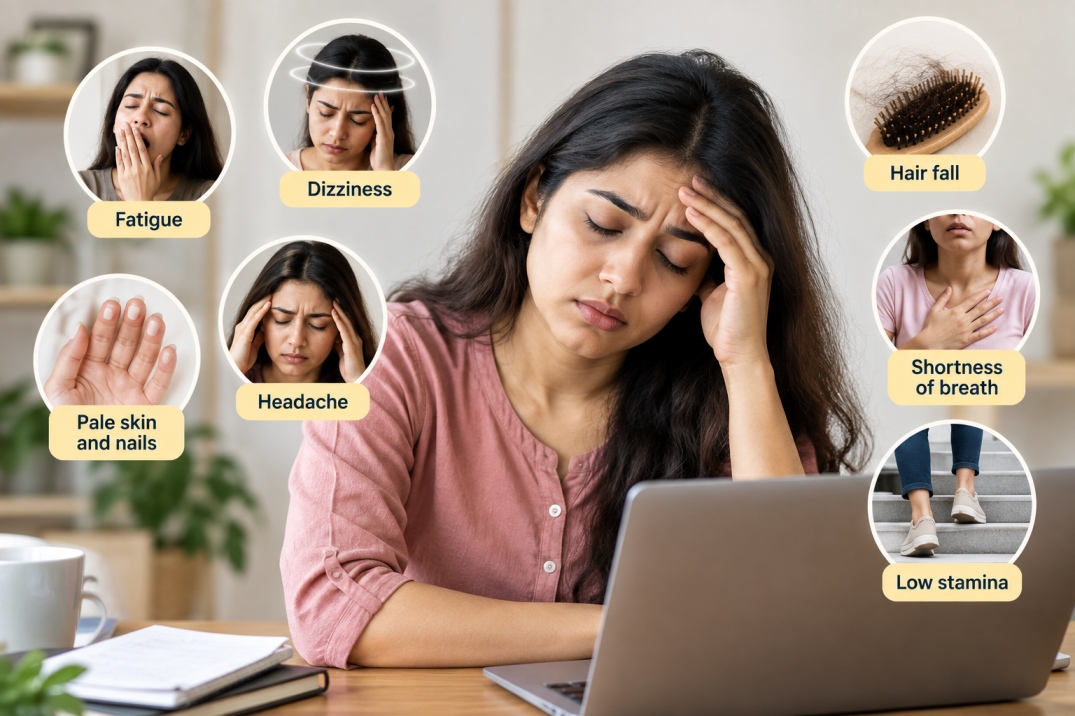
Common Symptoms of Iron Deficiency
Iron deficiency can develop gradually.
Some people may have few or no obvious symptoms initially.
As deficiency becomes more significant, symptoms may include:
Persistent tiredness
Weakness
Low energy
Headache
Dizziness or light-headedness
Reduced concentration
Shortness of breath, particularly during exertion
Reduced exercise tolerance
Pale skin or mucous membranes
Cold hands and feet
WHO lists tiredness, dizziness, headaches, cold hands and feet, and shortness of breath among common symptoms associated with anaemia.
Less Common Signs That May Occur
Some people with iron deficiency may experience unusual symptoms such as:
Brittle or Spoon-Shaped Nails
Significant iron deficiency can sometimes be associated with changes in the nails.
Hair Changes
Iron deficiency may be associated with hair loss in some people, although hair loss has many other possible causes.
Pica
Some people with iron deficiency develop pica, an unusual craving to eat substances that do not provide meaningful nutrition, such as ice.
Restless Legs
Iron deficiency can be associated with restless legs syndrome in some individuals.
These symptoms are not specific to iron deficiency.
If you experience them, proper medical assessment is more useful than self-diagnosing based on symptoms alone.
When Should You Get Checked for Iron Deficiency?
Consider discussing testing with a healthcare professional if you have:
Persistent unexplained fatigue
Recurrent dizziness
Breathlessness with ordinary activity
Very heavy menstrual bleeding
A known nutritional deficiency
Frequent blood donation
A gastrointestinal condition affecting absorption
A history of gastrointestinal bleeding
Pregnancy
A restrictive diet with low iron intake
Persistent symptoms despite improving your diet
A healthcare professional may recommend blood tests depending on your symptoms and risk factors.
These may include:
Complete blood count (CBC)
Haemoglobin
Ferritin
Serum iron
Total iron-binding capacity or transferrin-related tests
Other tests depending on the suspected cause
The exact testing strategy depends on the individual.
What Causes Iron Deficiency?
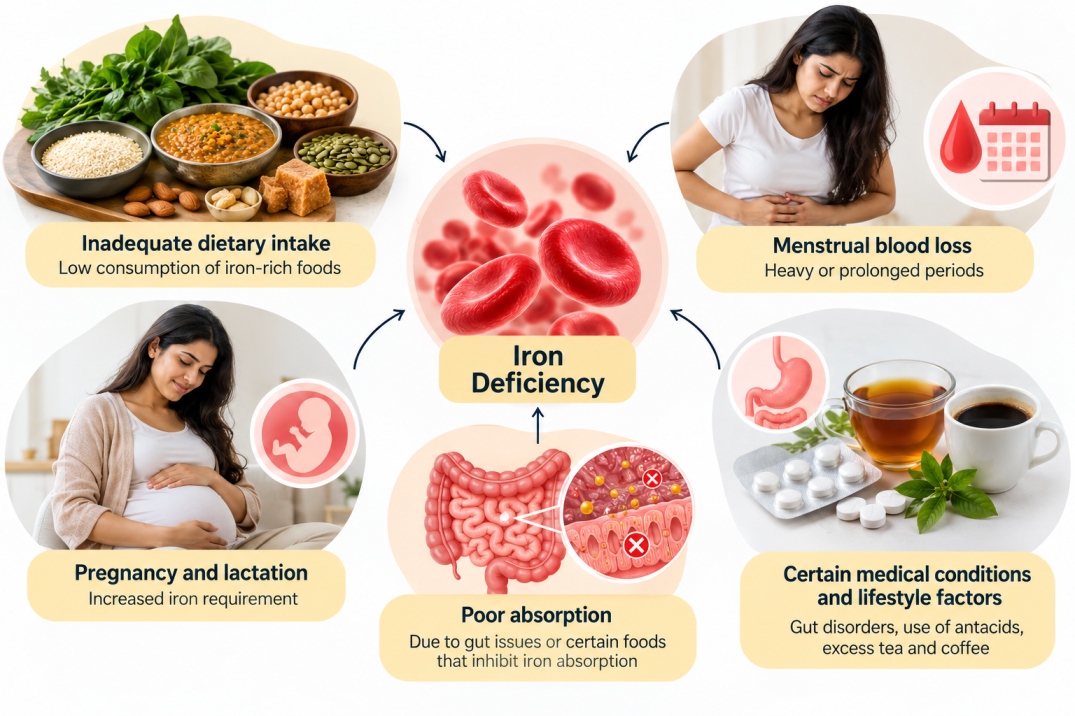
Iron deficiency can happen for several different reasons.
It is not always caused by simply "not eating enough spinach."
Major causes include:
Inadequate dietary intake
Poor iron absorption
Increased iron requirements
Blood loss
Certain medical conditions
Gastrointestinal disorders
Chronic inflammation or disease
Let's look at these in more detail.
1. Not Getting Enough Iron From Food
A diet consistently low in iron-rich foods can contribute to deficiency.
This can happen when meals are heavily based on:
Refined grains
Tea and biscuits
Low-variety diets
Highly processed foods
Very small portions of legumes
Limited intake of animal or plant iron sources
Vegetarian diets can provide iron, but because plant foods contain non-heme iron, absorption is generally lower than from heme iron sources.
This makes food combinations and meal planning particularly important.
2. Poor Iron Absorption
Eating iron is not the same as absorbing iron.
Several factors influence how much iron your body actually absorbs.
For example:
Vitamin C can improve absorption of non-heme iron.
On the other hand, compounds such as phytates and polyphenols can reduce absorption.
WHO notes that iron absorption can be affected by dietary components such as phytates and phenolic compounds.
This is why meal composition matters.
3. Increased Iron Requirements
Some stages of life increase iron requirements.
These include:
Pregnancy
Iron needs increase during pregnancy because of expansion of maternal blood volume and the needs of the developing fetus and placenta.
Adolescence
Rapid growth increases nutrient requirements.
Menstruation
Regular blood loss increases iron requirements, particularly when menstrual bleeding is heavy.
WHO identifies menstruating adolescent girls and women as particularly vulnerable to iron deficiency and anaemia.
4. Blood Loss
Blood loss is an important cause of iron deficiency.
Possible sources include:
Heavy menstrual bleeding
Gastrointestinal bleeding
Frequent blood donation
Blood loss during childbirth
Certain medical conditions
If blood loss continues, simply adding more iron-rich foods may not solve the underlying problem.
The cause of the blood loss needs to be identified and treated.
5. Gastrointestinal Conditions
Certain digestive conditions can reduce iron absorption or cause blood loss.
Examples include some:
Inflammatory bowel diseases
Malabsorption disorders
Gastrointestinal bleeding conditions
Conditions affecting the stomach or small intestine
If iron deficiency persists despite an adequate diet, an underlying absorption problem should be considered.
6. Chronic Disease and Inflammation
Not all low iron-related blood findings are caused by inadequate dietary iron.
Chronic inflammation and some diseases can alter iron metabolism and contribute to anaemia of chronic disease or inflammation.
This is another reason why taking iron supplements without knowing the cause is not always appropriate.
Who Is Most at Risk of Iron Deficiency?
Some groups require particular attention.
Menstruating Women
Regular menstrual blood loss increases iron requirements.
Heavy menstrual bleeding can significantly increase the risk.
Pregnant Women
Pregnancy increases iron requirements substantially.
Pregnant women should follow individualized prenatal nutrition and supplementation advice from their healthcare provider.
Adolescents
Rapid growth combined with menstruation can increase risk among adolescent girls.
Young Children
Rapid growth increases iron requirements.
Vegetarians and Vegans
Plant foods contain non-heme iron, which is absorbed less efficiently than heme iron.
This does not mean vegetarian diets cannot provide enough iron.
It means food variety, preparation and meal combinations become especially important.
Frequent Blood Donors
Repeated blood donation can increase iron losses.
Heme Iron vs Non-Heme Iron
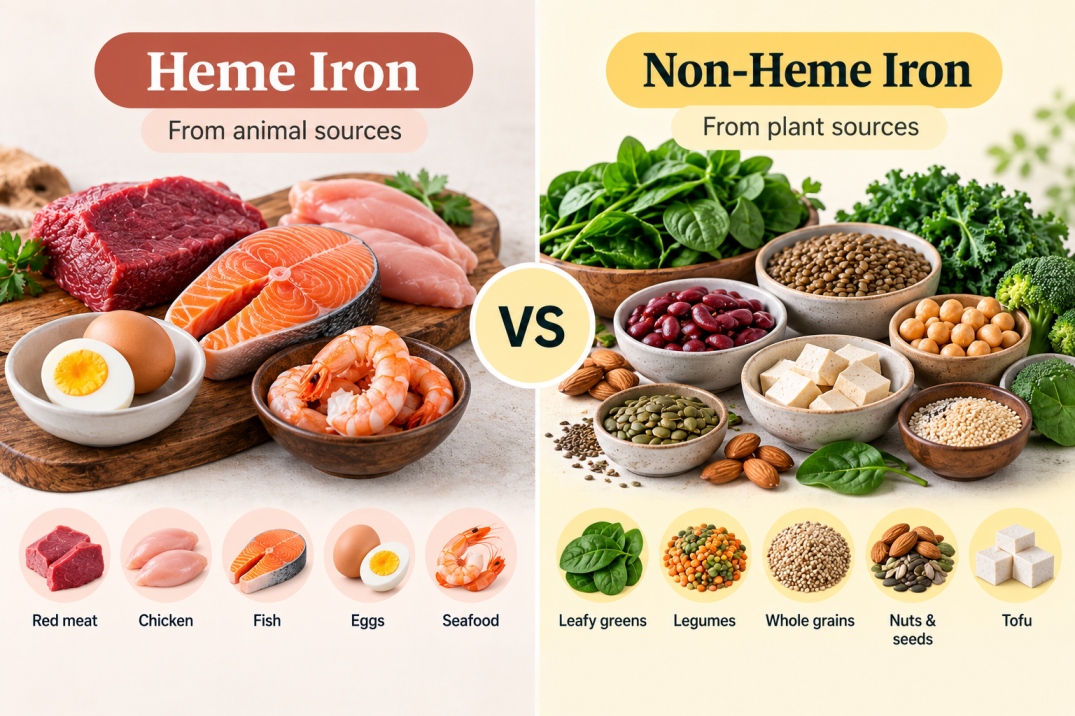
There are two major forms of dietary iron.
Heme Iron
Heme iron is found mainly in:
Meat
Poultry
Fish
Seafood
It is generally absorbed more efficiently than non-heme iron.
Non-Heme Iron
Non-heme iron is found mainly in:
Lentils
Beans
Chickpeas
Soy
Tofu
Green leafy vegetables
Nuts
Seeds
Fortified foods
Whole grains
Plant-based diets rely primarily on non-heme iron.
This is why vegetarian diets benefit from combining iron-rich foods with foods that improve absorption.
Best Vegetarian Indian Sources of Iron
There are many useful plant-based iron sources.
1. Lentils and Dal
Examples include:
Masoor dal
Moong dal
Chana dal
Toor dal
Urad dal
Include dal regularly rather than treating it as an occasional side dish.
2. Chickpeas
Chickpeas can be used as:
Chole
Chana curry
Chana chaat
Roasted chana
Chickpea salad
They provide iron along with protein and fiber.
3. Rajma
Rajma provides:
Iron
Protein
Fiber
Folate
Other micronutrients
A practical meal is:
Rajma + rice + vegetable + salad
4. Soybeans and Soy Foods
Soybeans and soy-based foods can contribute iron and protein.
Examples include:
Soybeans
Tofu
Soy chunks
5. Green Leafy Vegetables
Examples include:
Spinach
Amaranth leaves
Fenugreek leaves
Mustard greens
Other locally available leafy greens
Leafy vegetables are useful sources of iron and other micronutrients.
However, they should not be considered a guaranteed treatment for iron deficiency.
6. Sesame Seeds
Sesame seeds can contribute iron.
Use them in:
Chutneys
Til-based preparations
Vegetable toppings
Homemade seed mixes
Because seeds are energy-dense, portion size still matters.
7. Pumpkin Seeds
Pumpkin seeds provide iron along with protein, magnesium and healthy fats.
Use a moderate portion as part of:
Breakfast
Snacks
Salads
Homemade trail mixes
8. Peanuts
Peanuts provide iron as well as protein and healthy fats.
They can be added to:
Poha
Chutneys
Chaat
Snacks
Again, portion control is important because peanuts are calorie-dense.
9. Dried Fruits
Certain dried fruits such as raisins can provide some iron.
However, dried fruit is concentrated in natural sugars and calories.
Use small portions rather than relying on dried fruit as the primary iron source.
10. Fortified Foods
Some foods are fortified with iron.
Examples may include certain:
Breakfast cereals
Flours
Breads
Other fortified products
Check the nutrition label to determine whether a product actually contains added iron.
Is Jaggery a Good Source of Iron?
Jaggery is often recommended as a traditional remedy for iron deficiency.
But there is an important distinction:
Jaggery is not a reliable treatment for iron deficiency.
Although some jaggery can contain minerals, the amount of iron varies depending on the product and processing.
Eating large amounts of jaggery simply to increase iron intake also adds substantial sugar and calories.
For meaningful iron intake, prioritize foods such as:
Dal
Beans
Chickpeas
Soy
Green leafy vegetables
Seeds
Fortified foods
Meat or seafood if included in your diet
Jaggery can be enjoyed as part of a balanced diet, but it should not be considered an iron supplement.https://wellorafit.com/services/nutrition-diet-planning/
How Vitamin C Helps Iron Absorption
This is one of the most useful nutrition strategies for people relying on plant-based iron.
Vitamin C can improve absorption of non-heme iron.
Good vitamin C sources include:
Amla
Guava
Oranges
Lemon
Sweet lime
Tomatoes
Capsicum
Kiwi
Papaya
The easiest approach is to combine an iron-rich food with a vitamin-C-rich food.
Examples
Dal + tomato
Chana + lemon
Rajma + salad with lemon
Moong sprouts + tomato + lemon
Leafy vegetable sabzi + tomato
Chana chaat + lemon
NIH notes that vitamin C-rich foods can improve absorption of iron from plant foods.
Tea and Coffee: Why Timing Matters
This is particularly relevant in Indian households.
Tea and coffee contain compounds that can reduce iron absorption when consumed around an iron-rich meal.https://wellorafit.com/services/nutrition-diet-planning/
WHO specifically lists tea and coffee among foods or beverages that can slow iron absorption when consumed with iron-rich foods.
Practical Strategy
If you are trying to improve iron absorption:
Avoid having tea or coffee immediately with your main iron-rich meal.
Instead, keep some time between:
Iron-rich meal → tea/coffee
This is particularly important for people with diagnosed iron deficiency.
You do not necessarily need to stop drinking tea or coffee.
Timing is the practical solution.
What About Calcium?
Calcium can interfere with iron absorption under some circumstances.
WHO recommends separating calcium and iron supplements when both are being taken.
This does not mean you should stop eating dairy.
Milk, curd and other calcium-containing foods can remain part of a balanced diet.
If you are taking iron and calcium supplements, follow your healthcare professional's advice about timing.
What About Phytates?
Phytates occur naturally in many plant foods, including:
Whole grains
Legumes
Nuts
Seeds
They can bind minerals and reduce their absorption.
This does not mean you should avoid these nutritious foods.
Traditional preparation methods can help improve nutrient availability.
These include:
Soaking
Sprouting
Fermentation
Cooking
For example, soaking and cooking legumes properly can improve digestibility and reduce some antinutritional factors.
Does Sprouting Improve Iron Absorption?
Sprouting can reduce phytate in some legumes and grains.
This may improve the bioaccessibility of minerals such as iron and zinc.
However, sprouting does not automatically make every food an excellent source of absorbable iron.
It is one useful food-preparation method—not a treatment for iron deficiency.
Best Indian Meal Combinations for Iron
Rather than focusing on individual foods, think about combinations.
Breakfast
Moong dal chilla + tomato chutney + guava
Lunch
Rajma + rice + tomato/cucumber salad with lemon
Lunch
Dal + roti + leafy vegetable + lemon
Snack
Roasted chana + amla/guava
Dinner
Chole + roti + vegetable + lemon
Vegetarian Iron-Supportive Plate
Dal/beans + whole grain + leafy vegetable + vitamin-C-rich food
This approach improves the overall quality of the meal.
A Simple Iron-Friendly Plate
Build your meal using four components:
1. Iron Source
Dal, beans, chickpeas, soy, leafy vegetables or seeds
2. Vitamin C Source
Amla, lemon, guava, tomato, orange or capsicum
3. Balanced Carbohydrate
Roti, rice, millet or another grain
4. Other Nutrient-Rich Foods
Vegetables, curd or another suitable protein source
This creates a balanced meal rather than an "iron-only" diet.
Iron-Rich Foods for Non-Vegetarians
If you consume animal foods, additional iron sources include:
Lean meat
Fish
Seafood
Poultry
These provide heme iron, which is generally more bioavailable than non-heme iron.
However, a vegetarian diet can also provide iron through appropriate food selection and meal planning.
Does Cooking Destroy Iron?
Iron itself is not destroyed simply because a food is cooked.
However, cooking can alter the overall nutrient composition and the amount of water in a food.
Cooking legumes and vegetables also improves digestibility and makes many foods easier to consume in practical quantities.
The focus should therefore be on:
Appropriate preparation + variety + balanced meals.
Common Mistakes That Can Reduce Iron Intake or Absorption
1. Drinking Tea Immediately After Meals
Tea can reduce non-heme iron absorption.
Better: Keep tea/coffee away from iron-rich meals.
2. Eating Iron-Rich Foods Without Vitamin C
Adding lemon, tomato, guava or another vitamin-C-rich food can improve non-heme iron absorption.
3. Relying Only on Spinach
Spinach is nutritious, but it should not be your only iron strategy.
Include:
Dal
Beans
Chickpeas
Soy
Seeds
Leafy greens
Fortified foods
4. Assuming Jaggery Treats Iron Deficiency
Jaggery should not replace iron-rich foods or prescribed treatment.
5. Taking Iron Supplements Without Guidance
Iron supplements can be useful when deficiency is confirmed or when they are medically indicated.
But excessive iron can be harmful.
Do not self-prescribe high-dose iron simply because you feel tired.
6. Ignoring Heavy Periods
Heavy menstrual bleeding is an important cause of iron loss.
If your periods are unusually heavy, treating the bleeding is just as important as replacing iron.
Can Food Alone Correct Iron Deficiency?
Sometimes diet can help prevent deficiency or support recovery.
But established iron-deficiency anaemia may require iron supplementation in addition to dietary changes, depending on severity and cause.
WHO recommends treatment based on the underlying cause and notes that supplements may be needed when recommended by a qualified healthcare professional.
If laboratory tests confirm significant deficiency, do not rely only on spinach, dates or jaggery.
The appropriate treatment may involve:
Dietary changes
Oral iron
Treatment of blood loss
Treatment of an absorption problem
Other medical treatment depending on the cause
Why You Shouldn't Take Iron Supplements "Just in Case"
Iron is essential, but more is not always better.
Excess iron can cause:
Nausea
Abdominal discomfort
Constipation
Vomiting
Other adverse effects
Iron supplements should therefore be used according to medical or professional advice.
This is especially important because fatigue and weakness can have many causes.
Iron Deficiency vs Anaemia: Don't Confuse Them
Iron Deficiency
Iron-Deficiency Anaemia
Iron stores are low
Iron deficiency has affected red blood cell production
May occur without anaemia
Haemoglobin becomes low
Symptoms may be absent or mild
Symptoms may become more noticeable
Can progress if untreated
Requires appropriate evaluation and treatment
Can have nutritional or other causes
Iron deficiency is one possible cause of anaemia
Also remember:
Anaemia does not always mean iron deficiency.
Other nutrient deficiencies, chronic diseases, infections and inherited blood disorders can also cause anaemia.
Iron and Women's Health
Women who menstruate are particularly vulnerable to iron deficiency because of regular blood loss.
The risk can be greater when menstrual bleeding is heavy.
Symptoms such as:
Extreme fatigue
Dizziness
Reduced exercise tolerance
Breathlessness
should not simply be dismissed as "normal periods."
If bleeding is unusually heavy or symptoms are persistent, speak with a healthcare professional.
WHO identifies menstruating adolescent girls and women as an important population at risk of iron deficiency and anaemia.
Iron During Pregnancy
Pregnancy increases the body's iron requirements.
Iron is needed to support increased maternal blood volume and fetal development.
Pregnant women should not self-treat suspected iron deficiency with random supplements.
Prenatal iron and folic acid supplementation should follow the guidance of the healthcare professional managing the pregnancy.
Iron Deficiency in Vegetarians
Vegetarians can obtain iron from:
Lentils
Dal
Chickpeas
Rajma
Lobia
Soy
Tofu
Green leafy vegetables
Sesame seeds
Pumpkin seeds
Peanuts
Fortified foods
The key is to pay attention to iron absorption, not just iron content.
A useful formula is:
Plant iron + Vitamin C + appropriate meal timing = better opportunity for iron absorption
For example:
Chana + tomato + lemon
is a more iron-friendly combination than eating chana alone and immediately following it with tea.
A One-Day Iron-Supportive Indian Vegetarian Diet
This is an example of food combinations, not a therapeutic prescription.
Early Morning
Water + amla or another vitamin-C-rich fruit if suitable
Breakfast
Moong dal chilla + tomato chutney
Mid-Morning
Guava or orange
Lunch
Rajma + rice + vegetable + lemon-based salad
Evening Snack
Roasted chana + fruit
Dinner
Dal + whole-wheat roti + leafy vegetable + tomato
Beverage Timing
Keep tea or coffee away from the main iron-rich meals.
The exact quantities should be individualized according to energy needs, age, sex, activity level and health status.
How to Make Your Indian Diet More Iron-Friendly
You do not need to completely change your diet.
Try these simple habits:
Habit 1
Include one major iron-rich food in lunch and dinner.
Habit 2
Add a vitamin-C-rich food to plant-based iron meals.
Habit 3
Keep tea and coffee away from iron-rich meals.
Habit 4
Rotate different legumes rather than eating only one type.
Habit 5
Include leafy vegetables regularly.
Habit 6
Use traditional preparation methods such as soaking, sprouting and fermentation where appropriate.
Habit 7
If you have confirmed iron deficiency, follow your healthcare professional's treatment plan.
Iron-Rich Food Chart
Food Group
Examples
Practical Use
Pulses
Masoor, moong, chana dal, toor dal
Dal, chilla, khichdi
Legumes
Rajma, chickpeas, lobia
Curry, salad, chaat
Soy
Soybeans, tofu, soy chunks
Curry, bhurji, stir-fry
Leafy greens
Spinach, amaranth, methi
Sabzi, dal, curry
Seeds
Sesame, pumpkin seeds
Chutney, topping, snack
Nuts
Peanuts, almonds
Snack, chutney, toppings
Dried fruit
Raisins
Small snack portions
Fortified foods
Fortified cereals/breads
Check nutrition label
Animal foods
Meat, poultry, fish, seafood
If included in diet
NIH identifies legumes such as lentils and kidney beans, spinach, nuts and certain dried fruits among foods that provide iron, while meat, poultry and seafood provide heme iron as well as non-heme iron.
Common Myths About Iron Deficiency
Myth 1: Feeling Tired Means You Have Iron Deficiency
Fact: Fatigue has many possible causes. Iron deficiency is one possibility, but testing is needed for diagnosis.
Myth 2: Anaemia Always Means You Need Iron
Fact: Anaemia has multiple causes. Iron supplementation is appropriate when iron deficiency is present or when specifically recommended.
Myth 3: Spinach Is the Best Treatment for Iron Deficiency
Fact: Spinach is nutritious, but established deficiency may require more than dietary spinach. Include a variety of iron-rich foods and seek appropriate medical evaluation.
Myth 4: Jaggery Cures Anaemia
Fact: Jaggery should not be considered a treatment for iron-deficiency anaemia.
Myth 5: Vegetarians Cannot Get Enough Iron
Fact: Vegetarian diets can provide iron through legumes, soy, leafy vegetables, seeds, nuts and fortified foods. Attention to absorption is particularly important.
Myth 6: You Must Stop Drinking Tea and Coffee
Fact: You may not need to stop them completely. Keeping them away from iron-rich meals can help reduce their interference with non-heme iron absorption.
Myth 7: More Iron Is Always Better
Fact: Excess iron can be harmful. Supplements should be used appropriately and not simply because someone feels tired.
Key Takeaways
Iron is essential for haemoglobin production and oxygen transport.
Iron deficiency occurs when body iron stores become too low.
Iron deficiency can occur before iron-deficiency anaemia develops.
Anaemia has several causes, so low haemoglobin does not automatically mean iron deficiency.
Common symptoms can include fatigue, weakness, dizziness, headaches and shortness of breath.
Menstruating women, pregnant women, adolescents and people with blood loss are among those at greater risk.
Plant foods provide non-heme iron, while meat, poultry and seafood provide heme as well as non-heme iron.
Vegetarian diets can provide iron through dal, beans, chickpeas, soy, leafy vegetables, seeds, nuts and fortified foods.
Vitamin C can improve absorption of non-heme iron.
Tea and coffee can reduce iron absorption when consumed with iron-rich meals.
Soaking, sprouting, fermentation and cooking can help improve the nutritional quality and digestibility of some plant foods.
Jaggery should not be considered a treatment for iron deficiency.
Confirmed iron deficiency may require supplements and treatment of the underlying cause.
Persistent symptoms or heavy menstrual bleeding should be medically evaluated.
Conclusion
Iron deficiency is not simply a problem of "not eating enough spinach."
It is a nutrition and health issue influenced by dietary intake, absorption, increased requirements and iron losses.
For an Indian diet, practical iron-rich choices include:
Dal + legumes + soy + leafy vegetables + seeds + nuts + fortified foods
But choosing iron-rich foods is only part of the equation.
For plant-based iron, meal combinations matter.
Try:
Dal + lemon
Chana + tomato
Rajma + vegetable salad
Moong sprouts + tomato + lemon
and keep tea or coffee away from your main iron-rich meals.
At the same time, remember that persistent iron deficiency can have causes that food alone cannot fix.
Heavy menstrual bleeding, gastrointestinal blood loss, malabsorption and other medical conditions may need treatment.
If you suspect iron deficiency, the right approach is not to guess from symptoms or start high-dose supplements on your own.
Test, identify the cause, improve the diet, and treat the deficiency appropriately.
That is the sustainable approach to better iron status and better overall nutrition.
FAQ
1. What are the most common symptoms of iron deficiency?
Common symptoms may include fatigue, weakness, dizziness, headaches, cold hands and feet, reduced exercise tolerance and shortness of breath, particularly when deficiency has progressed to anaemia.
2. Is iron deficiency the same as anaemia?
No. Iron deficiency means the body's iron stores are low. If deficiency becomes severe enough to impair red blood cell production and lower haemoglobin, it can result in iron-deficiency anaemia.
3. What is the best vegetarian source of iron?
There is no single best food. Dal, lentils, chickpeas, rajma, soy, leafy vegetables, sesame seeds, pumpkin seeds and fortified foods can all contribute iron.
4. How can I increase iron absorption from vegetarian foods?
Combine plant-based iron sources with vitamin-C-rich foods such as lemon, amla, guava, tomatoes or oranges.
5. Does tea reduce iron absorption?
Yes. Tea contains compounds that can reduce absorption of non-heme iron when consumed around iron-rich meals. Keeping tea and coffee away from these meals is a practical strategy.
6. Is jaggery good for iron deficiency?
Jaggery should not be relied upon to treat iron deficiency. It can be part of a balanced diet but should not replace iron-rich foods or medically indicated treatment.
7. Can vegetarians become iron deficient?
Yes, but vegetarian diets can also provide adequate iron when they include a variety of legumes, soy, leafy vegetables, seeds, nuts and fortified foods and use strategies that improve absorption.
8. Can iron deficiency cause hair loss?
Iron deficiency may be associated with hair loss in some people, but hair loss has many possible causes. Testing is needed before attributing it to iron deficiency.
9. Should I take iron supplements if I feel tired?
Not automatically. Fatigue has many causes, and excessive iron supplementation can be harmful. Discuss symptoms and appropriate testing with a healthcare professional.
10. Can I correct iron deficiency through food alone?
Mild dietary inadequacy may improve with food changes, but confirmed iron-deficiency anaemia may require iron supplementation as well as treatment of the underlying cause.
11. Who is most at risk of iron deficiency?
Menstruating women, pregnant women, adolescents, young children, frequent blood donors and people with blood loss or gastrointestinal conditions are among higher-risk groups.
12. Does cooking destroy iron?
Iron itself is not destroyed simply by cooking. Cooking can change the overall nutritional composition of foods, but cooked legumes and vegetables remain useful components of an iron-supportive diet.
Ready to Begin Your Health Journey?
Get a personalized, medically guided plan built around your unique biology.