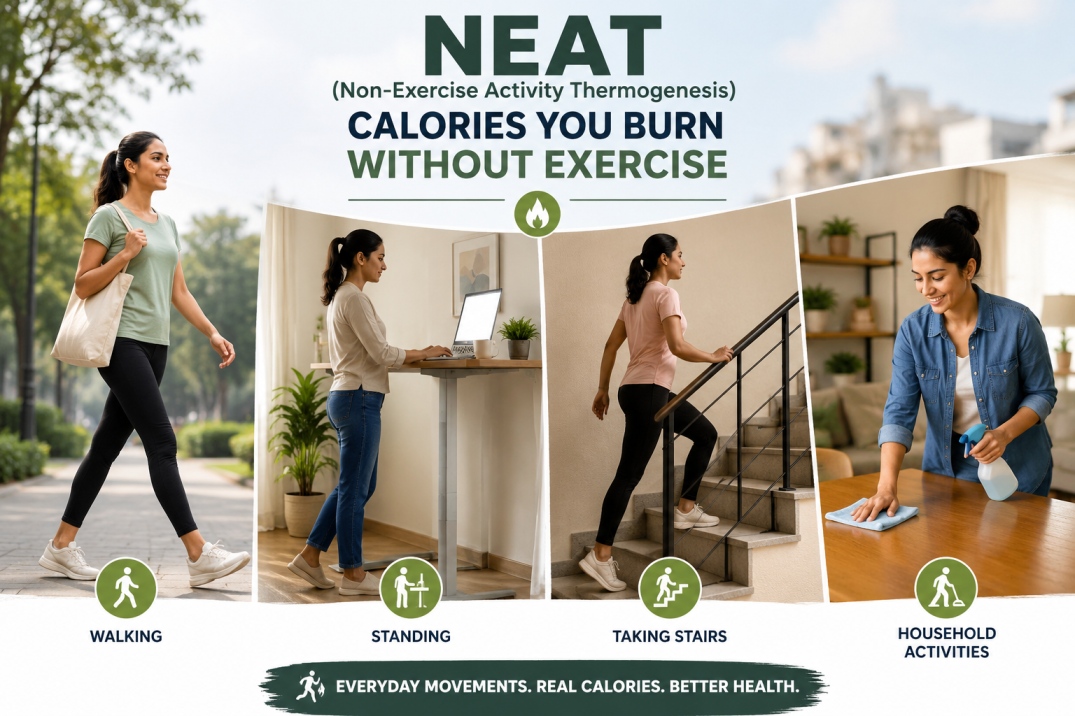
NEAT (Non-Exercise Activity Thermogenesis)
When people think about calories burned, they often think about gym workouts, running, cycling, or other planned exercise.
But your body uses energy throughout the day—even when you are not doing a formal workout.
Walking around the house, standing while working, climbing stairs, doing household chores, shopping, cooking, and even small movements such as fidgeting all contribute to daily energy expenditure.
This is where NEAT, or Non-Exercise Activity Thermogenesis, comes in.
NEAT refers to the energy your body uses for physical activities that are not planned exercise, sleeping, eating, or sports training.
It can be an important part of your overall daily calorie expenditure and may contribute to differences in energy balance and weight management between individuals.https://www.who.int
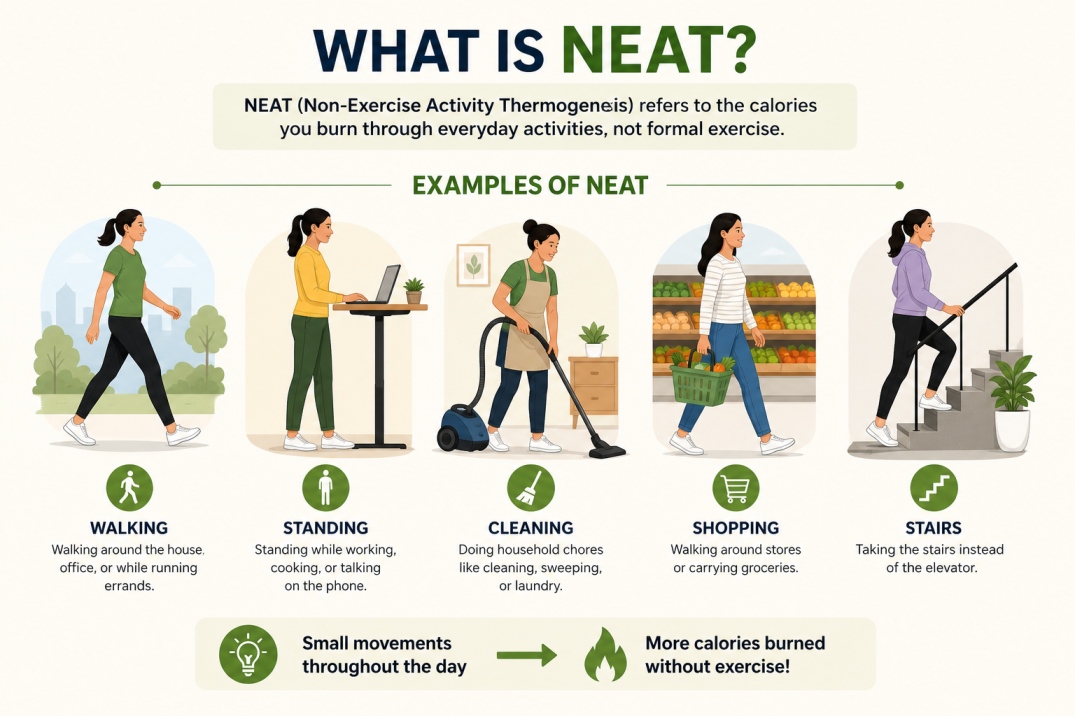
What Is NEAT?
NEAT stands for Non-Exercise Activity Thermogenesis.
It describes the energy your body uses for everyday physical activities outside structured exercise.
Examples include:
· Walking around your home
· Standing
· Cooking
· Cleaning
· Shopping
· Gardening
· Taking the stairs
· Walking while talking on the phone
· Moving around at work
· Fidgeting
· Doing household tasks
These activities may not feel like “exercise,” but they still require your body to use energy.https://www.cdc.gov
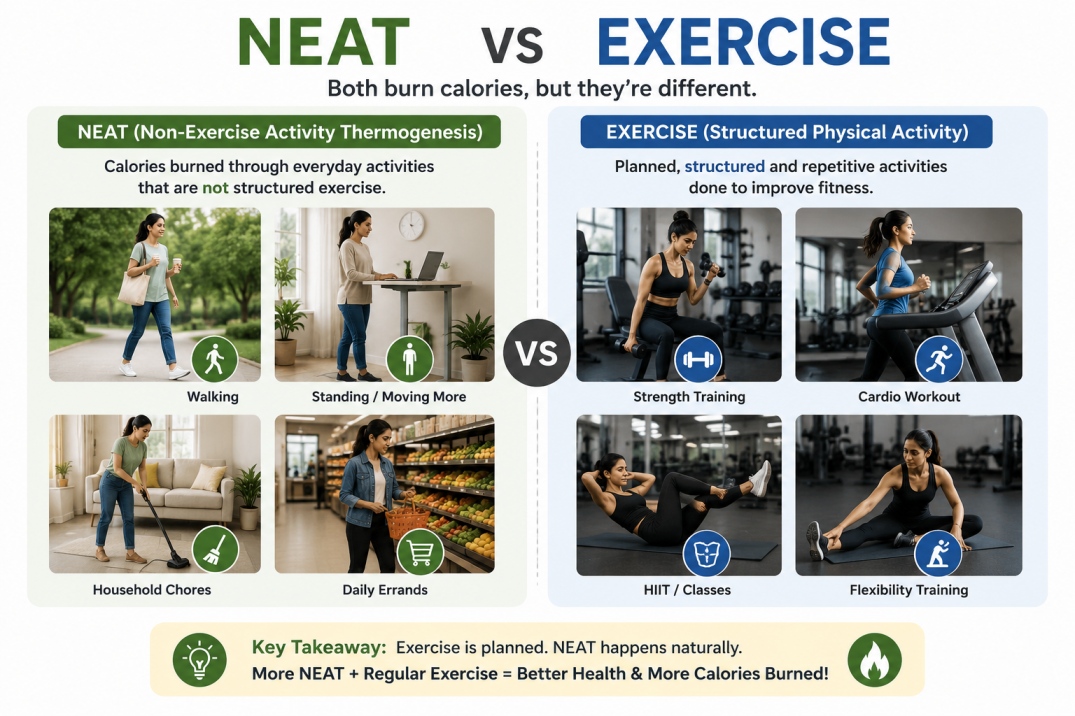
NEAT vs. Exercise
NEAT and exercise are related to physical activity, but they are not the same thing.
Exercise
Exercise is usually:
· Planned
· Structured
· Repetitive
· Performed with a specific fitness goal
Examples include:
· Weight training
· Running
· Cycling
· Swimming
· Fitness classes
NEAT
NEAT includes movement that happens as part of everyday life.
Examples include:
· Walking to another room
· Standing at your desk
· Cleaning your home
· Carrying groceries
· Taking the stairs
· Walking around while working
So, a person can have low exercise levels but relatively high NEAT, or exercise regularly while spending most of the rest of the day sitting.
Where Does NEAT Fit Into Daily Energy Expenditure?
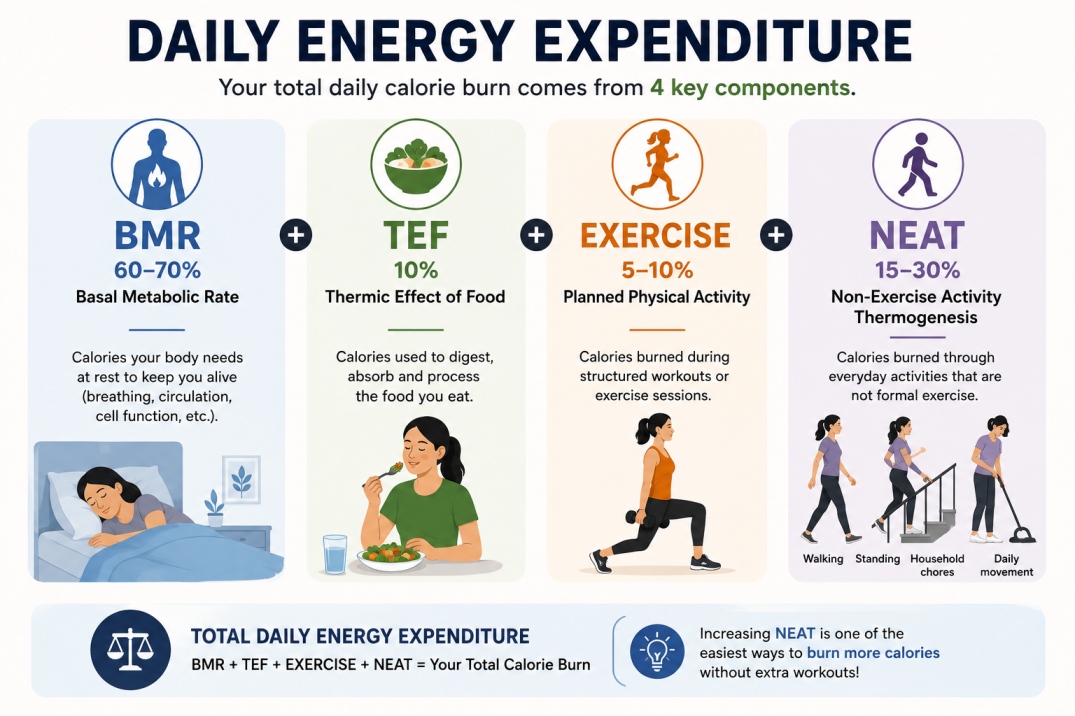
Your total daily energy expenditure is made up of several components.
A simplified model includes:
Basal Metabolic Rate (BMR)
Energy required to support essential body functions at rest.
Thermic Effect of Food (TEF)
Energy used to digest, absorb, and process food.
Exercise Activity
Energy used during planned physical activity.
NEAT
Energy used during non-exercise physical activity.
So:
Total Daily Energy Expenditure ≈ BMR + TEF + Exercise + NEAT
The exact contribution of each component varies between individuals.
Why Does NEAT Matter?
NEAT can make a meaningful contribution to the amount of energy you use throughout the day.
Consider two people who both complete a 45-minute workout.
Person A:
45-minute workout + 8 hours sitting + very little movement
Person B:
45-minute workout + regular walking + standing + household movement
Their total daily physical activity can be quite different even though they completed the same formal workout.
This is one reason daily movement matters beyond what happens inside the gym.https://wellorafit.com/services/fitness-training/
NEAT Can Vary Significantly Between People
People naturally have very different movement patterns.
One person may:
· Walk frequently
· Stand often
· Move around at work
· Take stairs
· Do household chores
Another person may:
· Sit at a desk most of the day
· Drive everywhere
· Spend most of their free time sitting
· Have little movement outside exercise
Both people could technically complete the same workout, but their total daily activity can still be very different.
NEAT and Weight Management
Weight management is influenced by the relationship between energy intake and energy expenditure over time.
NEAT contributes to energy expenditure, so changes in everyday movement can influence overall energy balance.
For someone trying to manage their weight, increasing everyday movement can be a practical strategy because it does not necessarily require adding another intense workout.
For example:
10-minute walk → Take stairs → Stand during calls → Walk while talking → Household chores
Small activities can add up throughout the day.
NEAT Is Not a "Fat-Burning Trick"
NEAT should not be presented as a magic solution for weight loss.
Increasing daily movement can contribute to energy expenditure, but weight management is influenced by many factors, including:
· Food intake
· Exercise
· NEAT
· BMR
· Sleep
· Stress
· Genetics
· Medications
· Health conditions
The goal should be to create a more active lifestyle rather than constantly trying to “burn calories.”
Why Sitting Less Can Matter
Modern lifestyles often involve long periods of sitting.
Desk jobs, commuting, television, smartphones, and other sedentary activities can reduce the amount of movement people naturally perform throughout the day.
Even if you exercise regularly, you may still spend many hours sitting.
Adding more movement throughout the day can help reduce sedentary time and increase overall physical activity.
NEAT and Office Workers
NEAT can be particularly relevant for people who work at desks.
A person may spend:
8 hours working at a desk + 1 hour commuting + several hours sitting at home
with relatively little movement outside their workout.
Simple changes can increase daily movement:
· Walk during phone calls.
· Take short movement breaks.
· Use stairs when practical.
· Walk to nearby locations.
· Stand periodically during the workday.
· Move around while completing routine tasks.
These changes don't replace structured exercise, but they can complement it.
NEAT and Metabolism
NEAT is sometimes described as part of your “metabolism,” but technically it is better understood as a component of daily energy expenditure.
Increasing NEAT does not permanently “speed up” your metabolism.
Instead, becoming more physically active means your body uses more energy through movement.
This distinction is important because many online claims about metabolism and calorie burning oversimplify how energy expenditure works.
NEAT Can Change With Weight Loss
When people lose weight, energy expenditure can change for several reasons.
One potential factor is that people may unconsciously move less as they become more tired or as their body adapts to changes in energy availability and body weight.
This can make maintaining weight loss challenging for some people.
Rather than trying to compensate with extreme workouts, maintaining regular everyday movement can be a practical part of a long-term approach.
Examples of Everyday NEAT
You may already be doing NEAT without realizing it.
At Home
· Cooking
· Cleaning
· Laundry
· Gardening
· Walking around the house
· Playing with children
At Work
· Standing during calls
· Walking to another desk
· Taking movement breaks
· Using stairs
· Walking during lunch
Outside
· Walking to nearby shops
· Carrying groceries
· Walking through a market
· Taking stairs instead of elevators
· Walking while talking on the phone
The key idea is simple:
Movement doesn't have to happen in a gym to count as physical activity.
Key Takeaways
· NEAT stands for Non-Exercise Activity Thermogenesis.
· It refers to energy used during everyday physical activities outside planned exercise.
· Walking, standing, cooking, cleaning, shopping, and taking stairs can contribute to NEAT.
· NEAT is different from structured exercise.
· It is one component of total daily energy expenditure.
· NEAT levels can vary considerably between individuals.
· Increasing everyday movement can support overall physical activity and weight management.
· NEAT does not permanently “speed up” metabolism.
· Sitting less and moving more throughout the day can complement regular exercise.
· Small movements repeated throughout the day can contribute to your overall activity level.
Part 2 — Factors That Affect NEAT
NEAT is not the same for everyone. The amount of movement you naturally do each day can change based on your job, lifestyle, environment, habits, body size, energy levels, and daily routine.
Understanding these factors can help you identify simple opportunities to move more without adding another formal workout.
1. Your Type of Work
Your occupation can have a major influence on daily movement.
More Active Jobs
Jobs that involve:
· Walking
· Standing
· Lifting
· Moving between locations
· Physical tasks
can naturally involve more daily movement.
Sedentary Jobs
Desk-based jobs may involve:
· Long periods of sitting
· Computer work
· Meetings
· Commuting
· Limited movement during working hours
A person with a sedentary job may therefore benefit from intentionally adding movement throughout the workday.
2. Your Daily Routine
Two people can have completely different activity levels even if neither follows a formal exercise program.
For example:
Person A
· Drives everywhere
· Uses the elevator
· Works at a desk
· Watches TV after work
Person B
· Walks to nearby places
· Takes stairs
· Does household chores
· Walks during phone calls
· Spends time standing and moving
The second person may accumulate substantially more everyday movement.
3. Sitting Time
Long periods of sitting can reduce opportunities for everyday movement.
You don't necessarily need to completely avoid sitting. Instead, look for opportunities to break up prolonged periods of inactivity.
Try:
· Standing during phone calls
· Walking during short breaks
· Getting up to refill your water bottle
· Walking to speak to a colleague when practical
· Taking a short walk after meals
· Moving around between tasks
These small changes can make your day less sedentary.
4. Walking
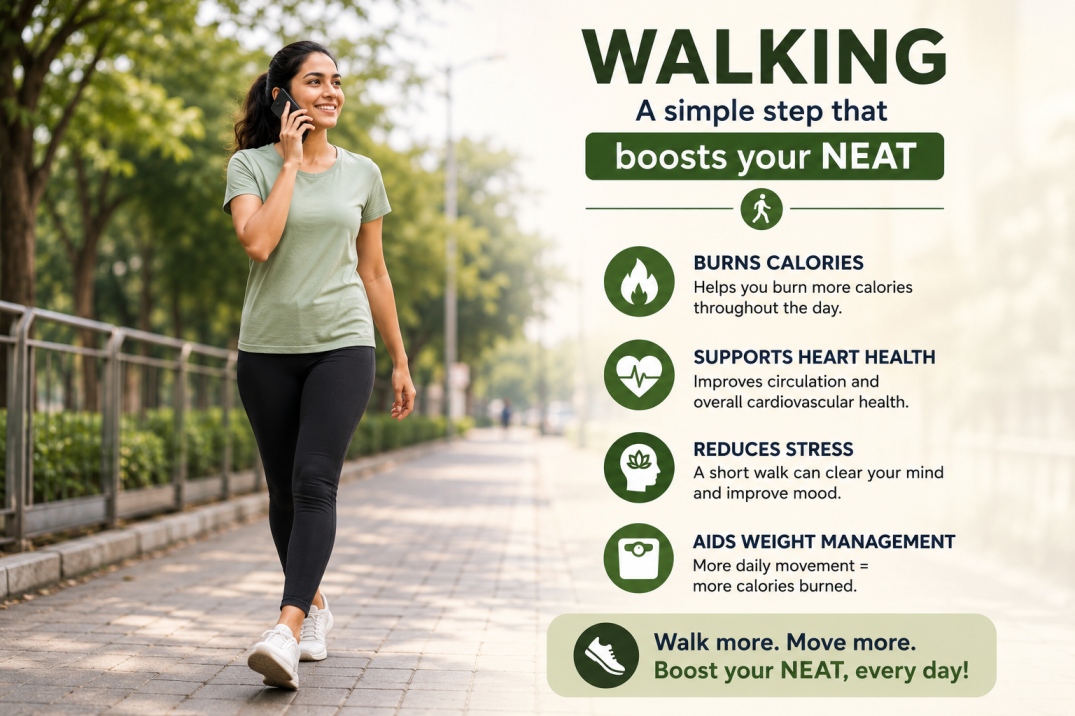
Walking is one of the easiest ways to increase everyday movement.
You can add walking without creating a separate workout.
For example:
· Walk while talking on the phone.
· Walk to nearby shops.
· Take a short walk after lunch.
· Park slightly farther away when practical.
· Take the stairs.
· Walk around while waiting.
· Take short walking breaks during work.
The goal is not to make every walk intense.
The goal is simply to move more throughout the day.
5. Household Activities
Household tasks can contribute to everyday physical activity.
Examples include:
· Cooking
· Cleaning
· Sweeping
· Mopping
· Laundry
· Gardening
· Organizing
· Grocery shopping
These activities should not necessarily be treated as a replacement for exercise, but they are still physical movement and contribute to your overall activity level.
6. Standing More Often
Standing uses more energy than sitting, although the difference should not be exaggerated.
Practical opportunities include:
· Standing during phone calls
· Using a standing desk for part of the day
· Standing while folding laundry
· Standing while talking with someone
· Taking regular standing breaks
If you work at a desk, alternate between sitting and standing rather than trying to stand continuously.
7. Taking the Stairs
Choosing stairs instead of an elevator is a simple way to add movement.
For example:
Elevator → Minimal movement
Stairs → Additional walking + climbing activity
You don't need to take the stairs every time.
Choose them when they are practical and appropriate for your fitness level and health.
8. Your Environment Matters
Your surroundings can influence how much you move.
If everything you need is within a few steps, you may naturally move less.
On the other hand, environments that encourage walking can increase everyday activity.
Simple environmental changes can include:
· Keeping frequently used items slightly farther away.
· Taking walking routes when practical.
· Choosing stairs.
· Walking to nearby destinations.
· Keeping your phone away from your desk so you need to get up to retrieve it.
The idea is to make movement a natural part of your routine.
9. Your Energy Levels Can Affect NEAT
NEAT can change when your energy levels change.
When you're tired, stressed, or recovering from poor sleep, you may naturally:
· Sit more
· Walk less
· Move less frequently
· Spend more time resting
This can happen without you consciously deciding to become less active.
That is why sleep, nutrition, stress management, and recovery are important components of an active lifestyle.
10. Stress and Daily Movement
Stress can affect everyday behavior differently from person to person.
Some people may become restless and move more, while others may spend more time sitting or relaxing.
If stress is causing you to become less active, simple movement breaks can help you maintain some daily activity.
For example:
5-minute walk → Short break → Return to work
You don't need to turn every movement break into a workout.
11. Sleep and NEAT
Poor sleep can affect energy, mood, and motivation to move.
When you are tired, it can become easier to:
· Take the elevator
· Drive instead of walking
· Skip household activities
· Sit for longer periods
· Avoid movement breaks
Prioritizing good sleep can therefore support your ability to stay active throughout the day.
12. Weight and Body Size
Body size can influence how much energy is used during physical activity.
However, NEAT should not be reduced to a simple calorie calculation.
Two people performing the same activity may use different amounts of energy because of differences in:
· Body size
· Body composition
· Movement efficiency
· Fitness
· Walking speed
· Duration of activity
This is another reason why online calculators should not be treated as exact measurements of your daily calorie burn.
13. NEAT Can Change Over Time
Your everyday movement is not fixed.
It can increase or decrease when your lifestyle changes.
For example:
New desk job → Less walking
Moving to a walkable area → More walking
Working from home → Different movement pattern
Starting a family → Different daily activities
Retirement → Potential change in routine
This means NEAT can be influenced by your environment and habits throughout life.
14. NEAT and Your Exercise Routine
Regular exercise and NEAT should complement each other.
For example:
Morning → Strength workout
Workday → Standing and walking breaks
Lunch → Short walk
Evening → Household activities
You don't have to choose between exercise and everyday movement.
A combination of both can create a more active lifestyle.https://wellorafit.com/services/fitness-training/
15. How to Identify Your Own NEAT Opportunities
Start by looking at your normal day.
Ask yourself:
· How much of my day do I spend sitting?
· How often do I walk?
· Do I take the stairs?
· Do I move during phone calls?
· Can I walk to nearby places?
· Do I take movement breaks at work?
· How much household activity do I do?
You may find several opportunities to add movement without changing your entire schedule.
Key Takeaways
· NEAT varies significantly between individuals.
· Occupation and daily routine can strongly influence everyday movement.
· Long periods of sitting can reduce opportunities for NEAT.
· Walking, standing, stairs, and household activities can increase daily movement.
· Environment can make movement easier or harder.
· Sleep, stress, and energy levels can influence how much you naturally move.
· NEAT can change when your lifestyle changes.
· NEAT and structured exercise can work together.
· You don't need to turn everyday movement into another intense workout.
· The best NEAT strategy is one that fits naturally into your daily routine.
Part 3 — Practical Ways to Increase NEAT Every Day
Increasing NEAT does not require another intense workout. The goal is to make movement a natural part of your daily routine.
Small changes can be repeated throughout the day and can help increase your overall physical activity.
1. Start With More Walking
Walking is one of the simplest ways to increase daily movement.
Try adding walking to activities you already do:
· Walk while talking on the phone.
· Take a short walk after meals.
· Walk to nearby shops when practical.
· Park farther away from your destination.
· Take a longer route when convenient.
· Walk during breaks at work.
You don't need to complete one long walk. Several short periods of movement can fit into a busy day.
2. Take Regular Movement Breaks
If you work at a desk, avoid staying seated for long uninterrupted periods whenever possible.
Try setting a simple routine:
Work → Move → Work → Move
During a short break, you can:
· Stand up
· Walk around
· Refill your water bottle
· Stretch gently
· Walk to another room
· Take a few minutes outside
These breaks can make your workday more active without becoming a formal workout.
3. Walk During Phone Calls
Phone calls are an easy opportunity to add movement.
Instead of sitting:
Phone call → Walk
You can walk around your home, office, or another safe location while talking.
If the call requires concentration or note-taking, you can return to your desk afterward.
4. Choose Stairs When Practical
Taking the stairs instead of an elevator can add movement to your day.
You can start with:
· One or two floors
· Stairs during short trips
· Walking up instead of down, if that feels more manageable
Choose the option that is appropriate for your fitness level and health.
5. Make Household Tasks Count
Household activities naturally involve movement.
Instead of thinking of them only as chores, recognize them as opportunities to stay physically active.
Examples include:
· Cooking
· Cleaning
· Sweeping
· Mopping
· Laundry
· Gardening
· Organizing
· Grocery shopping
You don't need to count the calories burned during each activity. Simply staying active throughout the day is the goal.
6. Stand More Throughout the Day
Look for opportunities to replace some sitting with standing.
For example:
· Stand while talking on the phone.
· Stand during short meetings.
· Stand while folding clothes.
· Stand while organizing items.
· Use a standing desk for part of your workday.
You don't need to stand all day.
Alternating between sitting, standing, and walking is a more practical approach.
7. Make Your Environment Encourage Movement
Your environment can influence your daily habits.
Try simple changes such as:
· Keep your water bottle away from your desk.
· Walk to speak with colleagues when practical.
· Use stairs when appropriate.
· Keep frequently used items in different locations.
· Choose walking routes when possible.
· Place your phone away from you so you have to get up to retrieve it.
The goal is to create small reasons to move.
8. Add Movement to Your Morning
Start the day with simple movement.
For example:
5–10 minute walk
or
Light household activity + mobility
You don't need to turn this into a workout.
Starting the day with movement can make it easier to remain active throughout the day.
9. Move After Meals
A short walk after a meal can be an easy way to add daily movement.
For example:
Lunch → 5–10 minute walk
Dinner → Short relaxed walk
The walk doesn't need to be fast or intense.
If walking immediately after eating is uncomfortable for you, choose another convenient time.
10. Make Weekends More Active
Weekends can be an opportunity to increase everyday movement without formal exercise.
Try:
· Going for a walk
· Visiting a market
· Gardening
· Cleaning
· Exploring a local area on foot
· Playing with children
· Doing outdoor activities with family
Choose activities you actually enjoy.
11. Reduce Unnecessary Sitting
Look at activities where you automatically sit.
For example:
Watching a short video → Stand or walk
Phone call → Walk
Waiting → Stand or walk
Nearby destination → Walk instead of drive
You don't need to eliminate sitting completely.
The goal is to create a healthier balance between sitting and movement.
12. Use a Step Goal Carefully
A step counter can be useful for becoming more aware of your daily movement.
However, you don't need to become obsessed with reaching a specific number every day.
Instead, use your current activity as a starting point.
For example:
Current average → 4,000 steps
Rather than immediately aiming for a very high number, gradually increase your daily movement.
Your appropriate activity level depends on your health, fitness, age, and lifestyle.
13. Combine NEAT With Exercise
NEAT should complement—not replace—structured exercise.
A balanced day could look like:
Morning: Strength workout
Workday: Regular standing and walking breaks
Lunch: Short walk
Evening: Household activities
Night: Relaxation and rest
This creates movement throughout the day without requiring multiple formal workouts.
14. Don't Turn NEAT Into a Calorie-Burning Obsession
NEAT can contribute to daily energy expenditure, but you don't need to calculate the calories burned by every movement.
Instead of thinking:
“How many calories did I burn by cleaning?”
Think:
“How can I make my day more active?”
This approach is more sustainable and avoids turning everyday movement into another source of pressure.
15. Start With One or Two Changes
You don't need to change your entire lifestyle overnight.
Start with simple habits such as:
Week 1: Take a 10-minute walk after lunch.
Week 2: Add walking during phone calls.
Week 3: Take the stairs when practical.
Week 4: Add regular movement breaks during work.
Small habits can gradually become part of your normal routine.
Sample Active Day
Morning
10-minute walk + normal morning activities
Work
Stand and move during breaks
Phone Calls
Walk whenever practical
Lunch
Short walk after the meal
Evening
Household activities or family walk
Night
Relaxation and adequate sleep
None of these activities needs to be a formal workout.
Together, they can create a more active daily routine.
Key Takeaways
· NEAT can be increased without adding another formal workout.
· Walking is one of the easiest ways to increase daily movement.
· Take regular movement breaks during long periods of sitting.
· Walk during phone calls when practical.
· Use stairs when appropriate.
· Household activities contribute to everyday movement.
· Alternate between sitting, standing, and walking.
· Make your environment encourage movement.
· Use step tracking for awareness rather than obsessing over a specific number.
· Combine everyday movement with structured exercise.
· Focus on becoming more active rather than constantly counting calories.
· Start with one or two simple changes and build gradually.
Part 4 — NEAT, Weight Loss & Long-Term Healthy Habits
NEAT can be a useful part of a healthy lifestyle because it focuses on movement throughout the day, not just what happens during a workout.
The goal is not to constantly burn more calories. Instead, it is to create a lifestyle where movement happens naturally and consistently.
NEAT and Sustainable Weight Management
Weight management is influenced by several factors:
Food Intake + Exercise + NEAT + Resting Energy Expenditure + Other Factors
Increasing everyday movement can contribute to overall energy expenditure.
For example, instead of relying only on a 45-minute workout, you can also:
· Walk during breaks
· Take the stairs
· Walk while talking on the phone
· Do household chores
· Take short walks after meals
· Spend less time sitting
These activities can complement structured exercise.
1. NEAT Is Not a Replacement for Exercise
NEAT is useful, but it should not replace planned exercise entirely.
Structured exercise provides specific benefits such as:
· Improving cardiovascular fitness
· Building muscle
· Increasing strength
· Improving physical performance
· Supporting bone health
A strong fitness routine can include both:
Structured Exercise + Everyday Movement
They serve different purposes and work well together.
2. Focus on Movement, Not Just Calories
One of the biggest mistakes is turning NEAT into another calorie-counting exercise.
You don't need to know exactly how many calories you burned by:
· Cleaning
· Walking
· Standing
· Cooking
· Shopping
Calorie estimates from watches, apps, and online calculators are not exact measurements of individual energy expenditure.
Instead, focus on the behavior:
“Am I moving more today than I normally do?”
That is a more practical goal.
3. Create Movement-Based Habits
NEAT works best when movement becomes automatic.
For example:
Phone rings → Walk
Lunch ends → Short walk
One-floor trip → Take stairs
Long sitting period → Stand and move
Nearby destination → Walk when practical
These simple associations can make daily movement easier to maintain.
4. Increase NEAT Gradually
If you're currently very sedentary, don't try to completely change your routine overnight.
Start small.
Week 1
Take one additional short walk each day.
Week 2
Add movement breaks during work.
Week 3
Walk during some phone calls.
Week 4
Use stairs when practical.
Over time, these changes can become part of your normal routine.
5. NEAT for Desk Workers
If you work at a desk, consider creating a simple movement routine.
For example:
Every 45–60 minutes → Stand and move briefly
During the day:
· Walk during phone calls.
· Use stairs.
· Walk to refill water.
· Take a short lunchtime walk.
· Stand during suitable meetings.
· Walk to nearby colleagues when practical.
You don't need to stop working to become more active.
The goal is to break up long periods of sitting.
6. NEAT at Home
You can also increase movement without leaving your home.
Try:
· Walking while talking on the phone
· Cleaning regularly
· Gardening
· Organizing your home
· Playing with children
· Doing household tasks manually
· Taking short movement breaks
These activities can make an otherwise sedentary day more active.
7. Combine NEAT With Strength Training
If your goal is healthy weight management and better body composition, don't focus only on calorie expenditure.
A balanced approach includes:
Strength Training → Muscle Health
NEAT → Everyday Movement
Cardio → Cardiovascular Fitness
Nutrition → Nutrient Intake & Energy Balance
Recovery → Adaptation & Consistency
Together, these components create a more complete approach to fitness.
8. Recovery Still Matters
Increasing NEAT doesn't mean you need to be moving constantly.
Your body still needs:
· Rest
· Sleep
· Adequate nutrition
· Recovery from exercise
If you are already highly active or physically tired, adding more movement may not always be necessary.
The goal is appropriate activity, not maximum activity.
9. Avoid the "All or Nothing" Approach
You don't have to choose between:
10,000 steps + workout
or
No movement at all.
A day with fewer steps can still include meaningful movement.
For example:
· 15-minute walk
· Household chores
· Taking stairs
· Standing breaks
· Normal daily activities
Every active choice can contribute to a more active lifestyle.
10. Track Progress Beyond Calories
Instead of focusing only on calorie burn, track behaviors.
Ask:
· Am I sitting less?
· Am I walking more?
· Am I taking regular movement breaks?
· Am I choosing stairs more often?
· Am I more active during my workday?
· Am I maintaining my exercise routine?
These indicators can help you build sustainable habits.
Common NEAT Mistakes to Avoid
1. Thinking NEAT Replaces Exercise
It doesn't. Both everyday movement and structured exercise have value.
2. Chasing a Specific Calorie Number
NEAT calorie estimates are difficult to measure precisely.
3. Forcing Movement When You're Exhausted
Recovery is still important.
4. Making Huge Changes Immediately
Small, repeatable changes are easier to maintain.
5. Ignoring Nutrition
More movement does not automatically compensate for an unbalanced diet.
6. Comparing Your NEAT With Someone Else's
Daily movement depends heavily on occupation, lifestyle, environment, and individual circumstances.
When to Adjust Your Approach
If increasing movement causes:
· Persistent fatigue
· Pain
· Reduced exercise performance
· Poor sleep
· Excessive soreness
consider reducing your activity and reviewing your overall training and recovery.
If you have a medical condition or physical limitations, discuss appropriate activity levels with your healthcare professional.
Key Takeaways
· NEAT is an important component of daily physical activity and energy expenditure.
· It can complement structured exercise.
· Everyday activities such as walking, standing, cleaning, and taking stairs contribute to movement.
· NEAT can be particularly useful for people who spend much of their day sitting.
· Focus on increasing movement rather than obsessively counting calories.
· Small movement habits can accumulate throughout the day.
· NEAT should be increased gradually.
· Structured exercise, nutrition, sleep, and recovery remain important.
· There is no universal “ideal” amount of NEAT.
· Sustainable movement habits are more valuable than short-term calorie-burning efforts.
Conclusion
NEAT is a reminder that physical activity doesn't only happen during a workout.
The steps you take around the house, the walk to the office, the stairs you climb, the household chores you complete, and the movement you add between periods of sitting all contribute to your overall daily activity.
You don't need to spend hours in the gym to become more active.
Start with small changes:
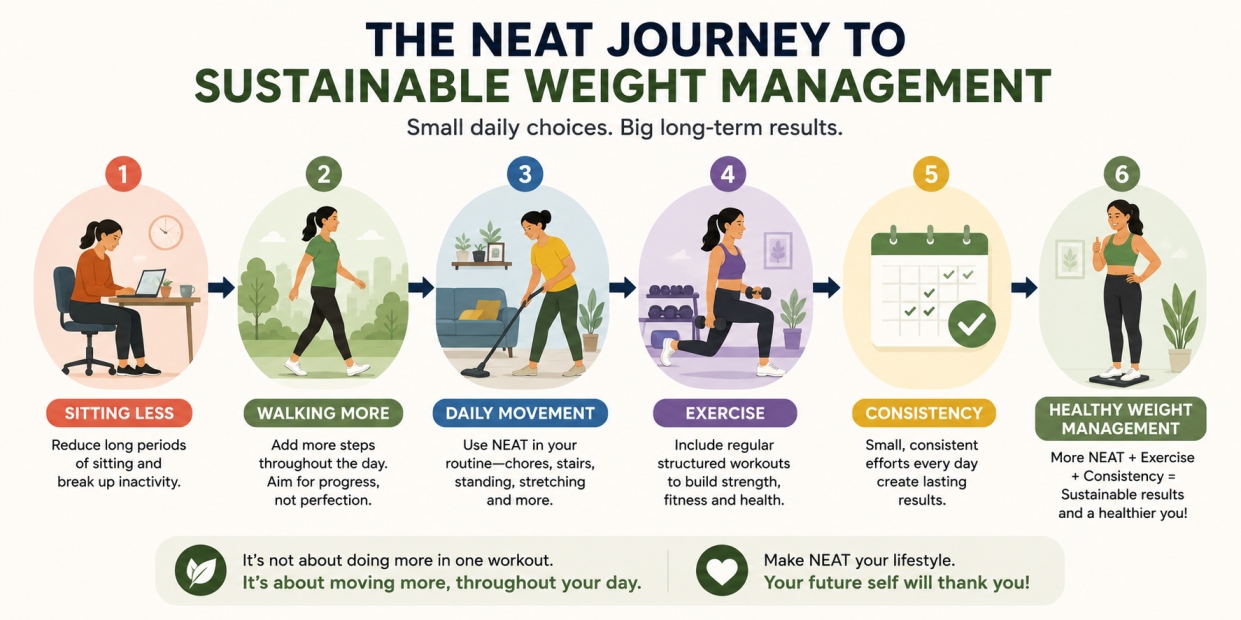
Walk more → Sit less → Move regularly → Stay consistent
Combined with balanced nutrition, structured exercise, adequate sleep, and recovery, everyday movement can become an important part of a sustainable approach to healthy weight management and long-term fitness.
Final Part — FAQ, Internal Links, External Links & Image Suggestions
FAQ Schema
1. What does NEAT stand for?
NEAT stands for Non-Exercise Activity Thermogenesis. It refers to the energy your body uses for everyday physical activities that are not planned exercise, sleeping, eating, or sports training.
2. What are examples of NEAT?
Walking around the house, standing, cooking, cleaning, shopping, gardening, taking stairs, walking during phone calls, and other everyday movements are examples of NEAT.
3. Does NEAT help with weight loss?
NEAT contributes to daily energy expenditure, so increasing everyday movement can support overall weight management. However, weight management depends on multiple factors, including nutrition, exercise, sleep, and individual health.
4. Is NEAT the same as exercise?
No. Exercise is usually planned and structured, such as running, strength training, or cycling. NEAT refers to everyday movement outside structured exercise.
5. How can I increase NEAT?
Simple strategies include walking more, taking stairs, standing during phone calls, taking movement breaks at work, walking after meals, and doing more household activities.
6. Does standing burn more calories than sitting?
Standing generally uses more energy than sitting, but the difference should not be exaggerated. The bigger goal is to reduce prolonged sitting by regularly changing positions and moving.
7. Can I increase NEAT if I have a desk job?
Yes. Desk workers can add movement by taking regular breaks, walking during phone calls, using stairs, walking to nearby colleagues, and taking short walks during breaks.
8. Does NEAT replace exercise?
No. NEAT and structured exercise provide different benefits. A healthy fitness routine can include both everyday movement and planned exercise.
9. Should I track NEAT calories?
You don't need to calculate every calorie burned through everyday movement. Fitness trackers and calorie estimates are not exact measurements of individual energy expenditure. Focus on building consistent movement habits.
10. How much NEAT should I get every day?
There is no universal NEAT target that applies to everyone. Your appropriate level of daily movement depends on your lifestyle, occupation, fitness, health, and overall activity.
Ready to Begin Your Health Journey?
Get a personalized, medically guided plan built around your unique biology.