Reverse Dieting Explained: Complete Guide
Reverse Dieting Explained: How to Increase Calories Without Regaining Weight
Losing weight is a major achievement, but maintaining that weight loss can often be even more challenging. Many people successfully follow a calorie-restricted diet for weeks or months, only to regain much of the lost weight once they begin eating normally again. This frustrating cycle, often called weight regain or yo-yo dieting, affects millions of people worldwide.
One strategy that has gained popularity among fitness professionals and nutrition experts is reverse dieting. Rather than immediately returning to your previous eating habits after a weight-loss diet, reverse dieting involves gradually increasing your daily calorie intake over time while monitoring body weight, energy levels, and overall health.
The idea behind reverse dieting is to help your body transition from a prolonged calorie deficit back to a maintenance level of eating without rapid fat gain. It may also improve energy levels, support exercise performance, reduce constant hunger, and make long-term weight maintenance easier.
Although reverse dieting has become increasingly popular, many people misunderstand what it actually involves. Some believe it allows unlimited eating after dieting, while others expect it to "reset" metabolism overnight. In reality, reverse dieting is a structured, gradual process that works best when combined with balanced nutrition, regular exercise, and consistent lifestyle habits.
In this comprehensive guide, you'll learn what reverse dieting is, how it works, who may benefit from it, the science behind metabolic adaptation, common myths, practical implementation strategies, and whether reverse dieting is the right approach for your health goals.https://www.who.int
What Is Reverse Dieting?
Reverse dieting is the gradual and planned increase of daily calorie intake after a period of calorie restriction or weight loss dieting.
Instead of suddenly returning to higher calorie intake, calories are increased slowly over several weeks while monitoring changes in:
Body weight
Body composition
Hunger levels
Energy levels
Exercise performance
Recovery
Overall well-being
The goal is to help your body adjust to higher energy intake while minimizing unnecessary fat gain.
Reverse dieting is commonly used by:
People who have completed a weight-loss program
Fitness competitors after competitions
Athletes after cutting phases
Individuals recovering from prolonged calorie restriction
People experiencing diet fatigue
Why Do People Gain Weight After Dieting?
Many people believe that once they reach their goal weight, they can immediately return to eating the way they did before starting their diet.
Unfortunately, this often leads to rapid weight regain.
Several biological changes occur during prolonged calorie restriction that make maintaining weight loss more difficult.
These include:
Reduced calorie expenditure
Increased hunger
Lower energy levels
Hormonal adaptations
Increased appetite
Reduced spontaneous physical activity
When calorie intake suddenly increases, these changes may promote fat storage more rapidly.
Reverse dieting aims to reduce this transition shock by increasing calories gradually instead of all at once.https://www.nih.gov
Understanding Metabolic Adaptation
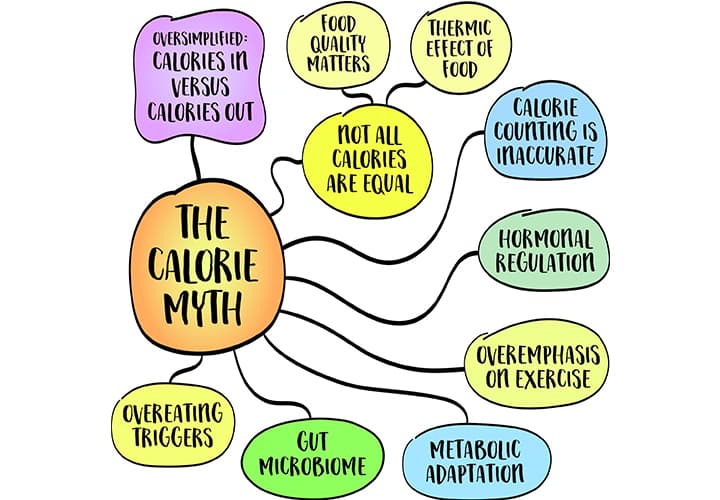
One of the main reasons reverse dieting has gained attention is a phenomenon known as metabolic adaptation, sometimes called adaptive thermogenesis.
When you consistently consume fewer calories than your body needs, it adapts in several ways to conserve energy.
These adaptations are a normal survival mechanism.
Your body may respond by:
Burning fewer calories at rest
Reducing spontaneous movement
Increasing hunger
Improving energy efficiency
Lowering exercise performance
Making weight loss slower over time
This doesn't mean your metabolism is "broken." Instead, it has adapted to lower energy availability.
Reverse dieting aims to help your body gradually adjust as calorie intake increases.
How Reverse Dieting Works
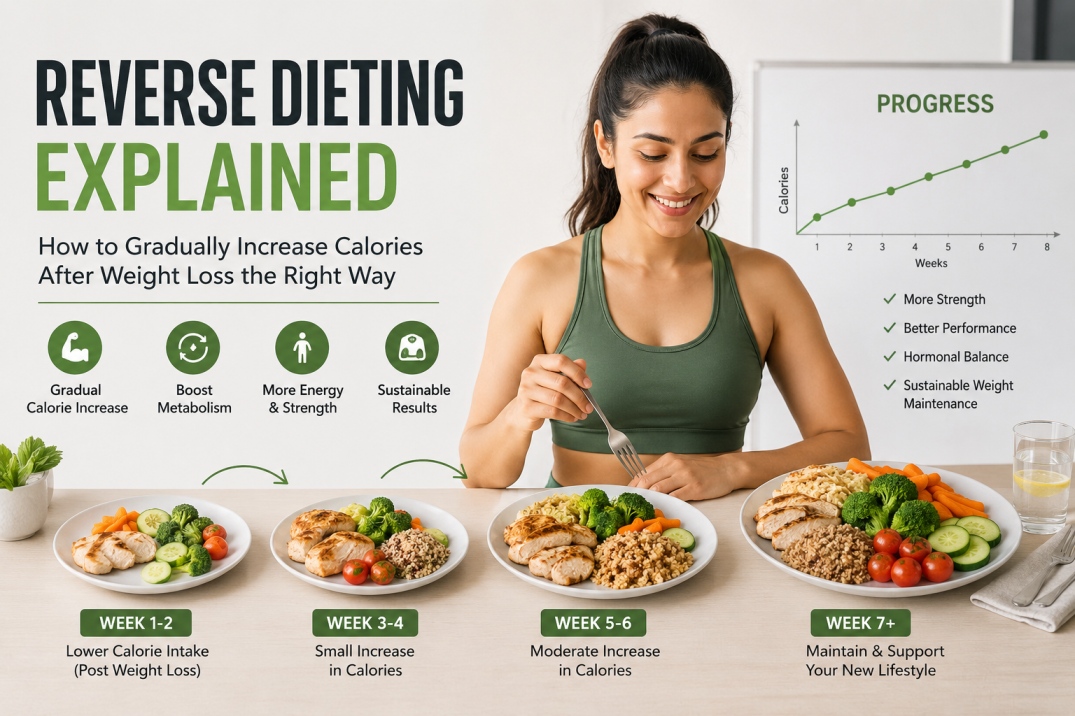
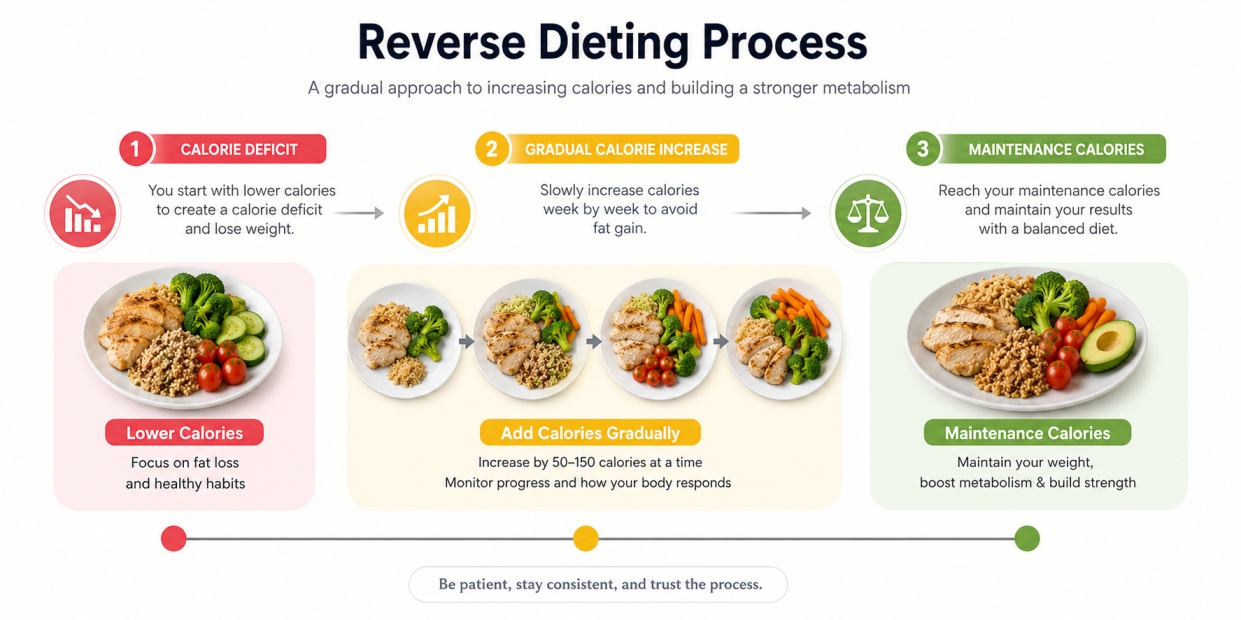
Reverse dieting typically involves increasing daily calories in small, controlled amounts over several weeks or months.
Instead of adding several hundred calories overnight, increases are made gradually while monitoring progress.
A typical approach may involve:
Starting from your current calorie intake.
Increasing calories by approximately 50–150 calories per week, depending on individual needs and progress.
Prioritizing nutrient-dense foods.
Continuing regular physical activity, including resistance training.
Monitoring body weight and waist circumference rather than relying on daily scale fluctuations.
The pace of calorie increases should be individualized based on goals, activity level, and how the body responds.
Potential Benefits of Reverse Dieting
Although scientific research specifically on reverse dieting is still limited, many people report practical benefits when the process is implemented thoughtfully.
Possible benefits include:
Easier transition out of a weight-loss diet
Improved energy levels
Better exercise performance
Reduced hunger and food cravings
Greater dietary flexibility
Support for long-term weight maintenance
Reduced feelings of restriction
Improved psychological relationship with food
It's important to remember that individual results vary, and reverse dieting should be viewed as one tool—not a guaranteed solution—for maintaining weight after dieting.
Who Should Consider Reverse Dieting?
Reverse dieting isn't necessary for everyone, but it may be helpful for people who have spent weeks or months in a calorie deficit and want to transition back to maintenance eating without quickly regaining weight.
You may benefit from reverse dieting if you:
· Have recently lost a significant amount of weight.
· Have been following a low-calorie diet for several months.
· Feel constantly hungry despite eating regularly.
· Notice reduced energy levels or workout performance.
· Have reached your weight-loss goal and want to maintain it.
· Want to gradually increase food intake while monitoring body weight.
· Are recovering from competition prep or an aggressive cutting phase.
Reverse dieting can provide a structured approach to increasing calories while continuing healthy lifestyle habits.
Who Should Avoid Reverse Dieting?
Reverse dieting is not appropriate for everyone.
It may not be the best strategy if you:
· Are still actively trying to lose weight.
· Have not yet established healthy eating habits.
· Have an eating disorder or a history of disordered eating (unless working with a qualified healthcare professional).
· Need a medically supervised nutrition plan due to chronic health conditions.
· Prefer a simple transition to maintenance eating rather than tracking calorie increases.
If you have diabetes, kidney disease, or other medical conditions, consult your healthcare provider or registered dietitian before making significant dietary changes.
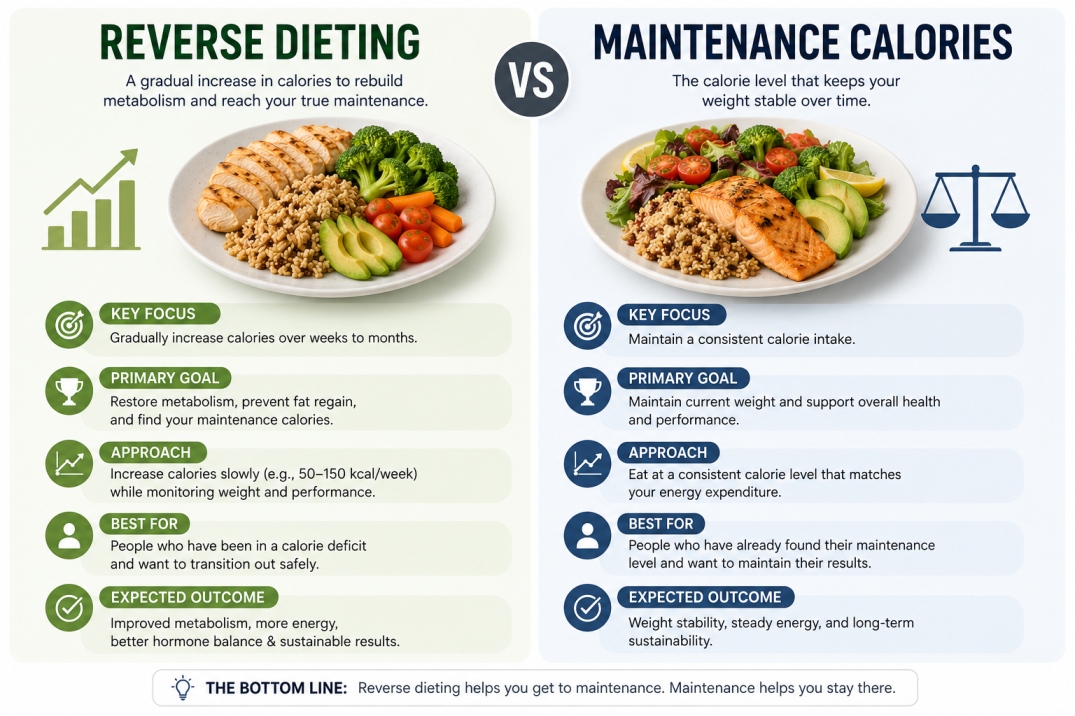
Reverse Dieting vs Maintenance Calories
These two concepts are often confused but serve different purposes.
Reverse Dieting
Maintenance Calories
Gradually increases calorie intake
Maintains calorie intake at a stable level
Used after prolonged calorie restriction
Used once maintenance intake has been reached
Small weekly calorie increases
Calories remain relatively constant
Focuses on transitioning safely
Focuses on maintaining body weight
Temporary strategy
Long-term eating approach
Think of reverse dieting as the bridge between a weight-loss diet and long-term weight maintenance.
Reverse Dieting vs Bulking
Reverse dieting is also different from bulking.
Reverse Dieting
Bulking
Gradual calorie increase
Intentional calorie surplus
Goal is weight maintenance
Goal is muscle gain
Minimize fat regain
Accept some fat gain for muscle growth
Small weekly adjustments
Larger calorie surplus
Often follows weight loss
Usually follows maintenance or cutting
Someone finishing a fat-loss phase may reverse diet to reach maintenance calories before deciding whether to bulk.
How to Start Reverse Dieting
A successful reverse diet is gradual, consistent, and personalized.
Step 1: Know Your Current Intake
Track your average daily calorie intake for several days.
This becomes your starting point.
Step 2: Increase Calories Slowly
Increase calories gradually rather than dramatically.
A common approach is adding approximately:
50–150 calories per week
The exact increase depends on:
· Activity level
· Weight-loss history
· Exercise routine
· Individual response
Step 3: Prioritize Protein
Continue eating enough protein to preserve lean muscle.
Aim for:
1.2–1.6 g protein per kg body weight
Include protein at every meal.
Step 4: Increase Mostly Carbohydrates and Healthy Fats
Protein intake often remains relatively stable.
Most additional calories typically come from:
Healthy carbohydrates
· Brown rice
· Oats
· Whole wheat
· Fruits
· Sweet potatoes
· Millets
Healthy fats
· Nuts
· Seeds
· Olive oil
· Avocado
· Peanut butter
Choose minimally processed foods whenever possible.
Step 5: Continue Strength Training
Resistance training helps direct extra calories toward muscle maintenance and performance rather than excess fat storage.
Aim for:
· 2–4 strength-training sessions weekly
· Regular walking
· Moderate cardio
Step 6: Monitor Progress Weekly
Instead of reacting to daily weight fluctuations, monitor trends over time.
Track:
· Body weight (once or twice weekly)
· Waist circumference
· Energy levels
· Hunger
· Workout performance
· Clothing fit
Small fluctuations are normal and often reflect changes in water or glycogen rather than body fat.
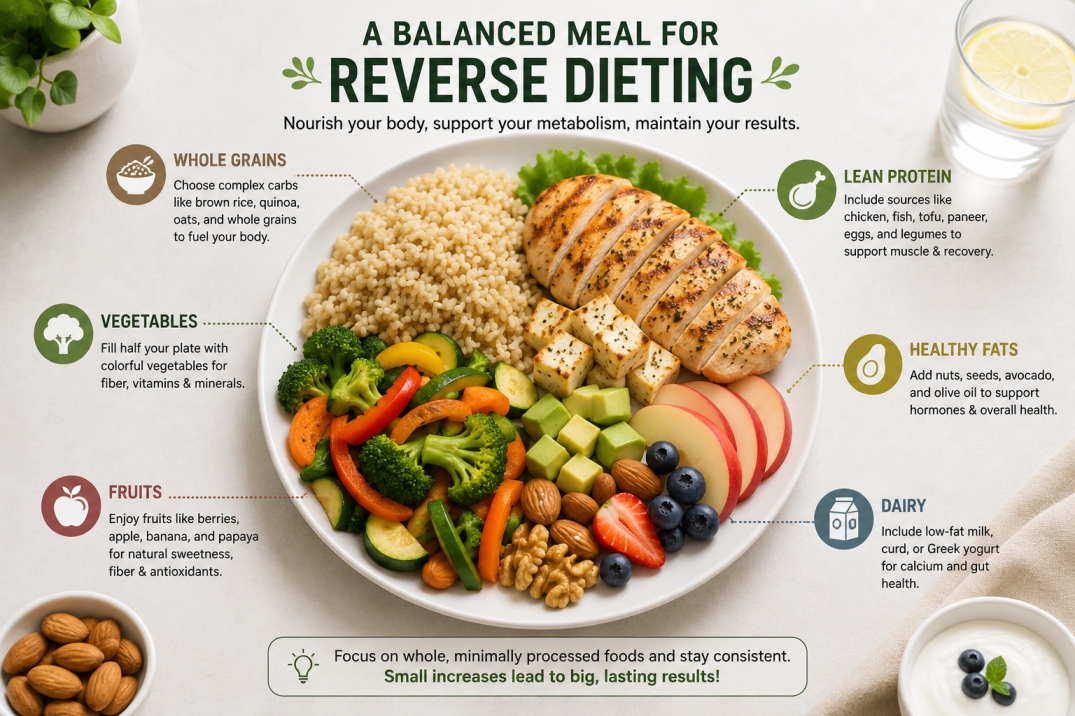
Best Foods During Reverse Dieting
Reverse dieting isn't about eating unlimited amounts of processed foods.
Instead, focus on nutrient-dense foods that support health and exercise performance.
Lean Protein
Examples:
· Chicken breast
· Fish
· Eggs
· Greek yogurt
· Paneer
· Tofu
· Lentils
· Chickpeas
· Soy chunks
Complex Carbohydrates
Healthy choices include:
· Brown rice
· Oats
· Quinoa
· Whole wheat
· Millets
· Sweet potatoes
· Fruits
· Beans
These foods replenish energy stores while providing fiber and essential nutrients.
Healthy Fats
Include moderate portions of:
· Almonds
· Walnuts
· Pistachios
· Chia seeds
· Flaxseeds
· Olive oil
· Peanut butter
· Avocado
Vegetables
Aim for a variety of colorful vegetables daily.
Examples:
· Broccoli
· Spinach
· Carrots
· Bell peppers
· Tomatoes
· Cauliflower
· Pumpkin
· Bottle gourd
Vegetables provide fiber, vitamins, minerals, and help maintain fullness.https://wellorafit.com/services/nutrition-diet-planning/
Foods to Limit
Reverse dieting is not an excuse to return to old eating habits.
Limit frequent consumption of:
· Sugary beverages
· Fast food
· Deep-fried snacks
· Cakes
· Pastries
· Candy
· Highly processed packaged foods
· Excess alcohol
Occasional treats can fit into a balanced eating pattern, but consistency matters most.
Sample Reverse Diet Meal Plan
Breakfast
· Vegetable oats cooked with milk
· Two boiled eggs or tofu scramble
· One fruit
Mid-Morning Snack
· Greek yogurt
· Mixed berries
· Chia seeds
Lunch
· Grilled chicken or paneer
· Brown rice
· Mixed vegetables
· Salad
Evening Snack
· Roasted chana
· Buttermilk
OR
· Apple with peanut butter
Dinner
· Fish or tofu
· Whole wheat chapati
· Dal
· Seasonal vegetables
Optional Bedtime Snack
· Warm milk
OR
· Cottage cheese
This balanced meal plan provides gradual calorie increases while supporting muscle maintenance and recovery.
Common Reverse Dieting Mistakes
1. Increasing Calories Too Quickly
Adding hundreds of calories overnight may increase fat gain.
Slow, gradual increases are generally easier for the body to adapt to.
2. Stopping Exercise
Physical activity remains important after weight loss.https://wellorafit.com/services/fitness-training/
Continue:
· Walking
· Strength training
· Daily movement
3. Ignoring Protein
Protein remains essential even after reaching your goal weight.
Maintain adequate intake to support lean muscle.
4. Focusing Only on the Scale
Small increases in body weight during reverse dieting may reflect:
· Glycogen storage
· Water retention
· Increased food volume
These changes do not necessarily indicate fat gain.
5. Eating Mostly Processed Foods
Increasing calories from highly processed foods can reduce nutritional quality and make long-term weight maintenance more difficult.
Choose mostly whole, minimally processed foods.
Does Reverse Dieting Really Work?
Reverse dieting has become increasingly popular among fitness professionals, athletes, and people who have successfully lost weight. However, many people wonder whether it truly works or whether it is simply another nutrition trend.
The answer is more nuanced than a simple yes or no.
While many individuals report positive experiences with reverse dieting, scientific research specifically on reverse dieting remains limited. Most of the current understanding comes from research on metabolism, weight maintenance, adaptive thermogenesis, and long-term energy balance rather than reverse dieting itself.
Current evidence suggests that reverse dieting may help some people transition more comfortably from a calorie-restricted diet to maintenance eating by:
· Gradually increasing calorie intake
· Supporting exercise performance
· Reducing feelings of restriction
· Improving energy levels
· Making long-term healthy eating easier
However, it should not be viewed as a guaranteed method to "repair" metabolism or completely prevent fat regain.
What Does Science Say About Reverse Dieting?
Although researchers continue studying reverse dieting, several well-established scientific principles help explain why it may be beneficial for some people.
1. Adaptive Thermogenesis Is Real
During prolonged calorie restriction, the body naturally conserves energy.
This process includes:
· Lower resting metabolic rate
· Reduced physical activity
· Increased hunger hormones
· Lower fullness hormones
· Greater energy efficiency
These changes are part of the body's normal survival response and are well documented in nutrition research.
Reverse dieting attempts to account for these changes by increasing calories gradually rather than abruptly.
2. Muscle Preservation Supports Metabolism
Muscle tissue burns more calories than fat tissue, even at rest.
Maintaining muscle during and after weight loss helps support:
· Higher resting energy expenditure
· Better exercise performance
· Improved body composition
· Long-term weight maintenance
This is why reverse dieting usually emphasizes:
· Adequate protein intake
· Resistance training
· Progressive calorie increases
3. Long-Term Habits Matter Most
Research consistently shows that people who successfully maintain weight loss tend to:
· Stay physically active
· Continue monitoring body weight
· Eat balanced meals
· Consume adequate protein
· Maintain consistent eating habits
Reverse dieting works best when combined with these long-term healthy behaviors.
Reverse Dieting for Women
Women often experience additional hormonal changes during and after dieting that can influence appetite, energy levels, and weight maintenance.
Reverse dieting may be particularly useful for women who have:
· Completed a prolonged weight-loss program
· Experienced very low-calorie dieting
· Lost a significant amount of weight
· Participated in physique competitions
· Noticed reduced exercise performance
Gradually increasing calories while continuing resistance training may help improve:
· Energy
· Workout recovery
· Mood
· Dietary flexibility
· Overall well-being
Women should avoid extremely restrictive diets whenever possible, as long-term severe calorie restriction may negatively affect hormonal health and nutritional status.
Reverse Dieting After Extreme Diets
Many people follow:
· Crash diets
· Detox diets
· Juice cleanses
· Very low-calorie diets
· Meal replacement programs
These approaches often produce rapid weight loss but are difficult to maintain.
Returning immediately to previous eating habits frequently results in rapid weight regain.
Reverse dieting offers a more gradual transition by slowly increasing calorie intake while reinforcing healthy eating habits.
This approach may feel more manageable and sustainable than abruptly ending a restrictive diet.
Signs Your Body May Be Ready for Reverse Dieting
You may be ready to begin reverse dieting if:
· You've reached your weight-loss goal.
· You've maintained your calorie deficit consistently.
· Your weight has stabilized.
· You feel constantly hungry.
· Your workouts feel increasingly difficult.
· Your energy levels are lower than usual.
· You want to transition toward maintenance eating.
These signs don't automatically mean reverse dieting is necessary, but they may indicate it's time to reassess your nutrition strategy.
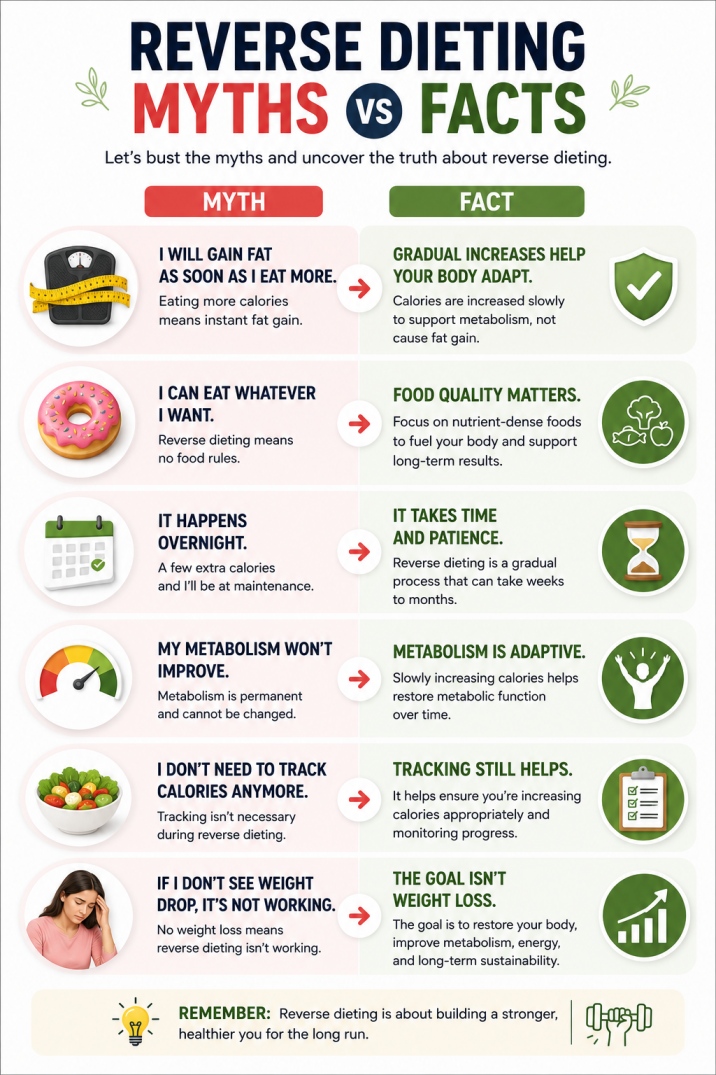
Reverse Dieting Myths vs Facts
Myth 1: Reverse dieting lets you eat anything you want.
Fact
Reverse dieting is not unlimited eating.
Calories are increased gradually while maintaining balanced, nutritious meals.
Myth 2: Reverse dieting instantly repairs metabolism.
Fact
Metabolism adapts over time, and any changes during recovery also occur gradually.
There is no evidence that reverse dieting produces an immediate "metabolic reset."
Myth 3: Everyone needs reverse dieting.
Fact
Not everyone benefits from reverse dieting.
Many people can transition directly to maintenance calories successfully, especially after moderate calorie restriction.
Myth 4: Weight gain during reverse dieting means failure.
Fact
Small increases in body weight often result from:
· Increased glycogen stores
· Water retention
· Greater food volume in the digestive tract
These changes do not necessarily represent body fat gain.
Myth 5: Reverse dieting replaces exercise.
Fact
Regular physical activity remains one of the most important factors for maintaining weight loss.
Exercise should continue throughout the reverse dieting process.
Daily Habits for Successful Reverse Dieting
Consistency matters far more than perfection.
Nutrition
✔ Increase calories gradually.
✔ Eat plenty of vegetables.
✔ Prioritize lean protein.
✔ Choose whole grains.
✔ Include healthy fats.
✔ Stay hydrated.
Exercise
Continue:
· Strength training 2–4 times weekly
· Walking daily
· Moderate cardiovascular exercise
· Mobility exercises
Maintaining muscle mass supports long-term weight maintenance.
Lifestyle
Aim to:
· Sleep 7–9 hours
· Manage stress
· Eat meals consistently
· Avoid frequent crash dieting
· Monitor progress weekly rather than daily
Practical Tips for Long-Term Weight Maintenance
Successfully maintaining weight loss requires ongoing healthy habits.
1. Continue Meal Planning
Planning meals reduces impulsive eating and helps maintain balanced nutrition.
2. Stay Physically Active
Aim for:
· 150–300 minutes of moderate physical activity each week
· Strength training at least 2–3 times weekly
3. Monitor Progress
Track:
· Body weight (weekly)
· Waist circumference
· Clothing fit
· Energy levels
· Workout performance
Avoid becoming discouraged by normal day-to-day fluctuations.
4. Allow Flexibility
Healthy eating does not require perfection.
Enjoy occasional treats while returning to balanced eating at the next meal.
One meal does not determine long-term success.
5. Keep Protein Intake Adequate
Protein continues to support:
· Muscle maintenance
· Satiety
· Recovery
· Healthy metabolism
Continue including protein at every meal.
When Should You Seek Professional Guidance?
Working with a registered dietitian or healthcare professional may be beneficial if you:
· Lost a large amount of weight.
· Have diabetes, PCOS, thyroid disease, or another medical condition.
· Are unsure how many calories to increase.
· Experience persistent fatigue or poor exercise recovery.
· Have a history of disordered eating.
· Need an individualized nutrition plan.
Professional guidance can help tailor calorie increases, monitor progress, and ensure nutritional adequacy.
Reverse Dieting Success Checklist
✔ Increase calories gradually.
✔ Continue resistance training.
✔ Eat enough protein.
✔ Choose nutrient-dense foods.
✔ Stay hydrated.
✔ Prioritize quality sleep.
✔ Manage stress.
✔ Monitor progress weekly.
✔ Avoid returning to old eating habits.
✔ Focus on long-term consistency instead of short-term perfection.
Key Takeaways
· Reverse dieting is a structured approach to gradually increasing calorie intake after a period of calorie restriction.
· It is designed to help transition from a weight-loss phase to maintenance while supporting healthy eating habits.
· Reverse dieting may improve energy levels, workout performance, and dietary flexibility after prolonged dieting.
· Adaptive thermogenesis (metabolic adaptation) is a normal response to calorie restriction, not a permanently "damaged" metabolism.
· Strength training, adequate protein intake, and regular physical activity remain essential during reverse dieting.
· Most calorie increases should come from nutrient-dense foods rather than highly processed foods.
· Not everyone needs reverse dieting, but it may be useful for people who have followed long-term or aggressive calorie-restricted diets.
· Long-term weight maintenance depends more on consistent healthy habits than any single nutrition strategy.
Conclusion
Losing weight is an important achievement, but maintaining those results requires a thoughtful and sustainable approach. Many people experience increased hunger, lower energy levels, and gradual weight regain after finishing a calorie-restricted diet. Reverse dieting offers a structured way to transition out of a weight-loss phase by gradually increasing calorie intake instead of returning immediately to previous eating habits.
Although scientific research specifically on reverse dieting is still emerging, the principles behind it are grounded in established nutrition science. Gradually increasing calories, continuing resistance training, prioritizing protein, and monitoring progress can help many individuals feel more energized and confident as they move toward long-term weight maintenance.
It is important to remember that reverse dieting is not a shortcut for eating unlimited amounts of food or a guaranteed way to "reset" metabolism. Rather, it is one of several tools that may support a smoother transition after weight loss when combined with balanced nutrition, regular physical activity, quality sleep, and stress management.
Ultimately, successful weight maintenance is built on consistency—not perfection. Developing lifelong habits such as eating nutrient-dense foods, staying active, monitoring your progress, and making gradual adjustments when needed will have a far greater impact than any short-term diet strategy.
If you've recently completed a weight-loss journey and are unsure how to increase calories safely, working with a registered dietitian or qualified healthcare professional can help you create an individualized plan that supports your health goals while minimizing the risk of weight regain.
Frequently Asked Questions (FAQ Schema)
1. What is reverse dieting?
Reverse dieting is the gradual increase of daily calorie intake after a period of calorie restriction or weight loss. The goal is to transition toward maintenance calories while supporting long-term weight management and healthy eating habits.
2. Does reverse dieting work?
Reverse dieting may help some people transition more comfortably after dieting by gradually increasing calories, improving energy levels, and reducing feelings of restriction. However, research specifically on reverse dieting is still limited, and results vary between individuals.
3. How many calories should I increase during reverse dieting?
Many reverse dieting plans increase calorie intake by approximately 50–150 calories per week, although the ideal amount depends on individual factors such as activity level, body weight, weight-loss history, and personal goals.
4. Can reverse dieting boost metabolism?
Reverse dieting does not instantly "repair" or dramatically increase metabolism. However, gradually increasing calorie intake while maintaining muscle mass and physical activity may help the body adjust after prolonged calorie restriction.
5. Will I gain weight during reverse dieting?
Small increases in body weight may occur due to greater glycogen storage, increased water retention, and more food in the digestive system. These changes do not necessarily represent body fat gain.
6. Is reverse dieting necessary after every diet?
No. Many people can transition directly to maintenance calories without following a structured reverse diet. Reverse dieting may be more beneficial after prolonged or aggressive calorie restriction.
7. What foods should I eat while reverse dieting?
Focus on nutrient-dense foods such as:
· Lean protein
· Whole grains
· Fruits
· Vegetables
· Legumes
· Healthy fats
· Dairy or fortified alternatives
Limit highly processed foods and sugary beverages.
8. Should I continue exercising during reverse dieting?
Yes. Regular physical activity—especially resistance training—helps maintain muscle mass, supports exercise performance, and contributes to long-term weight maintenance.
9. How long should reverse dieting last?
The duration varies depending on your starting calorie intake, goals, and progress. Some people reverse diet for several weeks, while others may continue for a few months until they reach a sustainable maintenance calorie intake.
10. Who should avoid reverse dieting?
Reverse dieting may not be appropriate for everyone, including people with certain medical conditions or a history of eating disorders. If you're unsure whether it's right for you, consult a registered dietitian or healthcare professional for personalized guidance.
Ready to Begin Your Health Journey?
Get a personalized, medically guided plan built around your unique biology.