Smart Food Swaps for a Healthier Indian Diet
Eating healthier does not mean giving up Indian food.
You do not need to stop eating roti.
You do not need to completely eliminate rice.
You do not need to avoid potatoes.
And you definitely do not need to survive on salads.
A healthier Indian diet is often about making small, practical changes to the foods you already eat.
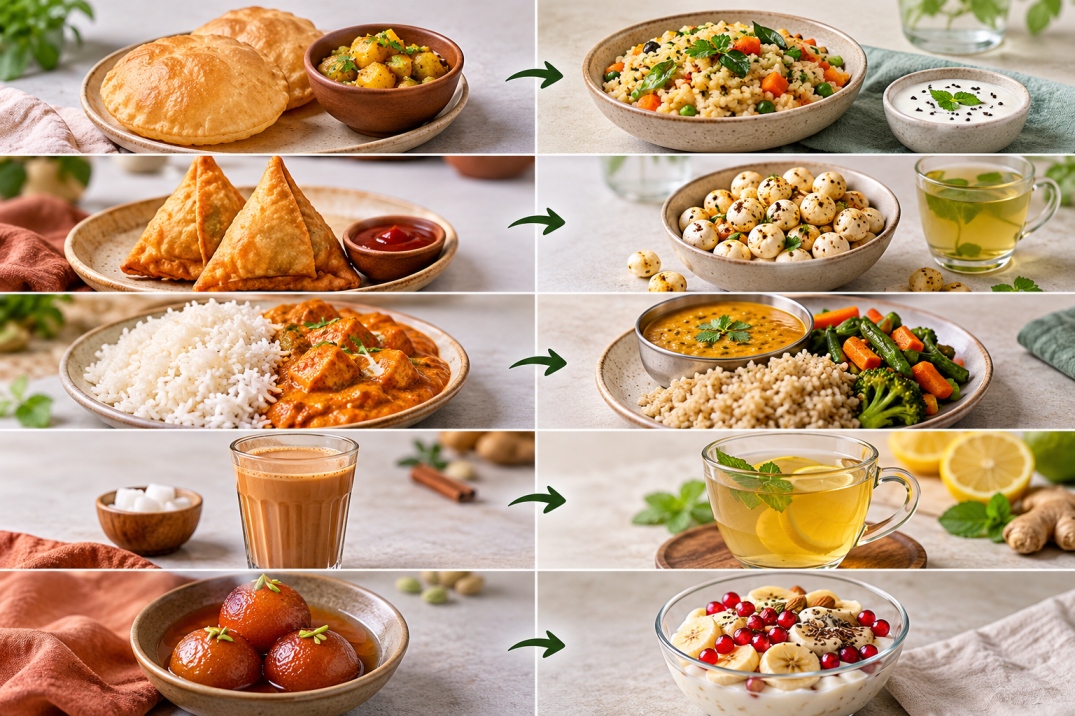
Instead of completely changing your meals, you can make simple swaps such as:
refined grain → whole grain
sugary drink → unsweetened beverage
deep-fried snack → roasted or steamed option
low-protein breakfast → protein-containing breakfast
large portion → appropriate portion
These changes may seem small individually, but repeated consistently, they can improve the overall quality of your diet.
WHO recommends a varied diet that includes vegetables, fruits, legumes, whole grains, nuts and appropriate protein sources while limiting excess salt, free sugars and unhealthy fats.
The goal is not to make your food "perfect."
The goal is to make your everyday food a little better.https://www.who.int/health-topics/healthy-diet
What Is a Food Swap?
A food swap simply means replacing one food or preparation with another option that provides a more favorable nutritional profile for your individual goal.
For example:
Sugary soft drink → water or unsweetened lemon water
Maida-based snack → whole-grain or pulse-based option
Deep-fried pakoda → baked/air-fried or steamed preparation
Sweetened flavored yogurt → plain curd + fruit
The best swap is one that is:
Practical
Affordable
Enjoyable
Culturally familiar
Sustainable
Appropriate for your nutritional needs
A food swap should not make healthy eating feel like punishment.
Why Small Food Swaps Matter
Many people think healthy eating requires a complete diet makeover.
It usually doesn't.
Consider how often certain foods appear in your routine:
Morning tea
Breakfast
Office snack
Lunch
Evening snack
Dinner
Dessert
Weekend meals
If you make a small improvement in several of these areas, your overall dietary pattern can change substantially.
For example:
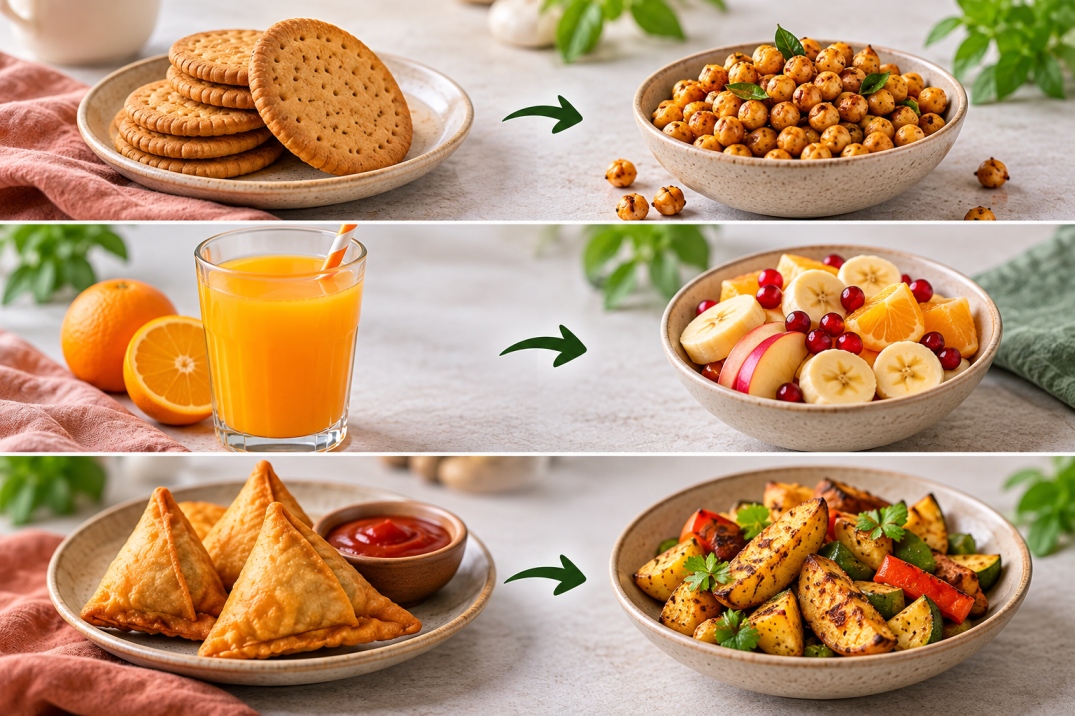
Tea + 4 biscuits every day
could become:
Tea with little/no added sugar + roasted chana
Or:
Fried namkeen every evening
could become:
Roasted chana + fruit
The purpose isn't to label the original food "bad."
It is simply to make a more nutrient-dense choice more often.
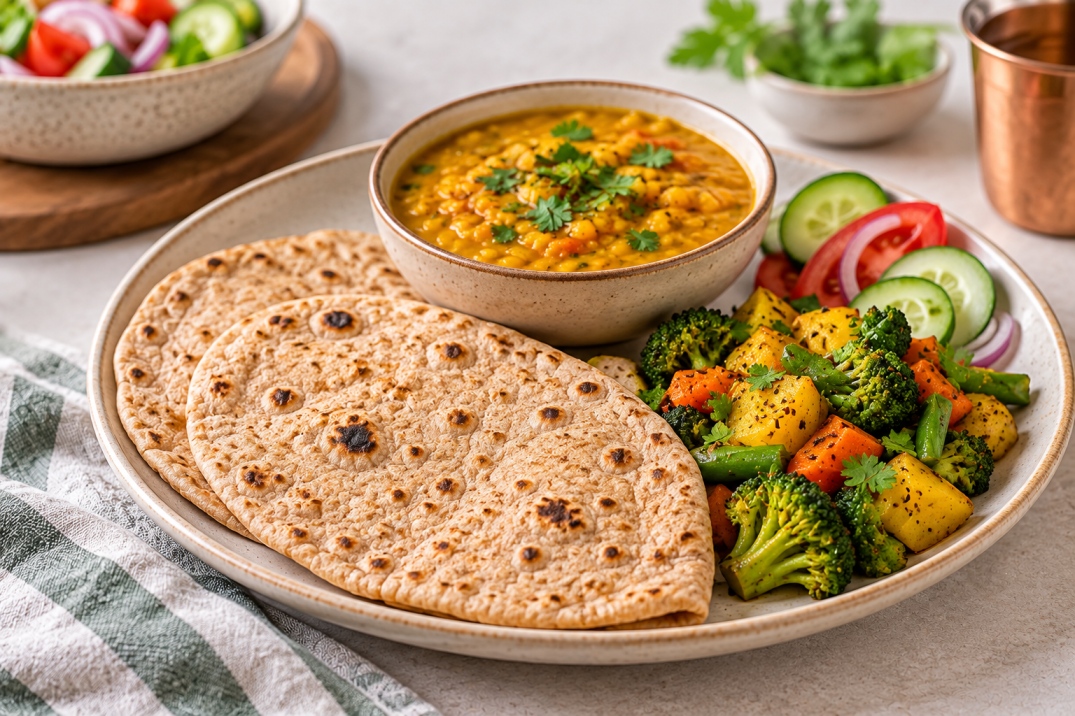
1. Maida Roti → Whole-Wheat Roti
One of the simplest swaps is choosing whole-grain options more often.
Instead of:
Refined flour-based breads, wraps or rotis as your regular staple.
Try:
Whole-wheat roti
Multigrain roti
Dalia
Oats
Barley
Other minimally processed whole grains
Whole grains generally provide more fiber and nutrients than refined grains.
WHO recommends obtaining much of dietary carbohydrate from foods such as whole grains and legumes.
Important:
"Multigrain" does not automatically mean healthier.
Check the ingredient list and choose products where whole grains are genuinely prominent.https://www.nin.res.in/dietaryguidelines/dietaryguidelines.html
2. Refined Breakfast Cereal → Dalia or Oats
Some breakfast cereals can contain significant amounts of added sugar.
Instead, consider:
Swap:
Sugary cereal → vegetable dalia
or
Sugary cereal → oats + milk/curd + nuts/seeds + fruit
This can increase fiber and make breakfast more substantial.
Indian options:
Vegetable dalia
Oats upma
Oats chilla
Savory oats
Dalia with vegetables and curd
The goal isn't that oats are magically healthier than every other grain.
The goal is choosing a less processed, nutrient-dense breakfast that fits your needs.
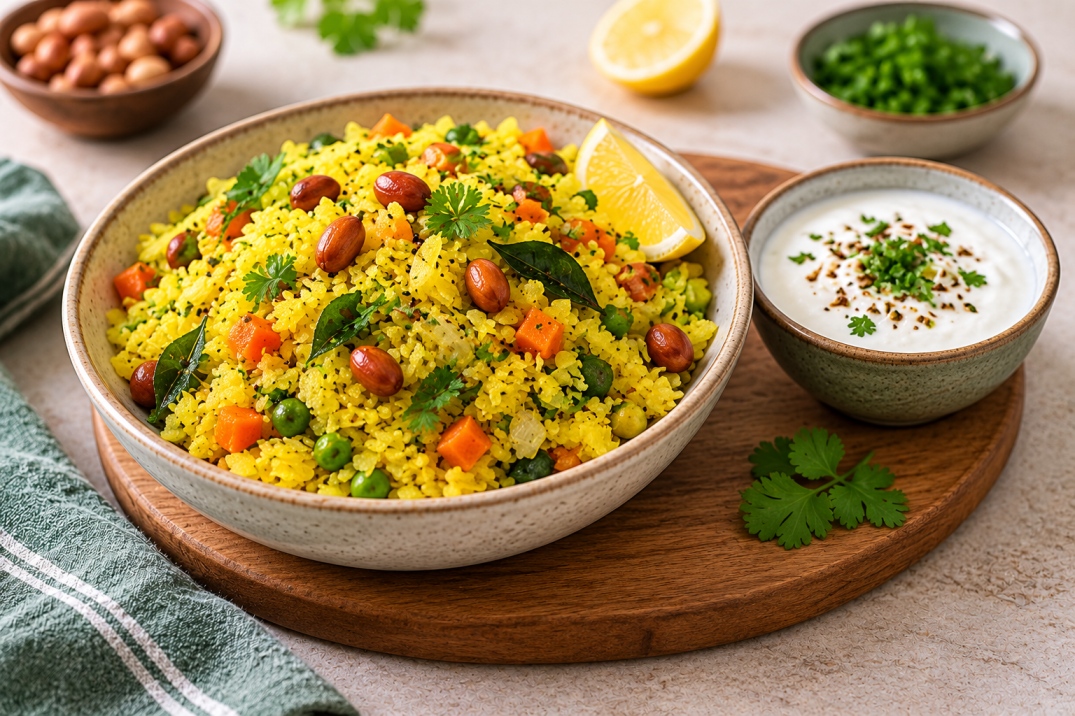
3. Plain Poha → Vegetable Poha + Protein
Poha can absolutely be part of a healthy diet.
You don't need to replace it.
Instead, improve the meal.
Instead of:
Large bowl of plain poha
Try:
Moderate portion vegetable poha + peanuts + curd
Add:
Peas
Carrot
Capsicum
Onion
Tomato
Coriander
Lemon
This creates a more balanced meal.
4. Plain Paratha → Vegetable-Stuffed Paratha
You don't have to eliminate paratha.
Instead of:
Plain paratha made with a large amount of oil/ghee.
Try:
Vegetable-stuffed whole-wheat paratha + curd
Fillings can include:
Methi
Palak
Gobi
Mooli
Mixed vegetables
Paneer in appropriate portions
Use the amount of oil or ghee appropriate for your overall dietary needs.
The important swap:
More filling + vegetables + controlled cooking fat
rather than simply "paratha = unhealthy."
5. Aloo Paratha → Aloo + Vegetable/Protein-Rich Paratha
Potatoes are not inherently unhealthy.
The issue is often the overall meal composition and preparation.
Instead of making the filling almost entirely potato, try:
Aloo + methi
Aloo + gobi
Aloo + peas
or
Aloo + paneer
Serve with:
Plain curd + vegetable side
This adds variety and improves the overall nutrient balance.
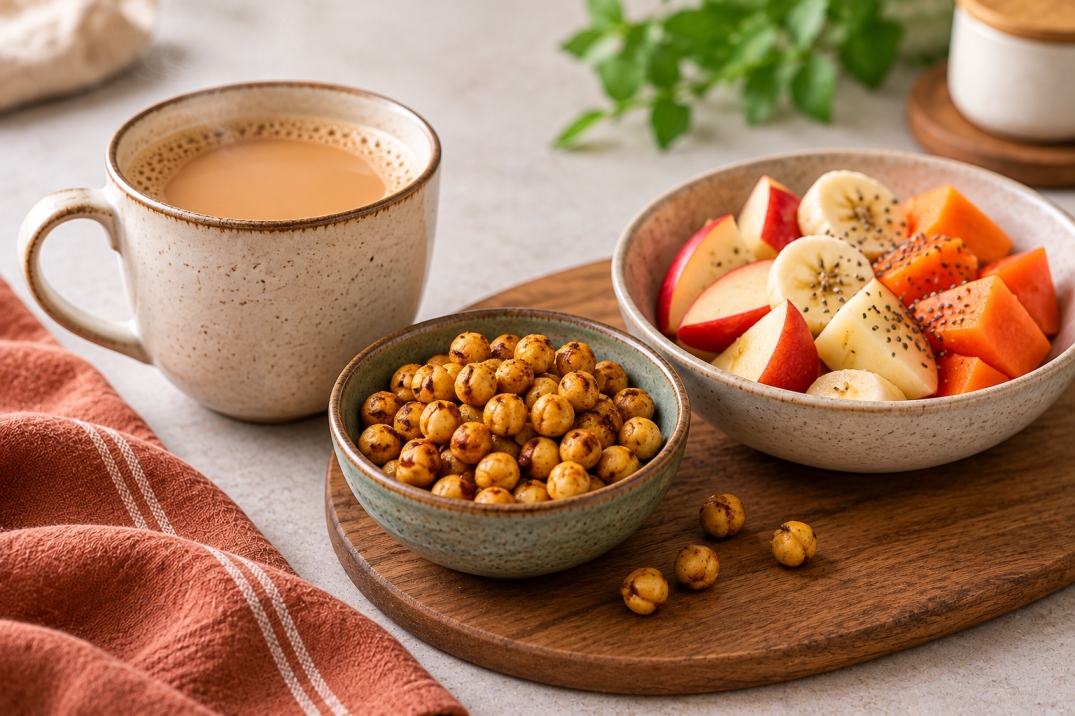
6. Biscuits With Tea → Roasted Chana
This is one of the easiest everyday swaps.
Instead of:
Tea + several biscuits
Try:
Tea + roasted chana
or
Tea + a small portion of nuts
or
Tea + fruit
Many biscuits are made primarily from refined flour, added sugar and fat.
The goal is not that biscuits can never be eaten.
It is simply to avoid making them the automatic everyday snack.
7. Namkeen → Roasted Chana or Homemade Chaat
Packaged namkeen can be high in salt and fat depending on the product and portion.
Swap:
Namkeen → roasted chana
or
Namkeen → homemade chana chaat
or
Namkeen → roasted makhana + roasted chana
For more flavor, use:
Lemon
Coriander
Cumin
Chaat masala in moderation
Black pepper
This allows you to keep the crunchy texture without relying on a packaged snack every day.
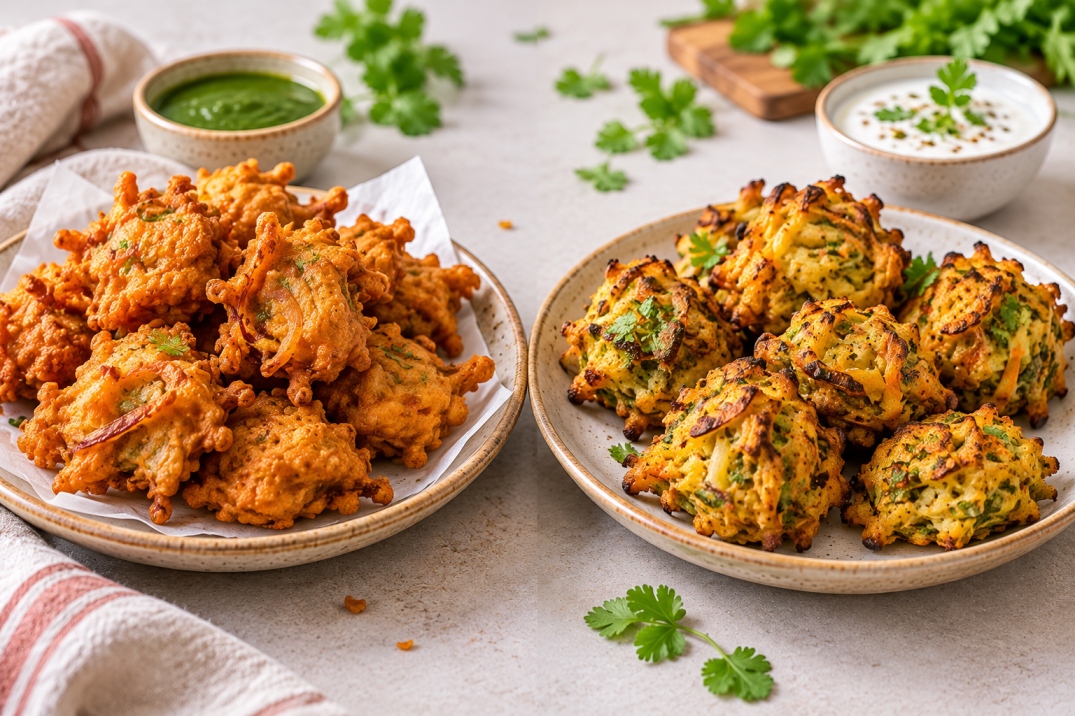
8. Fried Pakoda → Steamed/Baked/Air-Fried Version
You don't have to give up pakoda completely.
Change the preparation method when practical.
Instead of:
Deep-fried pakoda
Try:
Air-fried pakoda
Oven-baked pakoda
Steamed dhokla
Vegetable chilla
Besan chilla
Cooking methods such as steaming, boiling and baking can reduce the amount of added fat compared with deep-frying. WHO also recommends limiting foods high in unhealthy fats and choosing healthier cooking approaches.
9. Deep-Fried Samosa → Baked/Smaller Portion + Protein
Samosa doesn't have to be banned.
Instead, consider:
One smaller samosa + unsweetened beverage + protein-rich side
rather than:
Several samosas + sugary drink
Or choose a baked version when available.
Remember:
A healthier eating pattern does not require eliminating every fried food.
Frequency + portion + overall diet matter.
10. Sugary Tea → Less Sugar Tea
Tea itself does not need to be removed.
The easy swap is:
Reduce the amount of sugar gradually.
For example:
If you normally use:
2 teaspoons → 1½ → 1 → ½ → little/no added sugar
Your taste preference can adapt over time.
The same principle applies to:
Coffee
Milkshakes
Homemade drinks
Other sweetened beverages
WHO recommends limiting free sugars as part of a healthy diet.
11. Soft Drinks → Water or Unsweetened Drinks
This is one of the highest-impact simple swaps for people who regularly drink sugary beverages.
Instead of:
Cola
Sweetened soda
Sugary packaged drinks
Sweetened iced tea
Try:
Water
Sparkling water without added sugar
Unsweetened lemon water
Unsweetened tea
Unsweetened coffee
Buttermilk without added sugar
Sugary beverages can provide substantial amounts of free sugar without contributing much nutritional value.
12. Packaged Fruit Juice → Whole Fruit
A glass of fruit juice may sound healthy.
But whole fruit provides something juice does not provide in the same way:
intact fiber and the act of chewing.
Instead of:
Packaged fruit juice
Try:
Orange
Guava
Apple
Papaya
Watermelon
Pomegranate
Seasonal fruit
Whole fruit is generally the more useful everyday choice.
13. Flavored Yogurt → Plain Curd + Fruit
Flavored yogurt products can contain added sugar depending on the product.
Swap:
Sweetened flavored yogurt → plain curd + fruit
You can add:
Cinnamon
Chia seeds
Flaxseed powder
A few nuts
This gives you control over sweetness and portion.
14. Sweet Lassi → Unsweetened Chaas
Traditional dairy beverages can be nutritious, but added sugar can significantly change their calorie and sugar content.
Instead of:
Large glass of sweet lassi
Try:
Unsweetened chaas
Add:
Roasted cumin
Coriander
Mint
Ginger
This can be a refreshing everyday option.
15. Creamy Restaurant Gravy → Home-Cooked Vegetable/Dal Gravy
Restaurant gravies may contain substantial amounts of oil, cream, butter or other fats depending on the preparation.
At home:
Use:
Tomato
Onion
Curd
Spices
Vegetables
Dal
Appropriate cooking oil
This gives you greater control over ingredients and portion sizes.
16. Fried Papad → Roasted Papad
Papad can be part of an Indian meal.
The easiest swap is:
Deep-fried papad → roasted papad
But remember:
Papad can still be relatively high in sodium.
So the better approach is:
Roasted + moderate portion + not at every meal
This is particularly relevant if you need to limit sodium.
17. Pickle → Smaller Portion of Pickle + Fresh Chutney
Pickles can add flavor to an otherwise simple meal.
You don't necessarily need to remove them.
But many pickles contain substantial amounts of salt and oil.
Instead of:
Large serving of pickle
Try:
Small amount of pickle + fresh mint/coriander chutney
Fresh chutneys can provide flavor without relying entirely on salty pickles.
If you have a medical need to restrict sodium, your individual plan may require stricter limits.
18. Mayonnaise → Hung Curd-Based Spread
Mayonnaise can be calorie-dense.
For sandwiches and wraps, try:
Hung curd + herbs + lemon + pepper
or
Curd + mint + coriander
This creates a creamy spread while adding some protein.
19. Buttered Toast → Egg/Paneer Vegetable Toast
Instead of making butter the main component of your breakfast:
Try:
Whole-wheat toast + egg + vegetables
or
Whole-wheat toast + paneer + vegetables
This changes the meal from primarily refined carbohydrate + fat into a more balanced combination.
20. Potato Chips → Roasted Makhana
For a crunchy snack:
Swap:
Potato chips → roasted makhana
Season with:
Black pepper
Cumin
Paprika
Turmeric
Keep salt moderate.
Another option:
Roasted chana + makhana
This adds more protein and fiber than makhana alone.
21. Instant Noodles → Vegetable Noodles + Protein
Instant noodles are convenient, but they may be high in sodium and relatively low in protein and vegetables.
Instead of:
A packet of instant noodles alone
Try:
Whole-wheat noodles where available
Plenty of vegetables
Egg/tofu/paneer/chicken
Homemade seasoning
Example:
Vegetable noodles + egg + cucumber salad
The goal is to turn a convenience meal into a more balanced meal.
22. White Rice → Brown Rice/Hand-Pounded Rice/Mixed Grain Options
White rice is not "bad."
Rice can absolutely be part of a healthy Indian diet.
However, if you want more fiber and a less refined grain option, you can sometimes swap:
Highly polished white rice → hand-pounded rice/brown rice or other whole-grain options
You can also simply improve the meal by pairing rice with:
Dal + vegetables + curd
The overall meal matters.
ICMR-NIN's 2024 Dietary Guidelines recognize whole grains, minimally polished rice, whole wheat, millets, oats and legumes among minimally processed food choices.
23. Large Rice Portion → Smaller Rice Portion + More Dal and Vegetables
You don't necessarily have to remove rice to manage your weight.
Try changing the plate.
Instead of:
Large bowl of rice + little dal + little vegetables
Try:
Moderate rice portion + generous dal + vegetables + salad
This increases the overall variety of the meal without making rice the "enemy."
24. Refined Flour Noodles → Vegetable Dalia/Khichdi
If noodles are your regular quick meal, consider rotating them with:
Vegetable dalia
Vegetable khichdi
Moong dal khichdi
Vegetable poha
Millet-based meals
Whole-wheat options
This can increase the variety of whole grains, pulses and vegetables in your diet.
25. Dessert Every Day → Fruit-Based Dessert More Often
You don't need to stop eating dessert.
Instead, change the frequency and type.
Try:
Ice cream → fruit + curd
Sweetened yogurt → plain curd + fruit
Large dessert → smaller portion
Daily dessert → occasional dessert
The aim is not to remove enjoyment from food.
It's to make highly sugary foods less routine.
26. Sugar → Natural Sweetness From Fruit
If you regularly add sugar to:
Oats
Curd
Breakfast bowls
Smoothies
try using fruit for sweetness.
Examples:
Plain curd + banana
Oats + apple + cinnamon
Milk + fruit
However, remember that honey, jaggery and syrups are still sources of sugar. Simply replacing white sugar with jaggery does not make a food automatically "sugar-free" or calorie-free.
27. Ghee in Large Amounts → Measured Cooking Fat
Ghee can be part of an Indian diet.
The issue is usually quantity and overall dietary pattern, not the existence of ghee itself.
Instead of:
Adding generous amounts of ghee to every meal.
Try:
Using a measured amount of:
Vegetable oil
Groundnut oil
Mustard oil
Sesame oil
Other suitable oils
and using ghee occasionally for flavor.
WHO recommends shifting fat intake away from saturated and trans fats toward unsaturated fats.
28. Fried Snacks → Roasted Snacks
A simple preparation swap:
Instead of
Try
Fried chana
Roasted chana
Fried papad
Roasted papad
Fried makhana
Roasted makhana
Deep-fried peanuts
Dry-roasted peanuts
Fried potatoes
Roasted/air-fried potatoes
Fried sweet potato
Baked/roasted sweet potato
This does not make every roasted food automatically healthy, but it can reduce added cooking fat.
29. Creamy Salad Dressing → Lemon/Curd-Based Dressing
If you eat salads but cover them in calorie-dense dressings, the nutritional advantage of the vegetables can be offset by the dressing.
Try:
Lemon
Curd
Mint
Coriander
Black pepper
Roasted cumin
This keeps the salad flavorful without requiring a heavy dressing.
30. "Diet Food" → Real Food
One of the most important swaps is psychological.
Instead of constantly searching for:
diet biscuits
diet namkeen
fat-free desserts
detox drinks
focus on ordinary foods in appropriate portions.
Examples:
Fruit
Dal
Vegetables
Curd
Eggs
Whole grains
Nuts
Seeds
Homemade meals
A healthier diet does not need to look like a package of "diet food."
The Indian Plate: Make the Meal Better, Not Smaller
A common mistake during weight loss is simply reducing everything on the plate.
Instead, improve the composition.
A balanced meal can include:
Vegetables
Increase variety and volume.
Protein
Dal, beans, curd, paneer, eggs, fish, chicken, tofu or other suitable sources.
Whole or minimally refined carbohydrate
Roti, rice, dalia, millets or other grains.
Healthy fats
Nuts, seeds and appropriate amounts of cooking oils.
Harvard's Healthy Eating Plate similarly emphasizes vegetables and fruits, whole grains, healthy protein sources and healthy oils while limiting sugary drinks.
10 Smart Breakfast Swaps
Instead of
Try
Sugary cereal
Vegetable oats/dalia
Maida bread
Whole-wheat bread
Bread + jam
Bread + egg/paneer + vegetables
Plain poha
Vegetable poha + peanuts + curd
Plain paratha
Vegetable paratha + curd
Sweetened yogurt
Plain curd + fruit
Sweet chai + biscuits
Less-sugar chai + roasted chana
Fried puri
Roti/vegetable chilla more often
Sugary cornflakes
Oats + fruit + nuts
Bakery breakfast
Homemade protein-rich breakfast
10 Smart Snack Swaps
Instead of
Try
Biscuits
Roasted chana
Namkeen
Chana chaat
Chips
Roasted makhana
Cream biscuits
Fruit + nuts
Sweetened yogurt
Plain curd + fruit
Fried samosa
Baked version or smaller portion
Sugary drink
Water/chaas
Candy/chocolate daily
Fruit more often
Fried peanuts
Dry-roasted peanuts
Packaged snack
Homemade snack
10 Smart Lunch and Dinner Swaps
Instead of
Try
Large rice portion
Moderate rice + dal + vegetables
Plain rice
Rice + dal + vegetables
Maida roti
Whole-wheat roti
Fried vegetable
Sabzi cooked with less oil
Creamy gravy
Tomato/curd-based gravy
Fried papad
Roasted papad
Large pickle serving
Small pickle + fresh chutney
Instant noodles
Vegetable dalia/khichdi
Fried potato
Roasted/boiled potato + vegetables
Meal with little protein
Add dal/curd/paneer/egg/fish/chicken
Smart Food Swaps for Weight Management
If weight management is your goal, focus on swaps that improve satiety and diet quality without making your meals unnecessarily restrictive.
Examples:
Biscuits → roasted chana
Sugary drink → water
Fruit juice → whole fruit
Plain carbohydrate-heavy breakfast → protein-containing breakfast
Large rice portion → moderate rice + dal + vegetables
Fried snack → roasted/steamed option
Sweetened curd → plain curd + fruit
Large dessert → smaller portion or fruit-based option
The objective is not to make every food "low calorie."
It is to make your overall eating pattern more nutrient-dense and sustainable.https://wellorafit.com/services/nutrition-diet-planning/
Smart Food Swaps for More Protein
Many Indian meals can become protein-rich without becoming complicated.
Swap:
Poha alone → poha + peanuts + curd
Roti + sabzi → roti + sabzi + dal
Toast + jam → toast + egg
Fruit alone → fruit + curd
Makhana alone → makhana + roasted chana
Rice + pickle → rice + dal + vegetables
Tea + biscuits → tea + roasted chana
The goal is not to make every snack extremely high in protein.
It is to distribute protein-containing foods throughout the day according to your individual needs.https://wellorafit.com/services/nutrition-diet-planning/
Smart Food Swaps for More Fiber
Increase fiber by making simple substitutions:
Refined grains → whole grains
Maida → whole wheat
Refined snacks → pulses
Biscuits → roasted chana
Juice → whole fruit
Plain meals → vegetable-containing meals
Refined cereal → oats/dalia
Low-fiber snack → fruit + nuts/seeds
WHO recommends a diet rich in whole grains, vegetables, fruits, legumes and nuts.https://wellorafit.com/services/nutrition-diet-planning/
Smart Food Swaps for Less Salt
Salt is not the only source of sodium.
Packaged foods, sauces, pickles, papad, namkeen and convenience foods can contribute significant amounts.
Try:
Pickle → fresh chutney more often
Namkeen → roasted chana
Salted nuts → unsalted nuts
Packaged soup → homemade vegetable soup
Instant noodles → homemade noodles/vegetable meal
Salty sauces → herbs, spices and lemon
WHO recommends limiting sodium intake to less than 2,000 mg per day for adults, equivalent to less than 5 g of salt per day.
Individual needs can differ, particularly in certain medical conditions.
Smart Food Swaps for Less Added Sugar
You don't have to remove every sweet food.
Start with the foods you consume frequently.
Swap:
Sugary tea → less-sugar tea
Soft drink → water
Fruit drink → whole fruit
Sweetened curd → plain curd
Sweet cereal → unsweetened oats/dalia
Dessert every day → dessert occasionally
WHO recommends limiting free sugars to less than 10% of total energy intake, with additional benefit from lower intake.
Smart Food Swaps for Better Cooking
Sometimes the ingredient does not need to change.
The cooking method does.
Examples:
Deep frying → air frying/roasting
Frying vegetables heavily → sautéing with a measured amount of oil
Cream-heavy gravy → tomato/vegetable/curd-based gravy
Fried papad → roasted papad
Fried potato → roasted potato
Large amounts of ghee → measured cooking fat
This is one of the easiest ways to improve familiar recipes without changing the cuisine.
Don't Turn Every Food Into a "Good vs Bad" Choice
Healthy eating becomes difficult when every food is classified as:
GOOD
or
BAD
Real nutrition is more nuanced.
For example:
Rice
Can absolutely be part of a healthy diet.
Potato
Can provide carbohydrates, potassium and other nutrients.
Ghee
Can be consumed in small amounts.
Roti
Can be nutritious, especially when made from whole grains.
Sweets
Can fit occasionally.
Pickle
Can add flavor but may need portion control because of sodium.
Paratha
Can be part of a balanced diet when preparation and portions are appropriate.
The better question is:
How often? How much? What is it paired with? And what does the rest of the diet look like?
The 80/20 Approach to Food Swaps
You do not need to change everything at once.
Start with the foods you eat most frequently.
If you drink sugary beverages daily:
Start there.
If you eat biscuits every evening:
Change the snack.
If breakfast is mostly refined carbohydrates:
Add protein.
If vegetables are missing from lunch:
Add one serving.
If rice portions are very large:
Reduce the portion and add dal and vegetables.
If most snacks are packaged:
Keep two homemade options ready.
Small changes become meaningful when repeated consistently.
A Simple 7-Day Food Swap Challenge
Day 1
Sugary beverage → water/unsweetened drink
Day 2
Biscuits → roasted chana + fruit
Day 3
Refined grain → whole-grain option
Day 4
Fried snack → roasted/steamed option
Day 5
Fruit juice → whole fruit
Day 6
Low-protein breakfast → protein-containing breakfast
Day 7
Large rice/roti portion → balanced plate with more vegetables and protein
You don't need to stop after seven days.
The idea is to turn the swaps that work for you into normal habits.
A Better Question to Ask at Every Meal
Instead of asking:
"What should I remove?"
ask:
"What can I add or swap to make this meal better?"
Add:
Vegetables
Protein
Fruit
Whole grains
Fiber
Swap:
Sugary drinks
Excessively salty packaged foods
Frequent deep-fried foods
Refined grains
Highly processed snacks
This mindset is much more sustainable than restrictive dieting.
The Bottom Line
A healthier Indian diet does not require abandoning Indian food.
You can keep:
Roti.
Rice.
Dal.
Poha.
Paratha.
Curd.
Potatoes.
Pickle.
Even sweets occasionally.
The difference comes from how often you eat them, how much you eat, how they are prepared and what you pair them with.
The smartest food swap is not necessarily the food with the fewest calories.
It is the swap that improves your diet without making your lifestyle impossible to maintain.
Start with one meal.
Make one better choice.
Repeat it.
Then build from there.
Healthy eating doesn't have to mean eating differently from your culture.
Sometimes, it simply means eating your familiar foods a little smarter.
Key Takeaways
Healthy Indian eating does not require eliminating traditional foods.
Small food swaps can improve overall diet quality.
Choose whole grains and minimally processed foods more often.
Include vegetables, fruits, pulses, nuts and seeds regularly.
Add protein to carbohydrate-heavy meals.
Choose whole fruit more often than juice.
Reduce frequent sugary drinks and highly processed snacks.
Use cooking methods such as roasting, steaming and baking more often than deep-frying.
Keep salt, added sugar and cooking fats within appropriate amounts.
Portion size still matters—even for nutritious foods.
Ghee, rice, potatoes, roti and paratha do not need to be completely eliminated.
The best food swap is one that is realistic enough to maintain long term.
Frequently Asked Questions
1. What are smart food swaps?
Smart food swaps are simple substitutions that improve the nutritional quality of your usual meals while keeping them practical and enjoyable.
2. What is a healthy Indian food swap for weight loss?
Examples include biscuits → roasted chana, sugary drinks → water, juice → whole fruit, fried snacks → roasted options and large rice portions → moderate rice with dal and vegetables.
3. Is rice unhealthy?
No. Rice can be part of a healthy Indian diet. Portion size, type of rice and what you pair it with all matter.
4. Should I stop eating roti for weight loss?
Not necessarily. Whole-wheat roti can fit into a weight-management diet. The overall meal and portion are more important than eliminating roti.
5. Is brown rice always better than white rice?
Brown rice generally contains more fiber than polished white rice, but white rice can also fit into a balanced diet. The choice should consider individual preferences, digestion, availability and the overall meal.
6. Is jaggery healthier than sugar?
Jaggery is not a free pass. It still contains sugar and contributes calories. Replacing sugar with jaggery does not make a high-sugar food automatically healthy.
7. Is ghee healthy?
Ghee can be included in appropriate amounts, but it is a source of saturated fat and is energy-dense. Portion and overall fat intake matter.
8. What can I replace biscuits with?
Try roasted chana, fruit, curd, nuts in a measured portion, sprouts chaat or homemade chilla.
9. What can I drink instead of soft drinks?
Water, sparkling water without added sugar, unsweetened lemon water, plain chaas, unsweetened tea or coffee can be alternatives.
10. What can I replace fried snacks with?
Try roasted chana, roasted makhana, steamed dhokla, chilla, roasted sweet potato or homemade baked/air-fried versions.
11. Is poha healthy?
Poha can be part of a healthy meal. Add vegetables, peanuts and a protein source such as curd to make the meal more balanced.
12. What is the easiest food swap to start with?
Start with something you consume frequently, such as sugary drinks, biscuits or packaged snacks. Replacing a daily habit usually has more impact than changing an occasional food.
13. Do I need to eliminate sweets completely?
No. For most people, occasional sweets can fit into an overall balanced diet. Frequency and portion matter.
14. How can I make an Indian meal healthier without changing it completely?
Add vegetables and a protein source, choose whole or minimally refined grains more often, use measured cooking oil and moderate foods high in salt or added sugar.
15. Can food swaps help with weight management?
They can contribute by improving diet quality and helping manage energy intake, but weight management depends on the overall dietary pattern, physical activity, sleep, individual physiology and other factors.
Ready to Begin Your Health Journey?
Get a personalized, medically guided plan built around your unique biology.