Whole Grains vs Refined Grains: What to Choose?
Carbohydrates often get blamed when people talk about weight gain, diabetes or "unhealthy" eating.
But the type of carbohydrate you choose can matter just as much as the amount.
Rice, wheat, oats, millets, bread, pasta and other grain-based foods can all be part of a healthy diet. The important question is how the grain has been processed and what else comes with it.
This is where the difference between whole grains and refined grains becomes important.
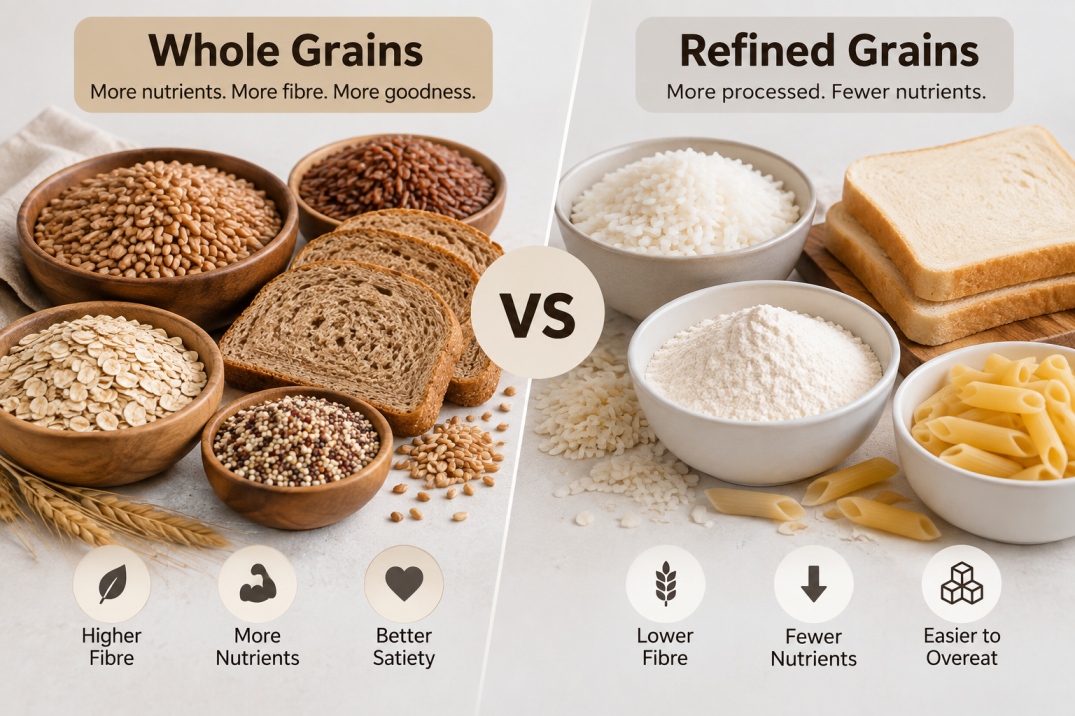
Whole grains retain all three major parts of the grain:
Bran
Germ
Endosperm
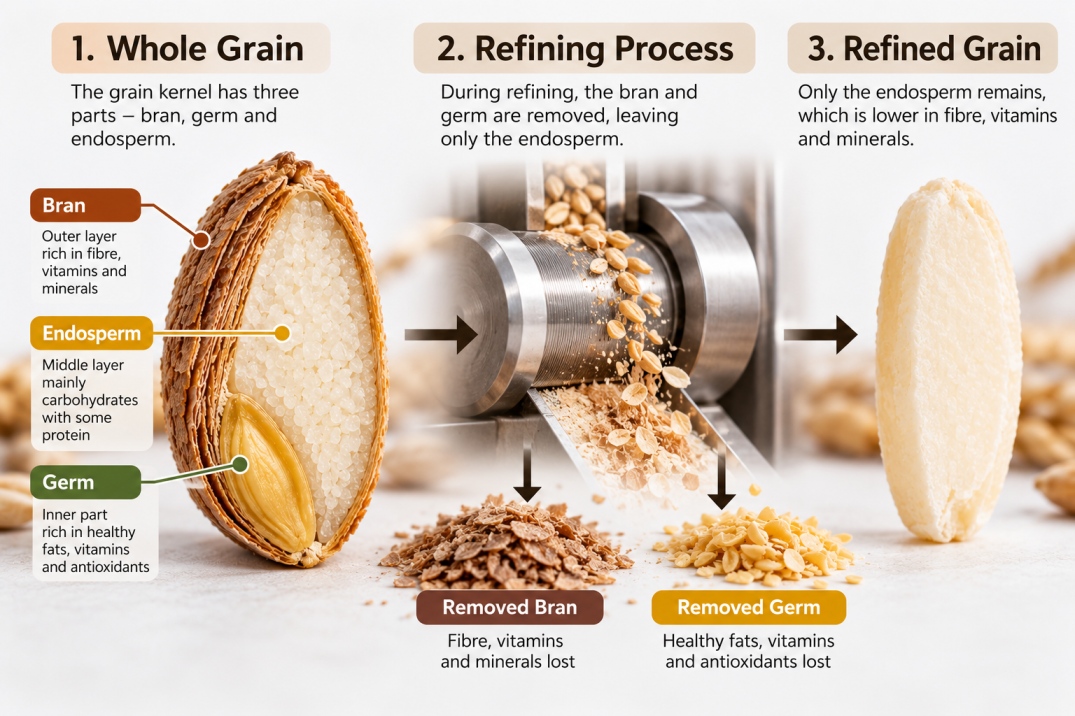
Refined grains, on the other hand, have the bran and germ removed during processing, leaving primarily the endosperm.
This processing changes the grain's fiber content and alters its overall nutrient profile.
Whole grains are generally richer in fiber and retain more naturally occurring nutrients than refined grains. Current dietary guidance recommends emphasizing whole grains while limiting excessive intake of refined grains.
But does that mean you should completely stop eating white rice, regular atta, bread or other refined grain foods?
Not necessarily.
Nutrition is about the overall dietary pattern, not labeling individual foods as "good" or "bad."
In this guide, we will explain the difference between whole and refined grains, their nutritional differences, their effects on blood sugar and weight management, common Indian examples, how to make healthier swaps and how to choose grains without unnecessary confusion.https://www.nin.res.in/dietaryguidelines/
What Are Whole Grains?
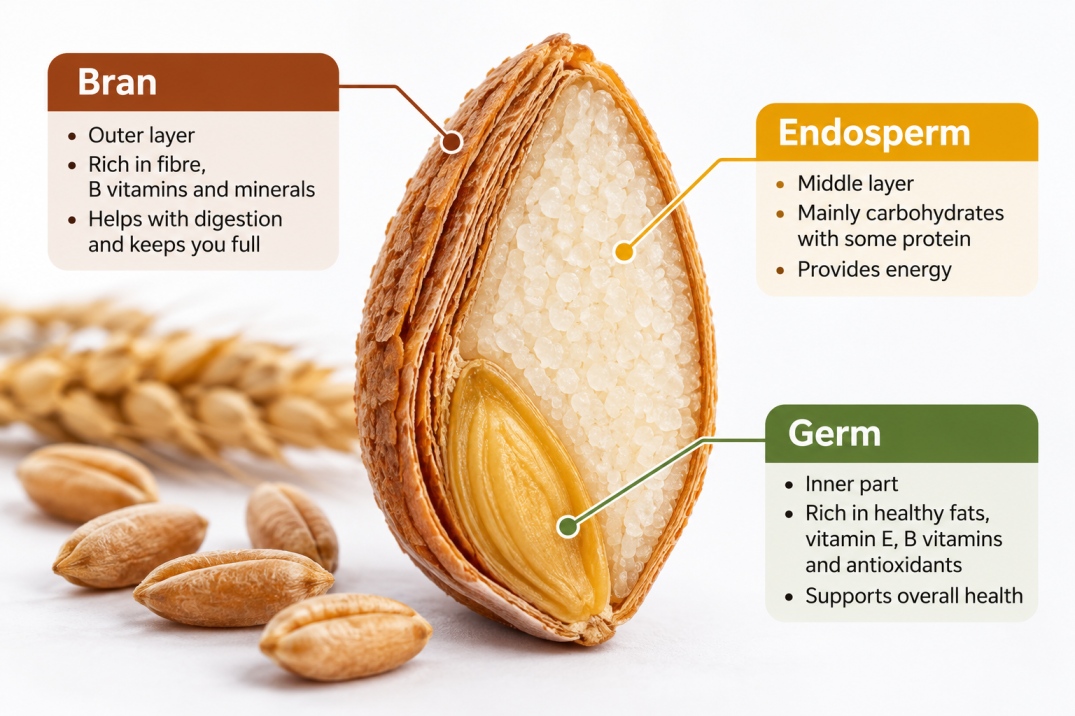
A whole grain contains all three natural components of the grain:
1. Bran
The bran is the outer protective layer.
It contains:
Dietary fiber
B vitamins
Minerals
Various plant compounds
2. Germ
The germ is the part of the grain that can develop into a new plant.
It contains:
Healthy fats
Vitamin E
B vitamins
Minerals
Bioactive compounds
3. Endosperm
The endosperm is the largest part of the grain.
It primarily provides:
Starch
Carbohydrates
Some protein
Because whole grains retain all three components, they generally contain more fiber and micronutrients than their refined counterparts.https://pubmed.ncbi.nlm.nih.gov/32933853/
What Are Refined Grains?
Refined grains have been processed to remove the bran and germ.
This leaves mainly the starchy endosperm.
Examples include:
Maida
White bread made primarily from refined flour
Refined flour-based pasta
Many bakery products
Some refined breakfast cereals
Polished white rice
Some refined grain products may have certain vitamins and minerals added back after processing. This is called enrichment or fortification.
However, adding selected nutrients back does not necessarily restore all of the original grain's fiber and naturally occurring components.
Whole Grains vs Refined Grains: The Basic Difference
Feature
Whole Grains
Refined Grains
Bran
Retained
Removed
Germ
Retained
Removed
Endosperm
Retained
Retained
Fiber
Generally higher
Generally lower
Natural micronutrients
More retained
Some lost during processing
Texture
Often denser
Often softer
Satiety
Generally greater
Often lower
Processing
Less refined
More processed
Examples
Whole wheat, oats, brown rice, whole millets
Maida, white bread, polished rice
Best use
Regular staple where practical
Can be included in moderation
The difference is not simply about calories.
Two grain products may provide similar calories while having very different amounts of fiber and micronutrients.
Why Does the Bran Matter?
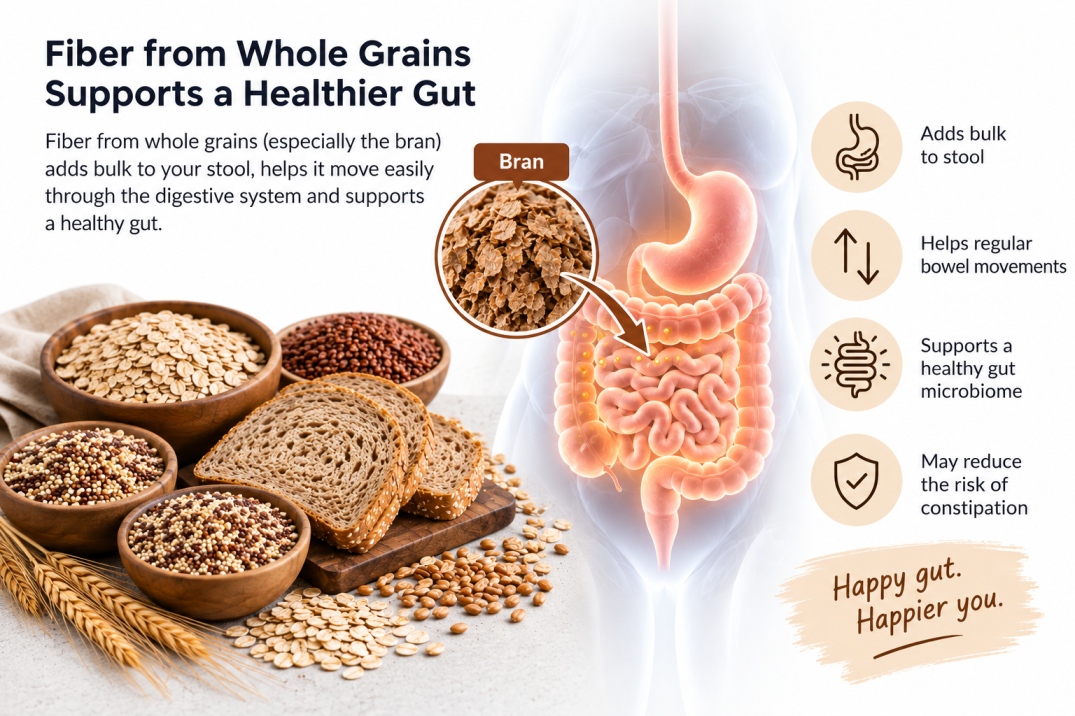
The bran is particularly important because it contributes dietary fiber.
Fiber can help:
Support bowel regularity
Increase fullness
Support healthy cholesterol levels
Slow digestion of carbohydrate-containing meals
Support healthy blood glucose regulation
Feed beneficial gut microbes
This is one major reason whole grains can be a better everyday choice than highly refined grain products.
However, fiber intake should come from the whole diet, not grains alone.
Vegetables, fruits, pulses, legumes, nuts and seeds are also important fiber sources.
Why Does the Germ Matter?
The germ contains a concentration of nutrients and plant compounds, including vitamin E, B vitamins, minerals and healthy fats.
When the germ is removed during refining, some of these naturally occurring nutrients are also lost.
Therefore, whole grains retain a broader range of the grain's original nutritional components.
Whole Grains vs Refined Grains: Which Has More Fiber?
This is one of the clearest nutritional differences.
Whole grains generally contain considerably more fiber because the bran is retained.
Fiber can help you feel fuller after meals and may help slow the digestion and absorption of carbohydrates.
This can be particularly useful for people trying to manage:
Appetite
Weight
Blood sugar
Digestive health
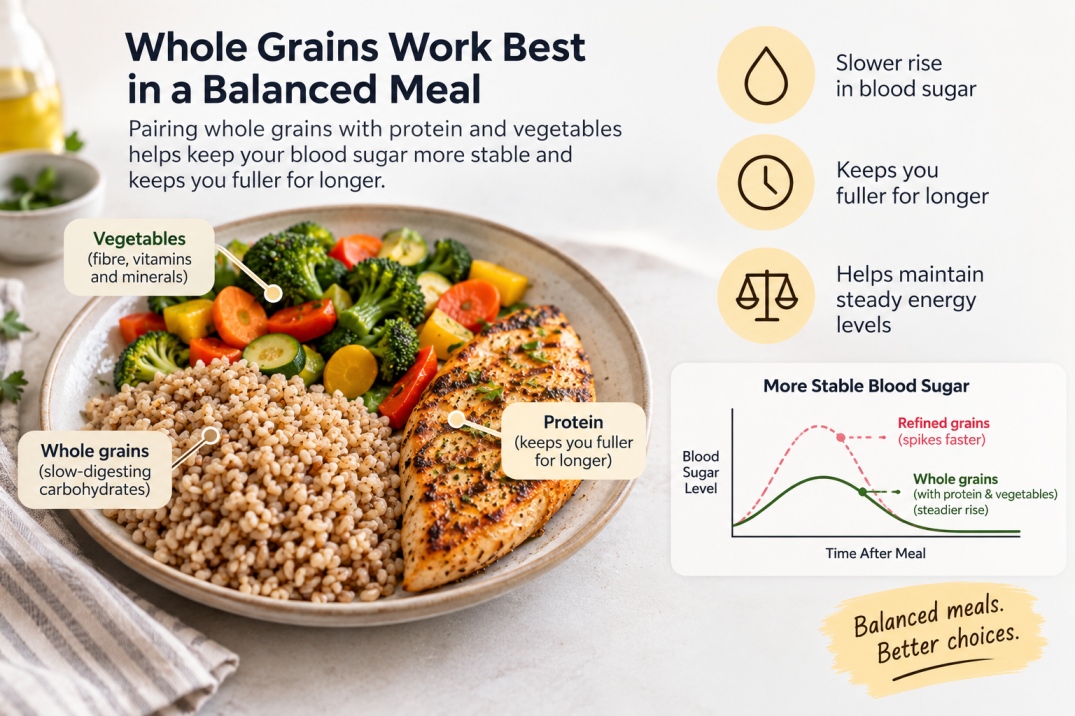
A meal containing a high-fiber grain along with protein and vegetables is generally more filling than a meal built primarily around highly refined carbohydrates.
Whole Grains and Blood Sugar
Not all carbohydrate-containing foods affect blood glucose in exactly the same way.
The structure of a grain, its fiber content, how finely it is processed, cooking method, portion size and what you eat with it can all influence the blood glucose response.
Whole grains often have a more favorable effect on post-meal glucose and insulin responses compared with refined grains. A systematic review and meta-analysis of randomized trials found that replacing refined grains with whole grains improved several measures of post-meal glycemia and insulin-related outcomes.
Another meta-analysis found that higher whole-grain intake was associated with lower risk of type 2 diabetes, although observational evidence cannot prove that whole grains alone prevent diabetes.
But there is an important point:
Whole grain does not mean unlimited grain.
Even a nutritious whole grain contributes carbohydrate and calories.
Portion size and the overall meal still matter.
Are Whole Grains Better for Weight Loss?
Whole grains can be helpful for weight management, but they are not weight-loss foods by themselves.
Their potential advantage comes partly from their fiber content and the greater satiety that can accompany higher-fiber meals.
For example:
Less filling meal
Large portion of white rice + little protein + few vegetables
versus
More balanced meal
Moderate portion of rice + dal + vegetables + curd + salad
The second meal may provide more protein, fiber and volume, making it easier to feel satisfied.
This is why simply replacing white rice with brown rice without considering portion size may not automatically result in weight loss.
The overall meal matters more than one ingredient.https://wellorafit.com/services/nutrition-diet-planning/
Can Whole Grains Help Reduce Belly Fat?
Whole grains cannot selectively burn belly fat.
There is no specific food that targets abdominal fat.
However, a diet rich in whole grains, vegetables, pulses, fruits and other minimally processed foods can support a healthy dietary pattern.
Weight and body-fat reduction depend on factors including:
Total energy intake
Protein intake
Fiber intake
Physical activity
Sleep
Stress
Overall food quality
Consistency
So, choose whole grains as part of a sustainable eating pattern rather than expecting them to directly burn belly fat.https://wellorafit.com/services/nutrition-diet-planning/
Whole Grains and Heart Health
Whole grains have been associated with better cardiovascular health outcomes.
A large dose-response meta-analysis found that higher whole-grain consumption was associated with lower risks of coronary heart disease, cardiovascular disease and all-cause mortality.
Randomized trials have also found improvements in certain cardiovascular risk factors when whole grains replace refined grains. For example, some whole-grain interventions have improved LDL cholesterol, total cholesterol, triglycerides or HbA1c depending on the grain used.
The benefits are likely related to the combination of:
Fiber
Minerals
Plant compounds
B vitamins
Grain structure
Overall dietary pattern
rather than one nutrient alone.
Whole Grains and Digestion
Fiber is essential for healthy digestion.
Whole grains can contribute both insoluble and soluble forms of dietary fiber depending on the grain.
Fiber can help support:
Regular bowel movements
Stool bulk
Healthy gut bacteria
Digestive function
However, increasing fiber suddenly can cause:
Gas
Bloating
Abdominal discomfort
If your current diet is low in fiber, increase whole grains gradually and drink enough fluids.
Whole Grains and Gut Health
The fiber and other plant compounds in whole grains can contribute to a diverse, fiber-rich diet that supports the gut microbiome.
However, eating oats or brown rice alone does not guarantee a healthy gut.
A gut-friendly dietary pattern should include a variety of plant foods such as:
Vegetables
Fruits
Pulses
Whole grains
Nuts
Seeds
Legumes
Fermented foods such as curd can also be included when suitable.
Variety is more important than relying on one "gut health" food.
Common Whole Grains in an Indian Diet
Whole grains do not have to mean expensive imported foods.
India has many traditional grain options.
Whole Wheat
Whole wheat retains the bran and germ.
It can be used to make:
Roti
Phulka
Chapati
Whole-wheat preparations
Choose whole-wheat flour rather than flour that is primarily refined.
Brown Rice
Brown rice is a whole-grain form of rice because the bran and germ are retained.
It generally provides more fiber and micronutrients than polished white rice.
However, brown rice is not automatically "low calorie."
The portion still matters.
Oats
Oats are whole grains and are a convenient option for:
Breakfast
Oats chilla
Savory oats
Oat porridge
Oats upma
Choose minimally processed oats more often and check flavored products for added sugar.
Millets
Millets such as:
Bajra
Jowar
Ragi
Foxtail millet
Little millet
Kodo millet
can be incorporated into a varied Indian diet.
They provide carbohydrates along with fiber and various micronutrients.
However, millet does not automatically mean unlimited or low-calorie.
Portion and preparation still matter.
Barley
Barley is another whole grain that can provide fiber and can be used in:
Soups
Khichdi
Salads
Mixed-grain dishes
Barley-based meals
What About White Rice?
White rice is a refined grain because polishing removes the bran and germ.
Does this mean you can never eat it?
No.
White rice can still be part of a healthy diet.
What matters is:
Portion size
Frequency
What you eat with it
Overall dietary quality
For example:
Rice + dal + vegetables + curd
is nutritionally very different from:
A large plate of plain white rice with very little protein or vegetables.
If you enjoy white rice, you do not necessarily need to eliminate it.
You can gradually introduce alternatives such as:
Brown rice
Hand-pounded rice
Less-polished rice
Millets
Whole grains
depending on preference and availability.
ICMR-NIN specifically lists minimally polished or hand-pounded rice among minimally processed grain choices.
What About Maida?
Maida is a refined wheat flour.
It is commonly used in:
White bread
Naan
Bakery products
Biscuits
Cakes
Pastries
Pizza bases
Refined-flour noodles
Many packaged snacks
The main concern is not that maida is "poisonous."
The issue is that refined flour products often contain:
Less fiber
More added sugar
More fat
More sodium
depending on the product.
For example, a plain refined-flour food and a cream-filled pastry are both refined-grain foods, but their overall nutritional profiles are very different.
This is why the entire food product matters.
Whole Wheat Bread vs White Bread
Whole-wheat bread can be a better everyday option when it genuinely contains whole-grain flour as a major ingredient.
But the label matters.
Do not assume that bread labeled:
Brown bread
Multigrain bread
Seven-grain bread
Healthy bread
is automatically a whole-grain product.
Check the ingredient list.
Look for terms such as:
Whole wheat flour
or
Whole grain wheat
near the beginning of the ingredient list.
A darker color does not automatically mean a bread is whole grain.
Multigrain Does Not Always Mean Whole Grain
This is a very common misconception.
"Multigrain" simply means that multiple grains are used.
Those grains can still be refined.
For example, a product can contain several refined flours and still be marketed as multigrain.
Therefore:
Multigrain ≠ automatically whole grain.
Read the ingredient list instead of relying only on the front-of-pack marketing.
Whole Grain vs Refined Grain: What About Calories?
One common misconception is:
"Whole grains are much lower in calories."
Usually, this is not the main advantage.
Whole and refined grains can have relatively similar calorie values depending on the food.
The bigger nutritional difference is often:
Fiber
Micronutrients
Grain structure
Satiety
Processing
Therefore, switching to whole grains while eating much larger portions will not automatically produce weight loss.
Portion Size Still Matters
Even healthy carbohydrates can contribute substantial calories when portions are large.
A practical plate approach is:
½ Plate
Vegetables and salad
¼ Plate
Protein-rich food such as:
Dal
Beans
Paneer
Tofu
Eggs
Fish
Chicken
¼ Plate
Grain or other carbohydrate source such as:
Roti
Rice
Millet
Quinoa
Barley
This creates a more balanced meal than focusing only on whether the grain is whole or refined.
Whole Grains vs Refined Grains for Diabetes
For people with diabetes or insulin resistance, choosing higher-fiber, less-refined carbohydrate sources can be useful.
Whole grains can be incorporated into a diabetes-friendly eating pattern.
However, "whole grain" does not mean:
Eat unlimited amounts.
Blood glucose is affected by:
Total carbohydrate
Portion size
Food combination
Cooking method
Activity
Individual response
For example, a moderate portion of whole grain paired with dal, vegetables and protein may be preferable to a large bowl of any grain eaten alone.
People taking diabetes medication should follow individualized dietary advice from their healthcare team.
What Should You Choose for Weight Loss?
If your goal is healthy weight loss, prioritize:
More Often
Whole wheat roti
Oats
Brown or minimally polished rice
Hand-pounded rice
Millets
Barley
Whole-grain products
Whole grains combined with pulses and vegetables
Less Often
Maida-based bakery foods
Refined-flour snacks
Cakes
Pastries
Cookies
Sugary cereals
Highly processed grain snacks
But remember:
"Less often" does not mean "never."
A sustainable diet should allow flexibility.
Healthy Indian Grain Swaps
Small changes are often easier to maintain than completely changing your diet.
Instead of
Try More Often
Maida roti
Whole-wheat roti
White bread
100% whole-wheat bread
Refined-flour breakfast cereal
Oats or other minimally processed whole grains
Polished rice every meal
Mix in brown or less-polished rice
Refined-flour noodles
Whole-grain or higher-fiber alternatives
Refined-flour snacks
Roasted whole grains, nuts or legumes
Bakery biscuits
Fruit, nuts, roasted chana or homemade snacks
The goal is not perfection.
The goal is to gradually increase the proportion of minimally processed, fiber-rich foods in your diet.
How to Read a Whole-Grain Food Label
Front-of-pack claims can be confusing.
Instead of looking only at words such as "healthy" or "multigrain," check the ingredient list.
Look for:
Whole wheat
Whole grain
Whole oats
Whole barley
or another clearly identified whole grain.
Ideally, a whole grain should appear near the beginning of the ingredient list when the product is being promoted as a whole-grain food.
Also check:
Dietary fiber
Added sugar
Sodium
Saturated fat
Total ingredients
A whole-grain product can still be high in sugar, salt or saturated fat.
Whole grain does not automatically mean healthy.
Are All Refined Grains Unhealthy?
No.
This is an important distinction.
Refined grains are not inherently toxic or forbidden.
Some refined-grain foods can be included as part of a balanced diet.
The problem arises when refined grain foods make up a large proportion of the diet while displacing:
Vegetables
Fruits
Pulses
Whole grains
Protein-rich foods
Other nutrient-dense foods
For example, occasionally eating white rice is very different from consuming refined-flour bakery foods and sugary snacks throughout the day.
Dietary pattern matters more than one ingredient.
Do You Need to Completely Stop Eating White Rice?
No.
If white rice is part of your cultural diet and you enjoy it, you do not necessarily need to remove it.
Instead:
Control the portion
Add dal or another protein source
Include plenty of vegetables
Add curd if suitable
Avoid making rice the only major component of the meal
Experiment with less-polished rice or other whole grains when practical
This approach is more realistic and sustainable than labeling rice as "bad."
Do You Need to Eat Brown Rice Every Day?
No.
Brown rice is one whole-grain option, not a requirement.
You can obtain whole grains from:
Whole wheat
Oats
Barley
Millets
Brown rice
Hand-pounded rice
Other intact or minimally processed grains
Choose options that fit your culture, taste, budget and digestion.
Whole Grains and Traditional Indian Diets
Whole grains are not a new health trend.
Traditional Indian diets have long included minimally processed grains, millets, whole wheat and other cereals.
The modern challenge is often the increased availability of highly refined grain products such as:
Bakery foods
Refined-flour snacks
Packaged desserts
Refined breakfast foods
Returning to a greater variety of traditional, minimally processed grain foods can be a practical nutrition strategy.
ICMR-NIN's dietary guidance identifies whole grains, whole wheat, whole millets, oats and minimally polished/hand-pounded rice among minimally processed food choices.
Common Myths About Whole and Refined Grains
Myth 1: All Carbohydrates Are Bad
Fact: Carbohydrates are an important source of energy. The quality, quantity and overall dietary pattern matter.
Myth 2: Brown Rice Has Almost No Calories
Fact: Brown rice still provides calories and carbohydrates. Its main advantage is that it retains more of the grain's natural components, including fiber.
Myth 3: White Rice Causes Diabetes
Fact: Diabetes risk is influenced by multiple factors, including genetics, body composition, physical activity and overall diet. White rice should not be viewed in isolation.
Myth 4: Multigrain Means Whole Grain
Fact: Multigrain only means that multiple grains are included. They may still be refined.
Myth 5: Whole-Wheat Products Are Always Healthy
Fact: A whole-grain product can still contain substantial added sugar, sodium or saturated fat. Check the full nutrition label.
Myth 6: You Must Avoid Refined Grains Completely
Fact: Refined grains can fit into a balanced diet. The goal is generally to emphasize whole or minimally processed grains more often.
Myth 7: Whole Grains Automatically Cause Weight Loss
Fact: Whole grains can support a higher-fiber, more filling diet, but weight loss still depends on overall energy balance and lifestyle.
Simple Ways to Eat More Whole Grains
You do not need to completely redesign your diet.
Try these small changes:
Breakfast
Choose:
Oats
Vegetable oats
Whole-wheat vegetable chilla
Millet-based breakfast
Whole-grain toast with protein
Lunch
Try:
Whole-wheat roti + dal + sabzi
Brown rice + rajma + vegetables
Hand-pounded rice + dal + vegetables
Millet roti + dal + sabzi
Snacks
Instead of refined-flour snacks every day, choose:
Roasted chana
Fruit + nuts
Homemade whole-grain snack
Unsweetened popcorn
Sprouted legumes
Dinner
Choose:
Whole-wheat roti + paneer + vegetables
Millet khichdi + curd
Barley-based meal + vegetables
Controlled portion of rice + dal + vegetables
A Practical Rule for Choosing Grains
Instead of asking:
"Is this grain good or bad?"
Ask:
1. Is it whole or minimally processed?
2. How much fiber does it provide?
3. What is the portion size?
4. What else is in the product?
5. What am I eating with it?
6. Can I include more vegetables and protein?
This way, grain choices become much easier and less restrictive.
Whole Grains vs Refined Grains: The Bottom Line
Whole grains generally have the nutritional advantage because they retain the bran, germ and endosperm.
This means they tend to provide more fiber and retain more naturally occurring nutrients.
Research supports higher whole-grain intake as part of healthy dietary patterns, with evidence linking whole grains to better cardiometabolic outcomes.
But refined grains are not automatically "bad," and eating whole grains does not guarantee weight loss or perfect blood sugar control.
The better approach is:
Choose whole or minimally processed grains more often, keep portions appropriate, pair carbohydrates with protein and vegetables, and enjoy refined grains occasionally without guilt.
Key Takeaways
Whole grains contain the bran, germ and endosperm.
Refined grains generally have the bran and germ removed.
Whole grains usually provide more fiber and retain more naturally occurring nutrients.
Fiber can support fullness, digestive health and healthy blood glucose regulation.
Whole-grain intake is associated with better cardiovascular and metabolic health outcomes in a substantial body of research.
Whole grains can support healthy weight management but are not "fat-burning foods."
White rice and other refined grains do not need to be completely eliminated.
Portion size and the overall meal matter.
Multigrain does not automatically mean whole grain.
Brown-colored bread is not necessarily whole-grain bread.
Read the ingredient list instead of relying only on marketing claims.
Indian diets can include whole wheat, oats, millets, barley, brown rice and minimally polished or hand-pounded rice.
A balanced meal should combine grains with protein, vegetables and appropriate portions.
The goal is not perfection—it is to make whole and minimally processed grains the more frequent choice.
Conclusion
So, whole grains vs refined grains—which should you choose?
For everyday eating, whole and minimally processed grains are generally the better choice more often because they retain the bran and germ and therefore provide more fiber and a broader range of naturally occurring nutrients.
That does not mean refined grains need to disappear from your diet.
White rice, refined-flour foods and other refined grains can still fit into a balanced eating pattern when consumed in appropriate portions and alongside nutrient-rich foods.
For a practical Indian approach, think about making meals such as:
Whole-wheat roti + dal + sabzi
Brown or hand-pounded rice + rajma + vegetables
Millet roti + paneer + sabzi
Oats + vegetables + protein
rather than focusing on eliminating carbohydrates altogether.
The healthiest grain is not necessarily the trendiest grain.
It is the one that fits into a balanced, varied and sustainable diet.
At WelloraFit, the focus should not be on fear-based food rules. It should be on helping people understand what they eat, why it matters, how much they need and how to make realistic choices that they can maintain long term.
FAQ
1. What is the main difference between whole grains and refined grains?
Whole grains contain the bran, germ and endosperm, while refined grains have the bran and germ removed, leaving primarily the endosperm.
2. Are whole grains better for weight loss?
Whole grains can support weight management because they generally provide more fiber and can contribute to greater fullness. However, total calorie intake and portion size still matter.
3. Is brown rice healthier than white rice?
Brown rice retains the bran and germ and generally provides more fiber and micronutrients than polished white rice. However, white rice can still fit into a balanced diet when portions and the overall meal are appropriate.
4. Is roti healthier than rice?
Neither is automatically healthier. The type of flour or rice, portion size, preparation and the foods served with it all matter.
5. Is millet better than wheat?
Millets can be nutritious whole grains and are excellent additions to a varied diet. But they are not automatically superior to whole wheat. Both can fit into a healthy diet.
6. Is multigrain bread the same as whole-grain bread?
No. Multigrain means that several grains are used. Those grains may be refined. Check the ingredient list for whole-grain or whole-wheat flour.
7. Can I eat white rice if I am trying to lose weight?
Yes. Weight loss does not require completely eliminating white rice. Focus on portion control and pair rice with protein, vegetables and other nutrient-rich foods.
8. Are whole grains good for diabetes?
Whole grains can be part of a diabetes-friendly eating pattern and may produce a more favorable glucose response than some refined grains. However, portion size and total carbohydrate intake remain important.
9. Are oats a whole grain?
Yes. Oats are whole grains. Plain oats are generally a more useful choice than highly sweetened flavored oat products.
10. Can whole grains cause bloating?
They can in some people, particularly when fiber intake increases suddenly. Increase fiber gradually and maintain adequate fluid intake.
11. Do whole grains have fewer calories?
Not necessarily. The main nutritional advantage of whole grains is their fiber, nutrient and grain-structure profile rather than dramatically lower calorie content.
12. Do I need to completely stop eating refined grains?
No. A healthy diet can include some refined grains. The practical goal is to make whole or minimally processed grains the more frequent choice.
Ready to Begin Your Health Journey?
Get a personalized, medically guided plan built around your unique biology.