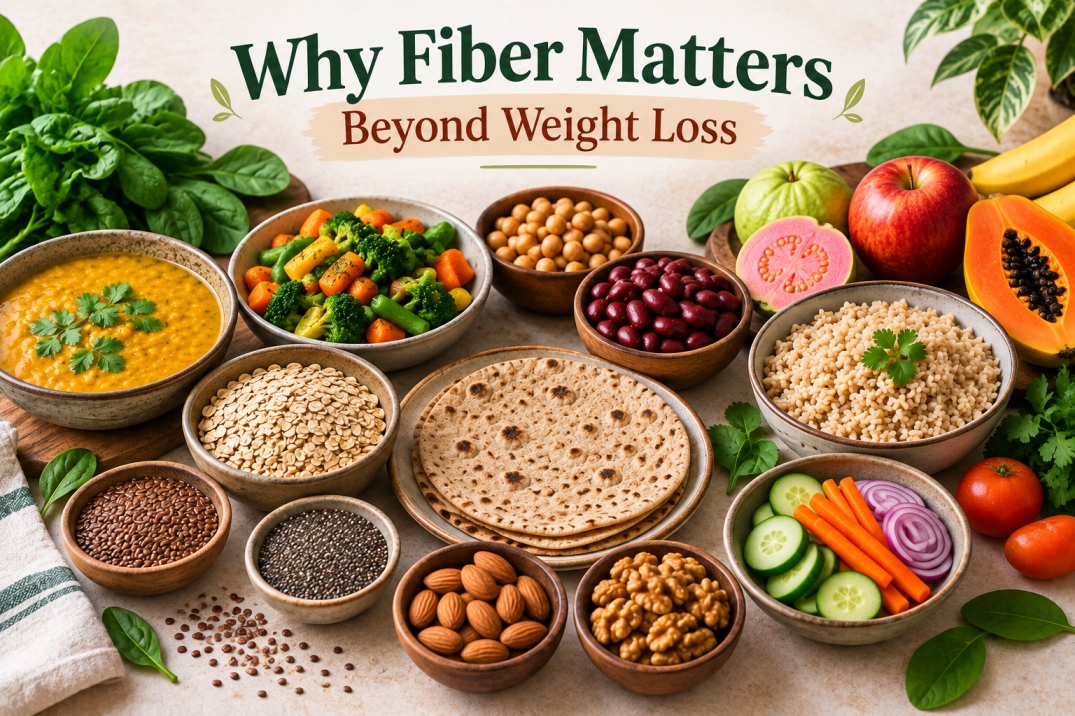
Why Fiber Matters Beyond Weight Loss
When people hear the word fiber, they often think of one thing:
Weight loss.
And there is a reason for that.
High-fiber foods can help increase fullness, which can make it easier to manage food intake.
But fiber's role goes much further than helping you feel full.
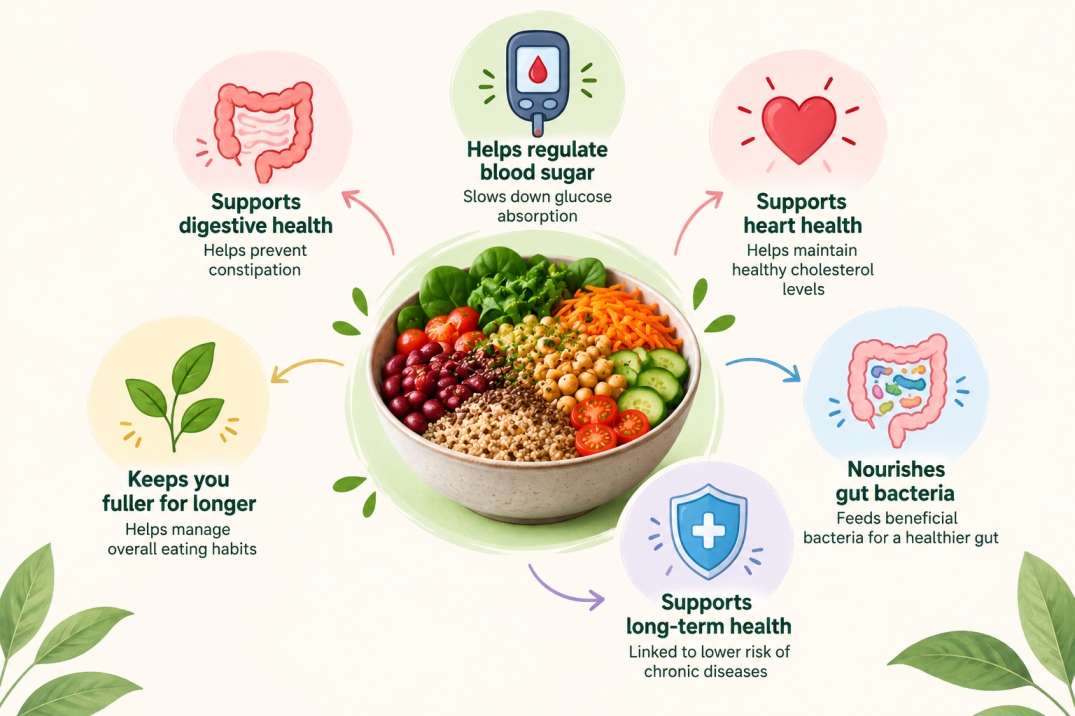
Fiber is an important part of a healthy dietary pattern and can influence:
Digestion
Bowel regularity
Gut microbiome
Blood glucose regulation
Cholesterol levels
Heart health
Satiety
Overall diet quality
ICMR–NIN describes dietary fibre as the indigestible portion of foods such as vegetables, fruits, whole grains, pulses, nuts and seeds. Its 2024 dietary guidance recommends including whole grains, pulses/beans, vegetables, fruits, nuts and seeds as part of a healthy dietary pattern.
This is particularly relevant to Indian diets.https://www.nin.res.in/
Many familiar Indian foods are naturally rich in fibre:
Dal
Rajma
Chana
Whole-wheat roti
Millets
Vegetables
Fruits
Nuts and seeds
Yet many modern eating patterns rely heavily on refined grains and highly processed foods, which can reduce overall fibre intake.
So fibre deserves attention not just when you are trying to lose weight, but as a nutrient that supports long-term health.
What Is Fiber?
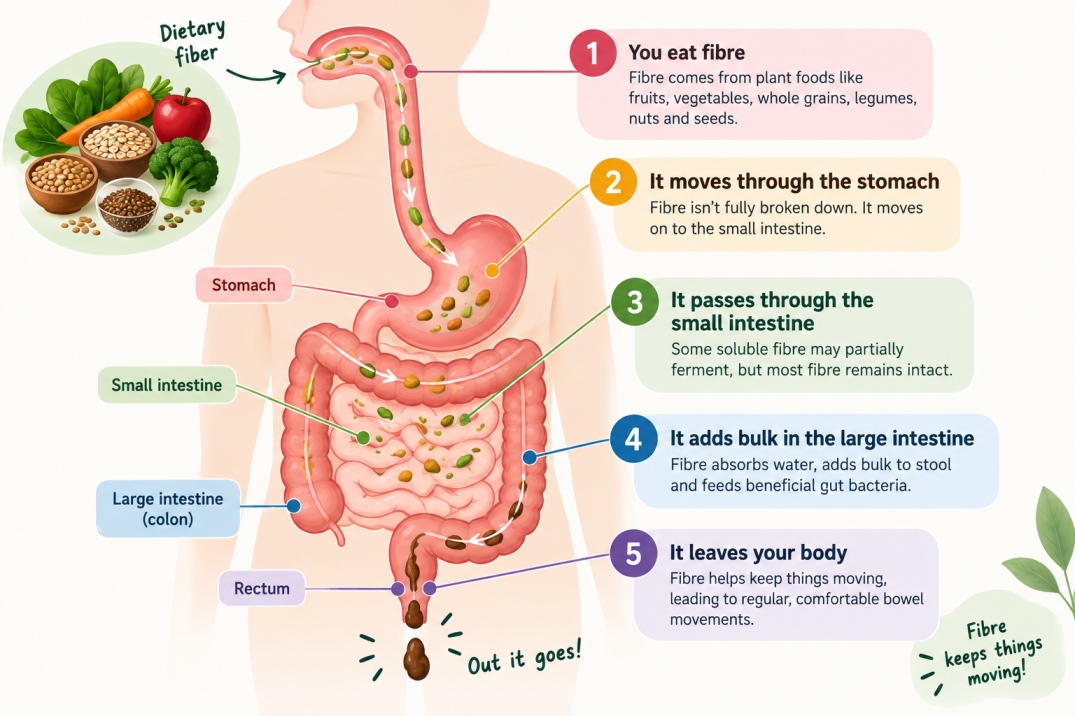
Dietary fibre refers broadly to carbohydrates and other components of plant foods that resist digestion in the small intestine.
Unlike many digestible carbohydrates, fibre is not completely broken down and absorbed in the same way.
Some types pass through the digestive tract largely intact.
Others can be fermented by microorganisms in the large intestine.
This difference helps explain why fibre can affect the body in several ways.
The Two Traditional Types of Fiber
Fiber is commonly discussed as:
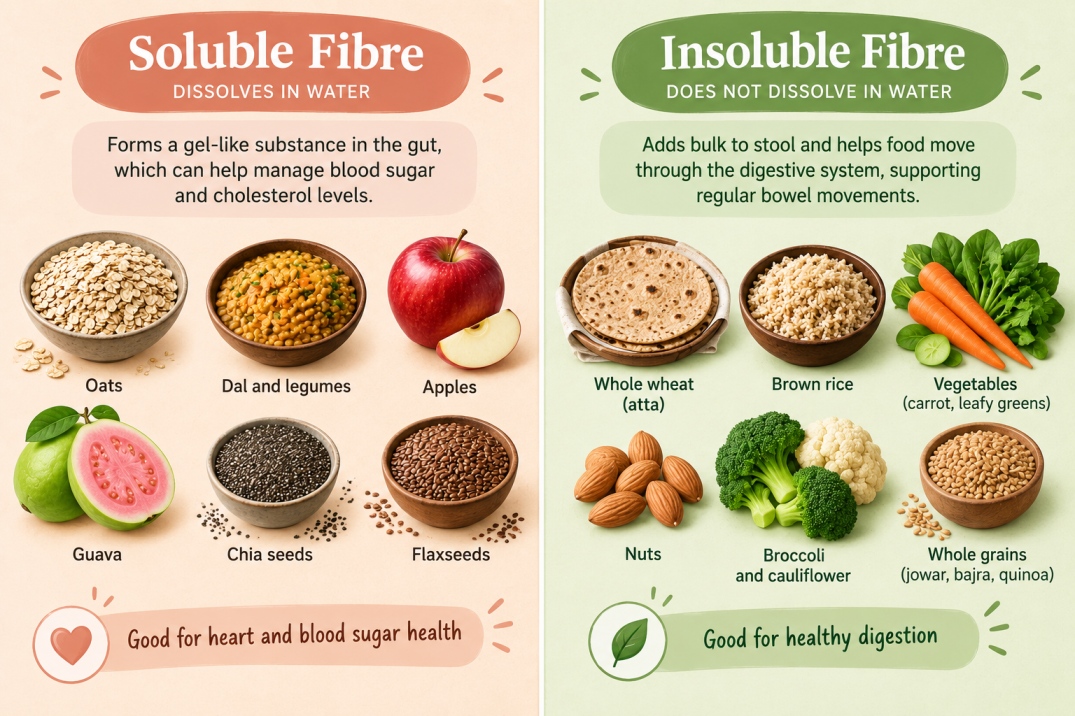
Soluble Fiber
Soluble fibre can dissolve or disperse in water and may form a gel-like substance.
It is found in foods such as:
Oats
Beans
Lentils
Some fruits
Some vegetables
Seeds
Some soluble fibres are fermented by gut microorganisms.
Research indicates that different fibres can have different effects depending on their type, amount and interaction with the gut microbiome.
Insoluble Fiber
Insoluble fibre does not dissolve in water and contributes to stool bulk.
It is found in foods such as:
Whole grains
Wheat bran
Vegetables
Beans
Some nuts and seeds
It can help support regular bowel movements.
Important
Foods rarely contain only one type of fibre.
Many plant foods provide a mixture of fibre types.
That is one reason eating a variety of plant foods is more useful than trying to focus on one "best" fibre source.
Why Fiber Is Different From Other Carbohydrates
Carbohydrates include sugars, starches and fibre.
Many digestible carbohydrates are broken down into smaller molecules and absorbed to provide energy.
Fibre behaves differently.
Because humans cannot fully digest many types of fibre, it can influence:
How quickly food moves through the digestive tract
How quickly carbohydrates are absorbed
Stool bulk
Satiety
Gut microbial activity
ICMR–NIN notes that dietary fibre can delay carbohydrate and fat absorption, increase satiety and increase stool bulk.https://www.nin.res.in/dietaryguidelines/
Why Fiber Matters Beyond Weight Loss
1. Fiber Supports Healthy Digestion
One of the best-known benefits of fibre is its role in digestive health.
Certain fibres increase stool bulk and help food waste move through the digestive tract.
This can support regular bowel movements.
Low-Fiber Pattern
A diet based heavily on:
Refined flour
White bread
Highly processed snacks
Sugary foods
with very few vegetables, fruits, pulses or whole grains may provide relatively little fibre.
Higher-Fiber Pattern
A diet containing:
Dal
Vegetables
Fruits
Whole grains
Millets
Beans
Nuts
Seeds
provides more opportunities to obtain fibre.https://wellorafit.com/services/nutrition-diet-planning/
2. Fiber Can Help With Constipation
Constipation can be influenced by many factors, including:
Low fibre intake
Inadequate fluid intake
Low physical activity
Certain medications
Some medical conditions
Increasing dietary fibre can help improve stool bulk and regularity for many people.
However, fibre should generally be increased gradually, especially if your current intake is low.
Suddenly eating very large amounts of fibre may cause:
Bloating
Gas
Abdominal discomfort
A gradual increase gives the digestive system more time to adapt.
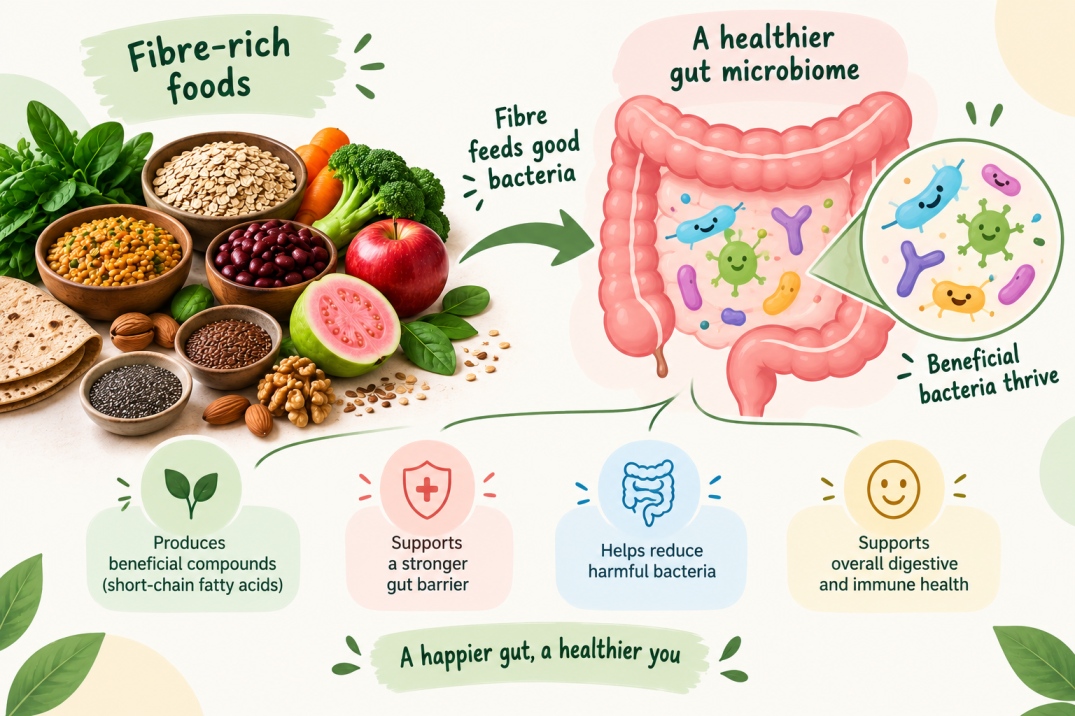
3. Fiber Feeds the Gut Microbiome
Your digestive tract contains trillions of microorganisms collectively referred to as the gut microbiota.
Some types of dietary fibre can be fermented by these microorganisms.
This interaction is one reason fibre is increasingly discussed in relation to gut health.
Certain fermentable fibres can be used by gut microbes to produce compounds such as short-chain fatty acids.
Research continues to explore how different fibre types influence the gut microbiome and health.
What Does This Mean Practically?
Instead of thinking:
"I need a probiotic supplement."
also think:
"Am I regularly eating the plant foods that provide fibre for my gut microbes?"
Foods such as:
Dal
Chana
Rajma
Vegetables
Fruits
Whole grains
Nuts
Seeds
can contribute to a fibre-rich dietary pattern.
4. Fiber Can Support Blood Sugar Management
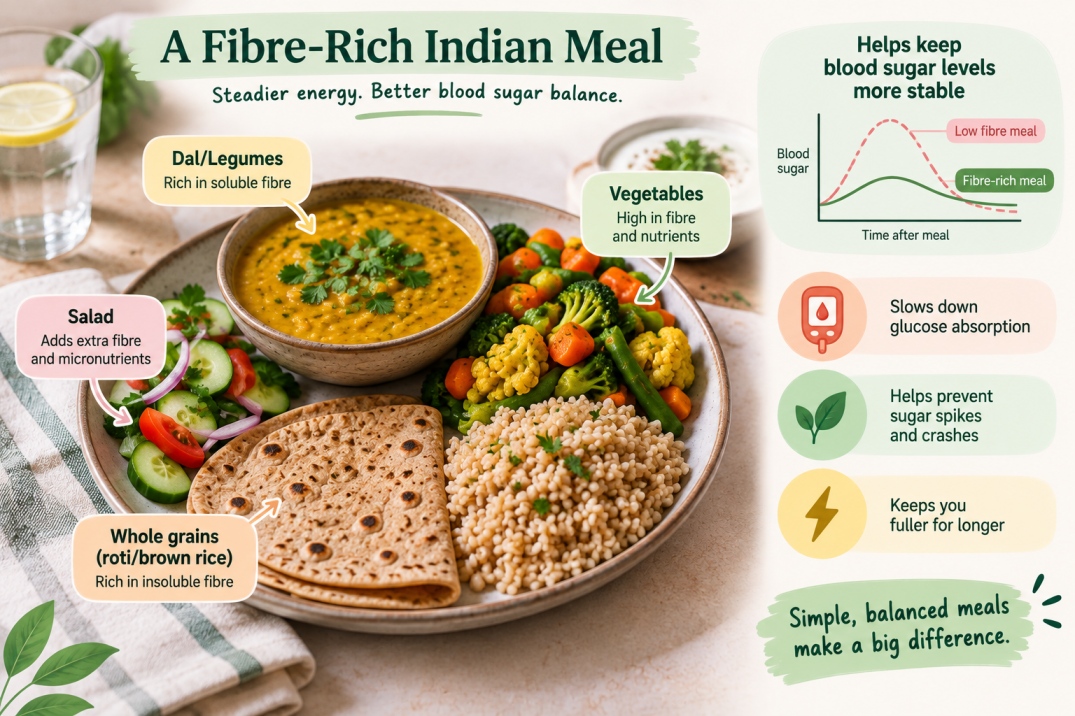
Fibre can influence how quickly carbohydrates are digested and absorbed.
Certain soluble and viscous fibres can slow digestion and carbohydrate absorption.
This may help moderate the rise in blood glucose after meals.
ICMR–NIN notes that fibre-rich diets can reduce blood glucose and improve insulin sensitivity.
Example
Compare:
Sweetened refined cereal + sugary drink
with:
Vegetable oats/vegetable dalia + nuts/seeds + plain curd
The second meal contains more fibre and a broader range of nutrients.
Important
Fibre does not make a high-sugar diet healthy.
Overall carbohydrate quality, quantity, meal composition and individual health status still matter.
People with diabetes should follow individualized nutrition advice.
5. Fiber Can Help Support Healthy Cholesterol Levels
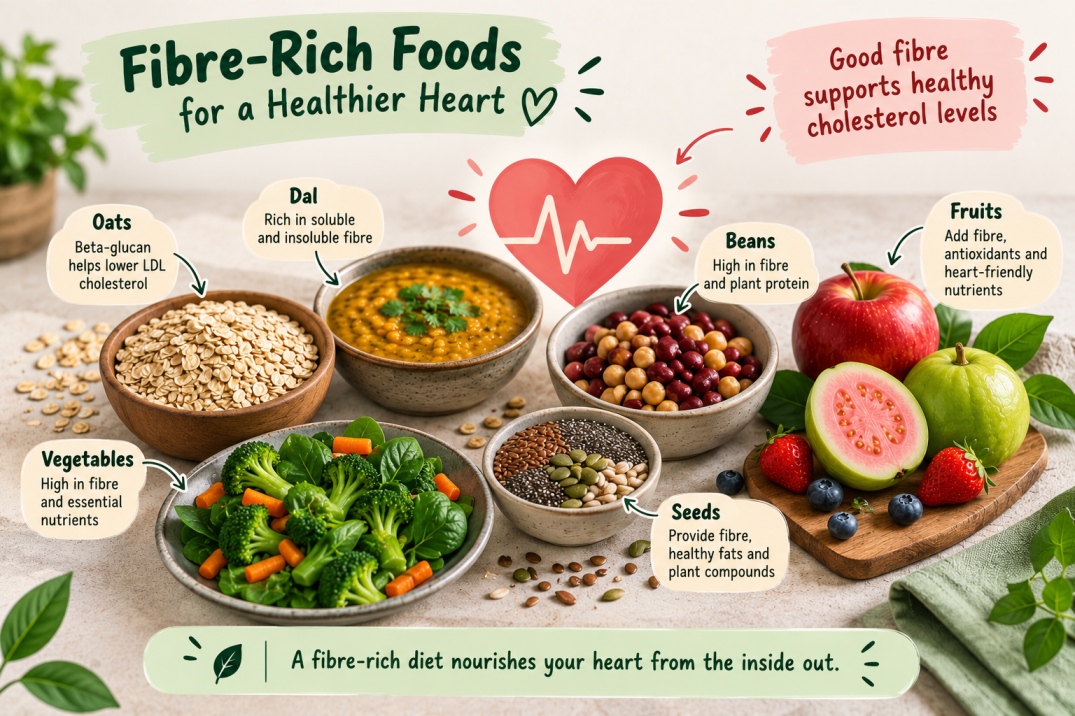
Some types of soluble fibre can interact with bile acids and influence cholesterol metabolism.
Higher-fibre dietary patterns are associated with cardiovascular benefits, and specific soluble fibres can help lower LDL cholesterol.
Indian Food Sources
Useful sources include:
Oats
Barley
Beans
Lentils
Fruits
Vegetables
Seeds
Instead of relying on fibre supplements, build fibre into everyday meals.
For example:
Oats + fruit + seeds
or
Dal + vegetables + whole-wheat roti
can naturally contribute fibre.
6. Fiber Supports Heart Health
A fibre-rich diet often goes hand in hand with a diet containing more:
Whole grains
Pulses
Fruits
Vegetables
Nuts
Seeds
and fewer highly processed foods.
Dietary patterns higher in fibre are associated with lower risk of cardiovascular disease and other chronic diseases.
This does not mean fibre alone prevents heart disease.
Rather, fibre is one important part of a broader healthy eating pattern.
7. Fiber Helps With Satiety
This is where fibre connects to weight management.
High-fibre foods can help meals feel more filling.
For example:
Vegetable dal + roti + salad
is likely to provide more volume and fibre than:
Refined snack + sugary beverage
Fiber can therefore make it easier to maintain an appropriate food intake.
But this is only one of its many benefits.
That is why the focus should be:
Fiber for overall health
rather than:
Fiber only for weight loss.
8. Fiber Helps Improve Overall Diet Quality
A person eating enough fibre is often eating more:
Vegetables
Fruits
Pulses
Whole grains
Nuts
Seeds
These foods also provide:
Vitamins
Minerals
Protein
Healthy fats
Phytonutrients
This makes fibre useful as more than just an isolated nutrient.
It can act as a practical marker of a plant-rich, minimally processed dietary pattern.
Best High-Fiber Indian Foods
1. Pulses and Legumes
Indian diets have an excellent advantage:
dal and legumes are everyday foods.
Examples include:
Moong dal
Masoor dal
Toor dal
Chana dal
Rajma
Chole
Lobia
Whole green gram
Black gram
Peas
ICMR–NIN food composition data show that pulses are among the richer commonly consumed food groups for dietary fibre.
Easy Ways to Include Them
Dal
Rajma curry
Chole
Sprouts
Dal khichdi
Mixed dal
Chana salad
Lobia curry
2. Whole Grains
Whole grains contain more of the grain's original components than highly refined grains.
Examples include:
Whole wheat
Oats
Barley
Brown rice
Dalia
Whole-grain breads
ICMR–NIN recommends that at least 50% of cereal and grain intake come from whole grains or minimally polished grains as part of a healthy dietary pattern.
Simple Swap
Instead of making refined grains the default at every meal:
Rotate whole wheat, oats, dalia, barley and millets.
3. Millets
Millets can contribute fibre along with other nutrients.
Indian options include:
Jowar
Bajra
Ragi
Foxtail millet
Little millet
Barnyard millet
They can be used as:
Roti
Dosa
Upma
Khichdi
Porridge
Other traditional preparations
The goal is not to replace rice or wheat completely.
Instead:
Add variety.
4. Vegetables
Vegetables are important sources of fibre.
Examples include:
Carrot
Beans
Cabbage
Cauliflower
Bhindi
Brinjal
Pumpkin
Bottle gourd
Ridge gourd
Peas
Beetroot
Radish
Spinach
Methi
Try to include vegetables in both lunch and dinner.
5. Fruits
Whole fruits provide fibre along with vitamins, minerals and other plant compounds.
Good options include:
Guava
Apple
Pear
Orange
Papaya
Pomegranate
Berries
Banana
Seasonal fruits
Whole Fruit vs Juice
A whole fruit generally retains its fibre, while juice contains much less fibre unless substantial pulp is retained.
So:
Eat the fruit more often than you drink it.
6. Nuts and Seeds
Nuts and seeds provide fibre along with healthy fats, protein and micronutrients.
Examples include:
Almonds
Walnuts
Peanuts
Flaxseeds
Chia seeds
Pumpkin seeds
Sunflower seeds
Sesame seeds
Because nuts and seeds are energy-dense, portion size still matters.
7. Traditional Indian Fiber-Rich Foods
Many traditional Indian foods can contribute substantial fibre.
Examples include:
Dal
Chana
Rajma
Lobia
Sprouts
Whole-wheat roti
Millet roti
Vegetable sabzi
Fruit
Nuts and seeds
You do not necessarily need expensive "superfoods" to increase fibre.
How Much Fiber Do You Need?
There is no single fibre target that applies identically to every person.
Requirements depend on factors such as:
Age
Sex
Energy intake
Dietary pattern
Life stage
The ICMR–NIN 2024 guidance emphasizes adequate fibre as part of a balanced diet and recommends a dietary pattern rich in whole grains, pulses, vegetables, fruits, nuts and seeds.
Rather than becoming overly focused on one number, a practical goal is to regularly include fibre-rich foods at meals and snacks.
How to Increase Fiber Without Digestive Problems
Increase Fiber Gradually
If your current diet is low in fibre, do not suddenly add huge amounts of:
Bran
Seeds
Raw vegetables
Legumes
Increase gradually.
For example:
Week 1
Add one fruit daily.
Week 2
Add vegetables to another meal.
Week 3
Include dal or beans more consistently.
Week 4
Replace some refined grains with whole grains or millets.
This gives your digestive system time to adapt.
Drink Enough Fluids
When increasing fibre intake, adequate fluid intake is important.
Fibre and fluids work together to support normal bowel function.
However, fluid requirements vary according to:
Climate
Activity
Body size
Diet
Health conditions
People with certain medical conditions may need individualized fluid guidance.
Don't Depend Only on Fiber Supplements
Fibre supplements can be useful in some circumstances.
But whole foods provide much more than fibre alone.
For example:
Apple
provides fibre plus vitamins and plant compounds.
Dal
provides fibre plus protein, minerals and other nutrients.
Nuts
provide fibre plus healthy fats, protein and micronutrients.
This is why food-first strategies are generally preferable when practical.https://wellorafit.com/services/nutrition-diet-planning/
Common Fiber Mistakes
Mistake 1: Eating Fiber Only for Weight Loss
Better Approach
Think about digestion, gut health, blood glucose, cholesterol and overall diet quality too.
Mistake 2: Suddenly Increasing Fiber
Problem
This can cause:
Gas
Bloating
Abdominal discomfort
Better Approach
Increase gradually.
Mistake 3: Getting Fiber Mainly From Packaged "High-Fiber" Products
A packaged food may contain added fibre, but that does not automatically make it nutritionally superior.
Better Approach
Prioritize:
Pulses + vegetables + fruits + whole grains + nuts + seeds
Mistake 4: Drinking Fruit Juice Instead of Eating Fruit
Juicing can reduce the amount of fibre consumed.
Better Approach
Choose whole fruit more often.
Mistake 5: Removing the Peel From Every Fruit and Vegetable
Some edible peels contain fibre and other nutrients.
Better Approach
When appropriate and safe, eat edible peels after washing thoroughly.
Mistake 6: Eating a High-Fiber Diet Without Enough Variety
Eating large amounts of only one fibre source is unnecessary.
Better Approach
Rotate:
Dal + vegetables + fruits + whole grains + nuts + seeds
Easy High-Fiber Indian Meal Ideas
Breakfast
Option 1
Vegetable oats + fruit
Option 2
Moong dal chilla + vegetable filling
Option 3
Vegetable poha + peanuts
Option 4
Dalia + vegetables + seeds
Option 5
Whole-wheat vegetable sandwich + fruit
Lunch
Option 1
2 small whole-wheat rotis
Dal
Mixed vegetable sabzi
Salad
Option 2
Brown rice
Rajma
Vegetable sabzi
Curd
Option 3
Millet roti
Chole
Green leafy vegetable
Salad
Evening Snack
Try:
Roasted chana
Fruit + nuts
Sprouts chaat
Vegetable chaat
Peanuts + fruit
These can be more fibre-rich than frequently choosing biscuits, chips or refined snacks.
Dinner
Option 1
Vegetable dal khichdi + curd + salad
Option 2
2 small rotis + dal + sabzi + salad
Option 3
Millet roti + mixed vegetables + paneer/tofu + salad
A Simple "Fiber Plate" Formula
At your main meals, think:
Whole grain
Dal / beans / other protein
2 types of vegetables
Salad or fruit
Nuts/seeds when appropriate
This naturally increases dietary fibre while also improving overall dietary variety.
Fiber and Different Health Goals
For Weight Management
Fiber can increase fullness and help support appropriate energy intake.
For Digestion
Fiber can increase stool bulk and support regularity.
For Blood Sugar
Certain fibre types can slow carbohydrate absorption and help moderate post-meal glucose responses.
For Cholesterol
Some soluble fibres can help lower LDL cholesterol.
For Gut Health
Fermentable fibres provide substrates that gut microorganisms can use.
For Heart Health
High-fibre dietary patterns are associated with cardiovascular benefits.
The important point is that one nutrient can influence multiple aspects of health.
When Should You Be Careful With Fiber?
More fibre is not always better for everyone at every time.
People with certain gastrointestinal conditions, bowel narrowing, swallowing problems, or other medical conditions may require individualized fibre advice.
If increasing fibre consistently causes significant:
Abdominal pain
Severe bloating
Persistent diarrhoea
Persistent constipation
Vomiting
Other concerning symptoms
seek medical advice rather than continuing to increase fibre on your own.
Key Takeaways
Fiber is much more than a weight-loss nutrient.
It supports digestion and regular bowel movements.
Certain fibres interact with the gut microbiome.
Fibre-rich diets can support healthy blood glucose and cholesterol levels.
Fibre contributes to heart health and overall diet quality.
Pulses, whole grains, vegetables, fruits, nuts and seeds are excellent everyday sources.
Indian diets already contain many naturally fibre-rich foods.
Increase fibre gradually if your current intake is low.
Adequate fluid intake is important when increasing dietary fibre.
Whole foods provide more than isolated fibre.
You do not need expensive fibre supplements or "superfoods" to improve your intake.
Aim for variety across the day and week, rather than relying on one food.
Conclusion
Fiber is often promoted as a tool for weight loss, but that is only one small part of its story.
It supports the digestive system, contributes to bowel regularity, interacts with the gut microbiome and can influence blood glucose and cholesterol. Fibre-rich dietary patterns are also associated with better cardiovascular and metabolic health.
The best part is that increasing fibre does not require a complicated diet.
Indian cuisine already offers many excellent sources:
Dal
Rajma
Chana
Whole-wheat roti
Millets
Vegetables
Fruits
Nuts
Seeds
Instead of thinking:
"I need more fibre for weight loss,"
think:
"I need enough fibre for overall health."
Build meals around whole and minimally processed plant foods, increase fibre gradually, drink adequate fluids, and vary your food choices.
You don't need to chase a single "superfood."
Sometimes, the most powerful nutrition strategy is simply to eat more of the traditional, fibre-rich foods already available in your kitchen.
Fiber isn't just about the number on the weighing scale. It's about supporting the body from the inside out.
FAQ
1. What is dietary fiber?
Dietary fibre is the part of plant foods that resists digestion in the small intestine. Different fibres have different physical and physiological effects.
2. Why is fiber important?
Fibre supports digestive health, bowel regularity, satiety and gut microbial activity. Certain fibres can also help support healthy blood glucose and cholesterol levels.
3. Does fiber only help with weight loss?
No. Weight management is only one potential benefit. Fibre also supports digestion, gut health, blood glucose regulation, cholesterol management and overall dietary quality.
4. Which Indian foods are high in fiber?
Good choices include dal, rajma, chana, lobia, whole grains, millets, vegetables, fruits, nuts and seeds.
5. Is dal a good source of fiber?
Yes. Pulses such as lentils, chickpeas, kidney beans and other legumes provide both fibre and protein. ICMR–NIN food-composition data identify pulses as relatively fibre-rich foods.
6. Are fruits high in fiber?
Whole fruits provide dietary fibre along with vitamins, minerals and other plant compounds. Fibre content varies by fruit.
7. Is brown rice always better than white rice?
Brown rice is a whole-grain option and generally contains more fibre than polished white rice. However, overall dietary variety and meal composition matter more than relying on one grain.
8. Are millets high in fiber?
Many millets provide useful amounts of dietary fibre and can contribute to a varied whole-grain diet.
9. How can I increase fiber without bloating?
Increase fibre gradually, vary your sources and maintain adequate fluid intake. A sudden large increase can cause gas or bloating.
10. Can too much fiber be harmful?
Very high fibre intake can cause digestive discomfort in some people, particularly if increased suddenly. Certain medical or gastrointestinal conditions also require individualized dietary advice.
11. Is fiber from supplements as good as fiber from food?
Supplements can be useful in specific situations, but whole foods provide fibre along with vitamins, minerals, protein, healthy fats and other beneficial compounds.
12. What is the easiest way to eat more fiber?
Add one fibre-rich food to each meal:
Breakfast: fruit or whole grains
Lunch: dal + vegetables
Snack: roasted chana or nuts
Dinner: vegetables + pulses + whole grains
Small changes repeated consistently can make a significant difference.
Ready to Begin Your Health Journey?
Get a personalized, medically guided plan built around your unique biology.